Robert Kagan: Trump’s Path Toward Dictatorship and Its Impact on U.S. Democracy
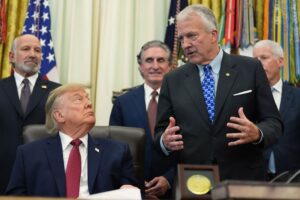
In a recent interview on NPR’s FRESH AIR, Robert Kagan, a senior fellow at the Brookings Institution and contributing writer at The Atlantic, discussed his alarming view that Donald Trump is on the brink of becoming a dictator. Kagan, who has previously described Trump as antiliberal and authoritarian, now believes that Trump’s actions have moved him dangerously close to dictatorial territory.
Kagan argues, “President Trump has managed in just one year to destroy the American order that was and has weakened America’s ability to protect its interests in the world that will be.” He highlights Trump’s attempts to nationalize elections and increase federal control over states, actions he considers as clear indicators of dictatorial behavior. Kagan further notes the Trump administration’s actions such as the dismantling of federal agencies and using bodies like ICE to instigate fear and control.
During the interview, Kagan expressed concerns over Trump’s persistent claims about the 2020 election being stolen and his intention to disrupt future elections. Trump recently announced his desire to federalize elections in at least 15 states, calling for Republican oversight, which Kagan views as an unprecedented move towards a one-party dictatorship.
Robert Kagan, a former Washington Post columnist, author, and senior fellow at the Brookings Institution, has been vocal about the dangers of Trump’s policies. He describes them as being rooted in historical Christian white supremacy and expresses concern over the potential implications for democracy in the United States.
Discussing Trump’s influence over American foreign policy, Kagan highlighted how Trump has managed to undermine the NATO alliance without formally withdrawing. He points out Trump’s aggressive tariff wars, threats of territorial aggression, and the demands for allies like Japan, Taiwan, and South Korea to pay the U.S. for protection.
Kagan warns that the end of American global leadership could lead to a multipolar world, reminiscent of the 19th century’s constant warfare among great powers. He argues that the U.S. has benefited enormously from its alliances and strategic partnerships and that severing these ties could have dire consequences for global stability.
As Kagan sees it, Trump’s foreign policy is marked by personal grievances and delusions of grandeur on the world stage. He criticizes Trump’s blending of personal and national interests, as demonstrated in speeches where Trump mixes topics like NATO with unfounded claims of election rigging.
Reflecting on the domestic landscape, Kagan stresses the need for Americans, including political elites and institutions, to stand up for democracy. He criticizes the Democratic Party and various American institutions for not doing enough to counter Trump’s authoritarian tendencies.
Kagan’s perspectives on Trump’s presidency are detailed in his book “Rebellion: Donald Trump And The Antiliberal Tradition In America,” and his latest article in The Atlantic, “America Vs. The World,” continues to explore these themes.
This article was originally written by www.npr.org