Trump Administration’s Decision to Dismiss Science Board Sparks Concerns
In a move that has stirred concerns about the autonomy of federal science agencies, the Trump administration has dismissed members of the National Science Board, which plays a crucial role in guiding the National Science Foundation. The impacted members have raised alarms about potential threats to the agency’s independence.
MARY LOUISE KELLY, HOST:
As the Trump administration continues to alter federal science institutions, a recent decision to remove members of a board critical to the National Science Foundation’s oversight has emerged. NPR’s Katia Riddle investigates the implications of this decision for the foundation’s future operations.
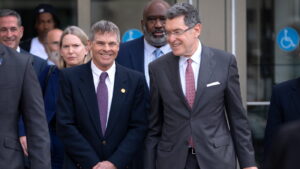
KATIA RIDDLE, BYLINE: Last Friday, 22 individuals, predominantly scientists and engineers, received a brief email from President Donald J. Trump’s office. The email informed them that their roles on the National Science Board were terminated “effective immediately.”
KEIVAN STASSUN: You know, it was a huge disappointment. I wouldn’t say that it was a big surprise.
RIDDLE: This sentiment was shared by Keivan Stassun, a physics and astronomy professor at Vanderbilt University, who was among those dismissed. Stassun, a board member since 2023, remarked that given recent trends in other agencies, this move seemed inevitable.
RIDDLE: The Trump administration has previously halted or reduced billions in research funding and diminished the federal science workforce.
ZOE LOFGREN: I am, once again, disappointed by the president and his attack on the science enterprise of this country.
RIDDLE: Zoe Lofgren, the ranking Democrat on the House Committee on Science, Space and Technology, criticized the decision. Meanwhile, Brian Babin, her Republican counterpart, defended the administration’s choice, suggesting that “every president expects advisers to serve in a manner consistent with executive and legislative priorities.” Lofgren highlighted that since the board’s creation in 1950, it has operated under 14 presidents.
LOFGREN: And all of a sudden there’s a problem? I don’t buy it.
RIDDLE: The board’s foundational purpose was to guide scientific decision-making without direct executive influence. Patrick McCray, a science policy historian at the University of California, Santa Barbara, emphasized the board’s role in significant scientific advancements, such as the development of the early internet and artificial intelligence.
PATRICK MCCRAY: I mean, I think the whole idea was to have a body of people that were not directly connected to the executive branch.
RIDDLE: McCray noted the board’s independent work has led to groundbreaking discoveries, including the detection of gravitational waves, emphasizing the importance of independent research prioritization.
MCCRAY: The expertise and the ability to decide which areas of research and development are more important to fund than others, you know, is crucial here.
RIDDLE: Responding to inquiries, the Trump administration issued a statement asserting that the agency’s operations would proceed “uninterrupted.” Nonetheless, McCray argues that dissolving the National Science Board contradicts national interests and the administration’s stated goals of advancing fields like AI and quantum computing.
MCCRAY: It’s hard for me to understand how continually attacking organizations like the National Science Foundation advances those goals.
RIDDLE: Despite its unassuming nature, McCray insists that the board has been instrumental in pivotal scientific achievements, such as AI, the internet, and microchips. Katia Riddle, NPR News.