
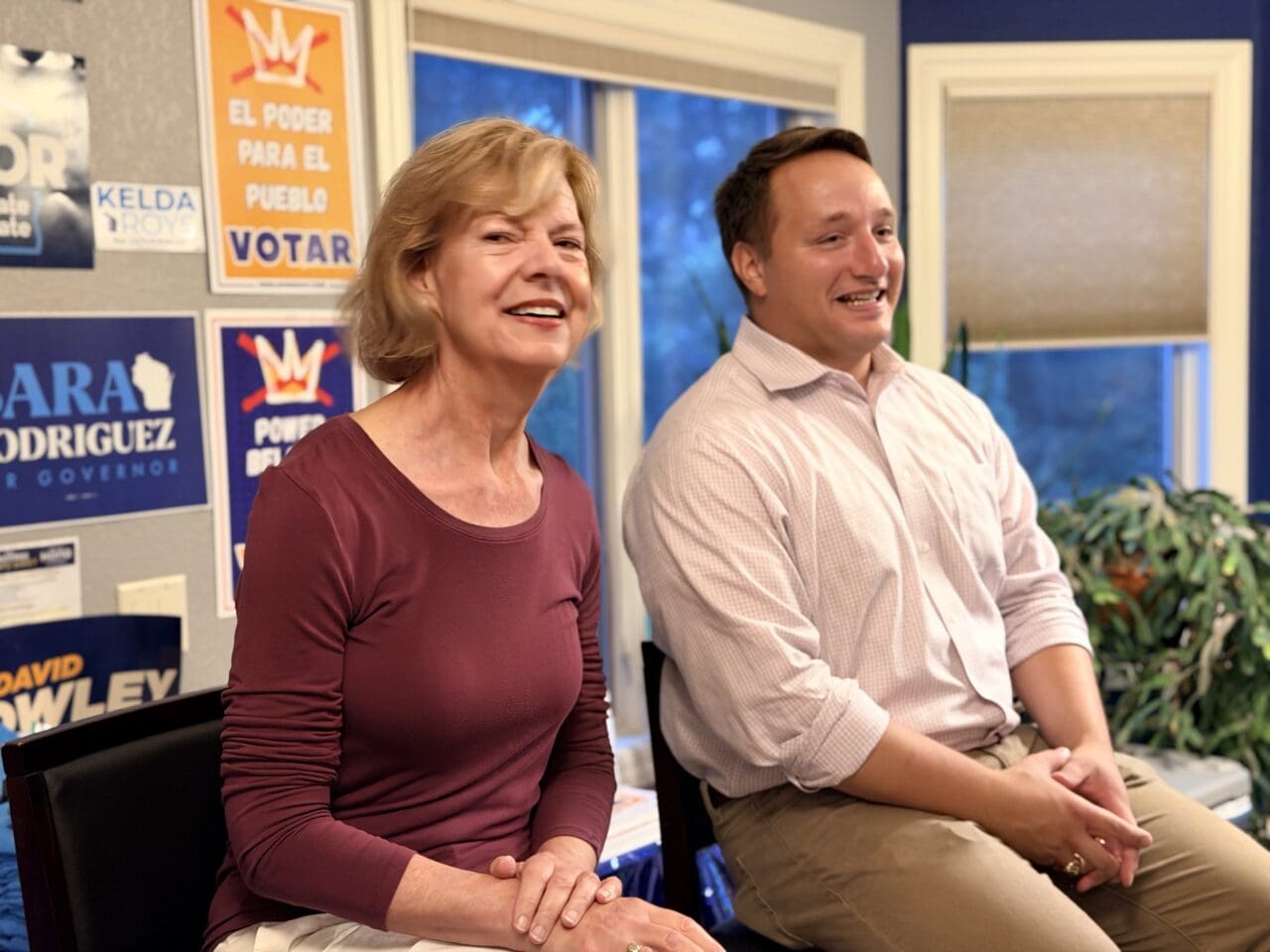
For many Wisconsin families, the gap between making ends meet and falling behind comes down to a single bill — a property tax notice, a prescription refill, or a utility payment that arrives at the worst possible time. In Assembly District 61, covering parts of southwest Milwaukee and its surrounding suburbs, Democratic candidate Ben Brist says that gap has been widening for years — and he’s running to close it.
Brist is challenging Republican incumbent Bob Donovan in one of Wisconsin’s most closely watched legislative races this midterm cycle. His campaign is built around a simple argument: the people he’s met across the district are struggling with costs that didn’t have to rise this high, and the politicians in power share the blame.
“People are mad right now and they’re frustrated. … Republican leaders in both Washington and in our state legislature in Madison, have made life more expensive, made it harder to afford everyday things like rent, electricity, groceries, and prescription drugs,” said Brist.
When Healthcare Costs Force Impossible Choices
After knocking on roughly 2,500 doors and speaking directly with around 500 residents, Brist says the conversations he’s had paint a stark picture of financial strain. For many people in the district, healthcare costs aren’t an abstract policy debate — they’re the reason someone can’t keep the lights on or stay in their home.
“I talked to a retired woman in the Milwaukee part of my district who had to come out of retirement to go back to work part time because she couldn’t keep up with costs and didn’t know how she would make her rent payments,” Brist said. “She had recently started selling her plasma to make ends meet.”
Another story stayed with him just as much.
“A retired Army vet told me he was trying to decide between paying his property taxes so he could keep his house, paying his We Energy bill so he could keep his electricity on and paying to get his car fixed so he can still get around,” Brist said.
These aren’t isolated cases, Brist argues. They reflect the downstream consequences of policy decisions made in Madison — particularly the repeated refusal by Republican legislators to expand Medicaid in Wisconsin.
Medicaid Expansion: A Decision With Real Consequences
Wisconsin Republicans have controlled both chambers of the state legislature since 2011, and during that time they have repeatedly refused to accept the federal government’s offer to expand Medicaid — a program known in Wisconsin as Badgercare. Accepting that expansion would extend health coverage to more low-income residents and reduce the financial burden on Wisconsin’s budget, Brist contends.
“That should be a day one priority,” Brist said.
He also supports establishing a statewide public-option healthcare plan to give families more affordable coverage choices.
Brist places direct responsibility on his opponent for those decisions.
“Bob Donovan is part of the Republican majority in the state legislature that has voted against [Medicaid] expansion multiple times. He has voted to defund public education, which has led to higher property taxes, and he has voted against capping the price of insulin and other lifesaving prescription drugs,” Brist said.
The insulin vote is especially significant for patients managing chronic conditions like diabetes, where the cost of medication can determine whether someone stays healthy or ends up in a hospital emergency room. Capping insulin prices has broad public support, and Brist says blocking those caps is a choice — not an inevitability.
School Vouchers, Property Taxes, and the Cost Connection
Beyond healthcare, Brist argues that Wisconsin’s school voucher program is quietly driving up property taxes — and that the two issues are more connected than many residents realize. Taxpayer-funded vouchers can reach up to $13,371 per pupil for private school students, and Brist says sustaining two parallel education systems is fiscally unsustainable.
“We cannot afford to continue to fund two education systems: a private school system paid for by taxpayer-funded vouchers of up to $13,371 per pupil, and a public school system,” Brist said. “This has led to struggling school districts and sky-high property taxes. Undoing vouchers won’t be a quick or simple process, but we have to do it over time.”
For families already stretched thin by healthcare costs and rising rents, a property tax bill inflated by education funding choices adds one more pressure point to an already fragile household budget.
Reproductive Rights: A Stark Divide
On reproductive healthcare, the contrast between the two candidates could not be sharper. Donovan has publicly called abortion “manifest wickedness,” and he voted to keep Wisconsin’s 1849 abortion ban in place. In 2024, he also voted to impose an abortion ban after 14 weeks of pregnancy, a measure that Democratic Governor Tony Evers ultimately vetoed.
Brist wants to fully repeal the 1849 law and enshrine reproductive rights into state statute — framing it as a matter of personal medical decision-making rather than a question for lawmakers.
“We should all be able to agree that decisions about abortion should not belong to a legislator in Madison,” Brist said.
A Veteran’s Perspective on Public Service
Born and raised in Madison, Brist served as a paratrooper in Iraq and Kuwait with the Army’s 82nd Airborne Division before becoming a Company Commander in the 4th Infantry Division. After leaving the military, he worked for Senator Tammy Baldwin and Dane County Executive Melissa Agard — both of whom, he told UpNorthNews, inspired him by the way they
“show up to work every day to move the ball forward for their constituents.”
He and his wife Hannie, a former military intelligence officer, now live in Greendale and are planning to start a family. His military service, Brist says, gave him a direct understanding of what it means to work alongside Americans from every background and every region of the country — an experience he believes shapes how he approaches public life differently than a career politician would.
“It’s living a life where you’re actually pursuing public service and one where you’re just seeking public office,” Brist said. “It’s that ability to find that common purpose and work with anybody to get stuff done to make Wisconsin a better place.”
As the 2026 midterms draw closer, the race in Assembly District 61 is shaping up as a test of whether voters connect rising healthcare costs, unaffordable prescriptions, and mounting property tax burdens to the decisions made by their state legislators — and whether they’re ready for a different direction.





Comments are closed.