An Overview of the Impact of Recent Strikes on Iran’s Nuclear Sites
In the wake of extensive military operations by the United States and Israel, the state of Iran’s nuclear facilities has become a focal point for international scrutiny. While some officials assert significant damage, others suggest the impact may not be as extensive as claimed.

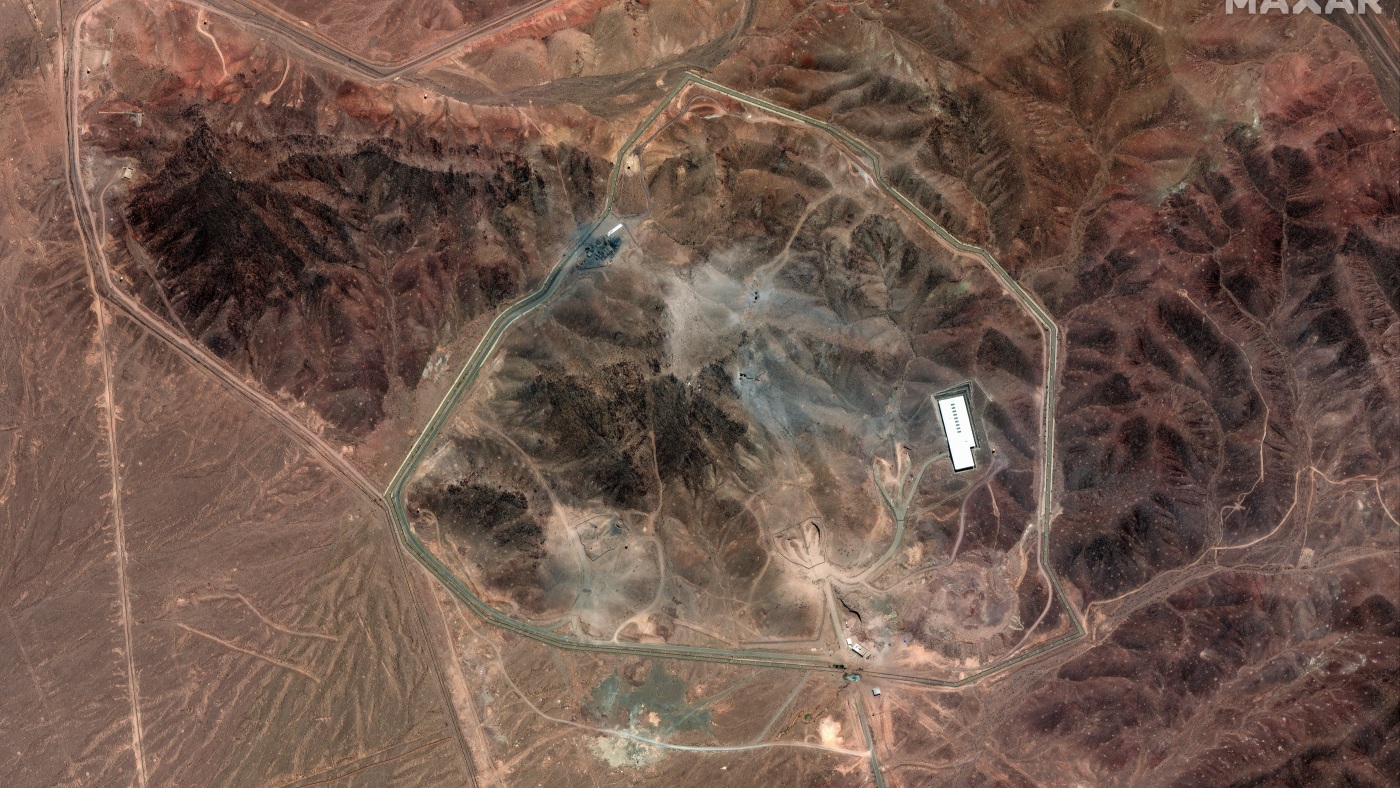
A satellite photo of Iran’s Fordo fuel enrichment facility taken on June 24 shows debris (grey) from a U.S. strike employing several bunker-busting weapons. The Israeli Air Force destroyed additional roads and surface facilities in a subsequent strike. Maxar Technologies
The aftermath of nearly two weeks of military actions by the U.S. and Israel on Iran’s nuclear sites has left much to be analyzed. A leaked document from the Defense Intelligence Agency suggests minimal damage to one location, whereas CIA Director claims severe damage overall. President Trump boldly stated, “It’s called obliteration,” emphasizing the alleged destruction of Iran’s nuclear ambitions during a press conference in the Hague.
Fordo
Fordo, a deeply fortified site within a mountain, housed numerous centrifuges for uranium enrichment. The U.S. military devised the Massive Ordnance Penetrator, a potent bunker-buster, specifically for this type of target. B-2 bombers deployed these weapons, aiming to reach the site via its ventilation shafts. Despite the precision of the attack, geological factors make penetrating such facilities challenging. General Dan Caine noted the difficulty, saying, “We don’t grade our own homework, we let the intelligence community do that.”
Post-strike assessments vary, with the Israel Atomic Energy Commission declaring Fordo “inoperable.” Rafael Mariano Grossi of the International Atomic Energy Agency echoed this sentiment, stating the centrifuges are “no longer operational.” Following these events, Israel conducted additional attacks to hinder access to the site.
Natanz
Natanz, another critical site, faced Israeli strikes at the onset of the conflict. Although above-ground facilities were significantly damaged, the underground centrifuge halls remained mostly intact. The U.S. later targeted these halls with bunker-busters. Jeffrey Lewis from the Middlebury Institute noted the severity of the damage, while also pointing out a new, possibly untouched facility nearby.
Isfahan
Isfahan’s complex, responsible for preparing and processing uranium, suffered extensive damage from initial Israeli strikes followed by American missile attacks. Despite the destruction of surface structures, nearby tunnels may still house crucial uranium stores, according to David Albright of the Institute for Science and International Security.
Arak
The Arak reactor, a non-operational heavy water facility, was targeted by Israel, resulting in the demolition of its dome and a laboratory. Though not active, its destruction potentially closes a chapter on Iran’s plutonium capabilities.
The Unknowns
Despite the damage inflicted, Iran’s nuclear potential remains uncertain. Prior to the strikes, Iran possessed over 400 kilograms of near bomb-grade uranium, which may now be hidden. Corey Hinderstein from the Carnegie Endowment for International Peace highlighted the mobility and concealability of these materials. President Trump expressed confidence in the promptness of the strikes preventing any removal, but experts like Lewis suspect undisclosed sites may still exist.
To halt Iran’s nuclear progress, experts, including Christopher Ford, advocate for negotiations involving cooperative verification and monitoring.
This article was originally written by www.npr.org