In a bold political maneuver, leaders in California and Texas are attempting to reshape the electoral landscape ahead of the upcoming midterm congressional elections. This move diverges from traditional redistricting practices and has been spurred by former President Trump’s appeal to Texas to favor Republican candidates.
Over recent months, the narrow Republican majority in Congress has facilitated the advancement of several Trump administration priorities, including mass deportations and tax cuts. However, with only a 219-to-212 edge in the U.S. House, the GOP is striving to maintain its control by urging states under Republican leadership to redraw voting maps to bolster their electoral advantage.
Redistricting typically occurs early in each decade following the census, a crucial process that can significantly influence election outcomes by determining how voters are grouped within congressional districts. As of this week, both Texas and California legislatures are set to deliberate on their respective redistricting strategies.
Understanding Redistricting

California Gov. Gavin Newsom speaks during a news conference Thursday. Marcio Jose Sanchez/AP
The U.S. House comprises 435 seats, and these are apportioned among the states according to population shifts determined by the decennial census. Each state is responsible for drawing its district boundaries, ensuring each district contains roughly the same number of people. However, the redistricting process often faces legal challenges, particularly when it is perceived as diminishing the voting power of racial groups.
While some states have enacted laws to create competitive and geographically compact districts, others focus on ensuring districts reflect common political interests among voters. This diversity in redistricting laws can significantly impact how politicians address constituent needs.
The Mechanics of Gerrymandering
Gerrymandering occurs when political figures manipulate district lines to gain an electoral advantage, often through methods known as “packing” and “cracking.” Critics argue this practice allows politicians to select their voters rather than the reverse. The term “gerrymandering” originates from the early 19th century when a Massachusetts district map, approved by Governor Elbridge Gerry, resembled a salamander.
The Brennan Center for Justice describes gerrymandering as a tactic that “skews election results, makes races less competitive, hurts communities of color, and thwarts the will of the voters.”
By “packing” voters from the opposing party into a few districts, the dominant party limits their influence elsewhere. Conversely, “cracking” disperses opposing voters across many districts, diluting their electoral impact.
Political Maneuvers in Texas and California
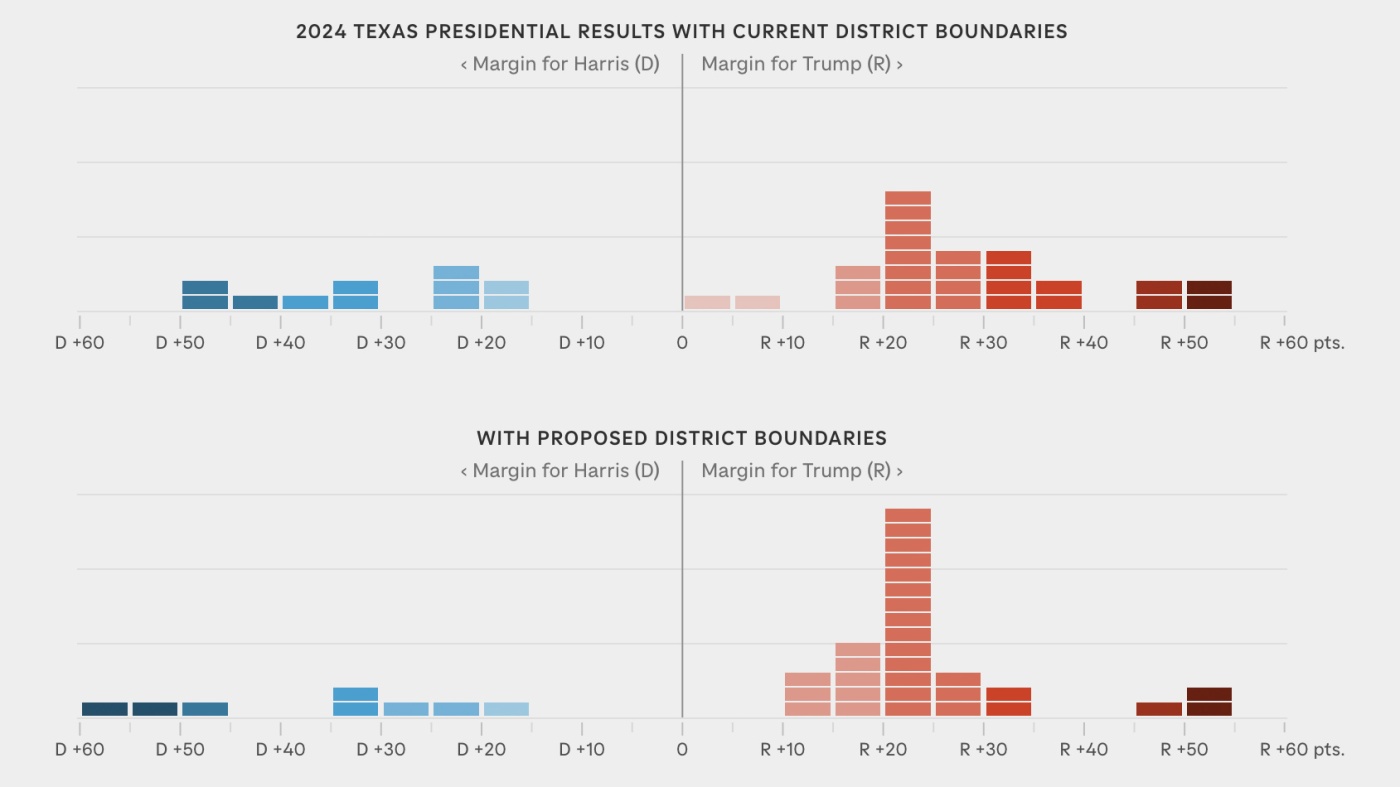
In Texas, Republicans are acting on Trump’s directive to create five additional GOP-favored districts. This initiative has led to a dramatic standoff, with Democratic lawmakers vacating the state to prevent a quorum, effectively stalling the vote on the new maps.

Members of the public view a proposed redistricting map at a public hearing in a Texas Senate committee this month. Brandon Bell/Getty Images
Meanwhile, in California, Governor Gavin Newsom is urging the legislature to introduce a new map that could benefit Democrats in five districts. This strategy aims to counterbalance the gains sought by Texas Republicans. Unlike Texas, California has a Citizens Redistricting Commission, established to remove partisan influence from the map-drawing process. Newsom’s proposal seeks to bypass this commission, potentially leading to a significant political shift.
Elsewhere, Republican leaders in states like Florida, Ohio, and Missouri are contemplating similar strategies to increase GOP-favored districts. Vice President Vance has even engaged with Indiana Republicans to explore this possibility.
Racial Implications in Gerrymandering
Racial gerrymandering is defined by the manipulation of district lines to diminish the electoral influence of racial groups. This practice is illegal, whether it involves “cracking” minority communities or “packing” voters of color into limited districts to minimize their impact elsewhere.
In Texas, Republicans assert that their proposed maps enhance Latino representation in some districts. However, U.S. Rep. Jasmine Crockett, a Democrat, argues that the extreme concentration of Latino voters in certain areas constitutes illegal “packing.”
“There is some district that went up to 70-something percent Latino. That is packing,” she said. “You don’t need some district to be almost 80% Latino for that district to perform as a Latino-opportunity seat.”
Partisan vs. Racial Gerrymandering

Texas House Speaker Dustin Burrows strikes the gavel last month. Eric Gay/AP
With 38 congressional districts, Texas Republicans currently hold 25 and are aiming to expand their influence. They argue that their actions align with the 2019 Supreme Court ruling allowing partisan gerrymandering. As Republican Texas state Rep. Tom Oliverson noted, “The courts have consistently held that redistricting for purposes of political performance by either party is acceptable.”
While some states, like Illinois, have been accused of similar practices, partisan gerrymandering remains legal in Texas, unlike racial gerrymandering.
Efforts to Remove Partisanship
Many states, predominantly led by Democrats, have established commissions to reduce political influence in redistricting. These bipartisan or nonpolitician commissions aim to create fairer electoral maps. However, Republican-led states, including Texas, have largely maintained traditional partisan processes.
This article was originally written by www.npr.org