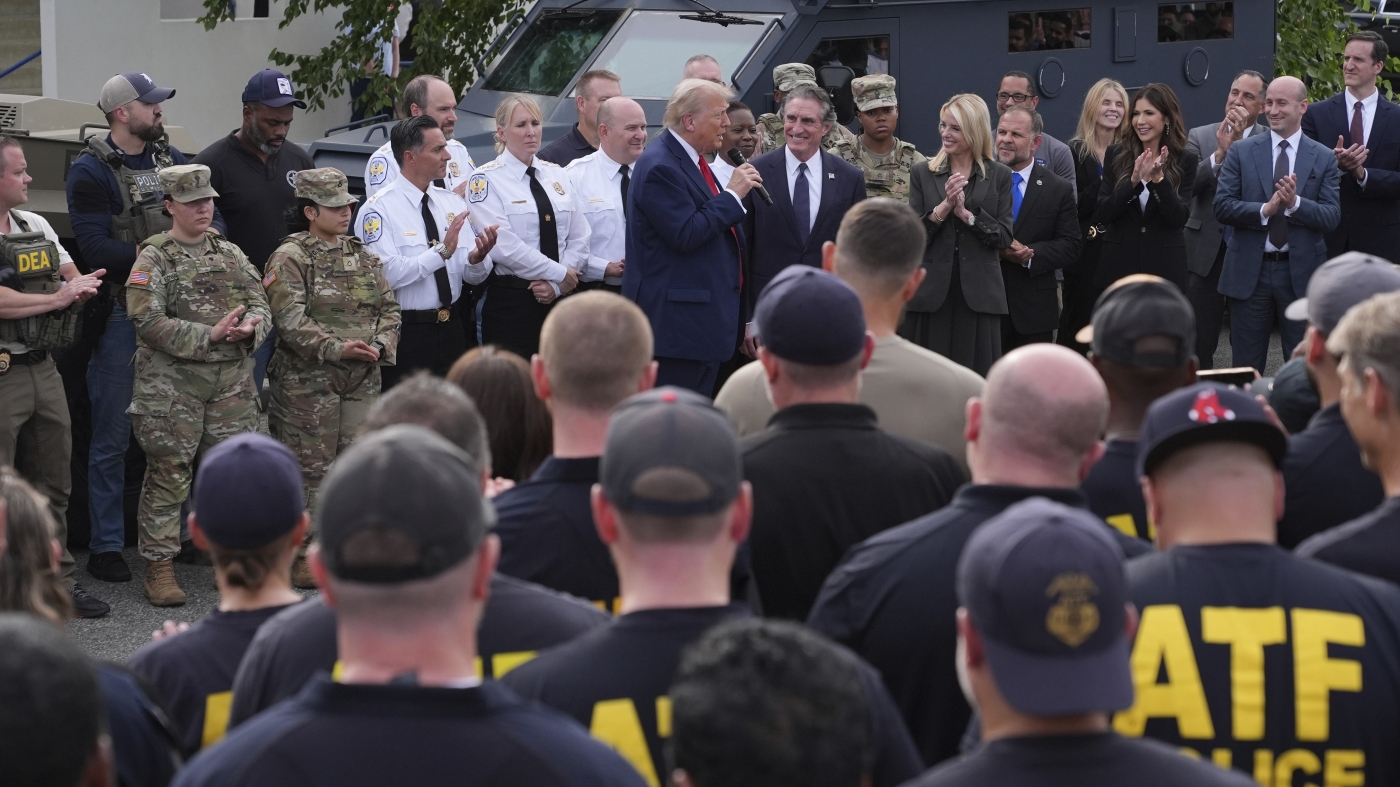

President Donald Trump speaks with members of law enforcement and National Guard soldiers on Aug. 21, 2025, in Washington. Jacquelyn Martin/AP
In a significant move to address rising crime rates in the nation’s capital, the Trump administration has reported the arrest of over 700 individuals in Washington, D.C. This initiative is part of a broader strategy to enhance public safety under President Trump’s directive.
Jeanine Pirro, the U.S. Attorney for D.C., has been vocal about the need for stringent penalties for offenders. Accompanied by President Trump during a recent visit to federal agents and National Guard members, Pirro emphasized the administration’s commitment to prosecuting crimes effectively.
“I am making sure we back the blue to the hilt. Every arrest you make, we’re going to the longest way to make sure that we charge in those cases,” Pirro stated to the assembled officers.
While the announcement of these arrests has drawn attention, there remains ambiguity regarding the full scope and details of the apprehensions. The D.C. Metropolitan Police Department noted approximately 800 arrests within the first ten days of the federal intervention, marking a 25% increase from the previous year and a 40% rise from 2023. However, clarity on the overlap between the White House’s and the D.C. police’s figures is still lacking.
NPR has formally requested a comprehensive list of the individuals arrested, but such information has not been disclosed by either the MPD or the Trump administration, leaving questions about the demographics and reasons for these arrests unanswered.
What do these arrests signify?
Details about the agencies responsible for the arrests remain vague. An official from the White House, preferring anonymity, revealed that about 40% of the arrests were tied to immigration issues. Furthermore, the official noted that about half of the non-immigration-related arrests occurred in Washington’s most crime-prone areas between Aug. 9 and Aug. 17. However, these claims have not been independently verified by NPR.
Jenn Rolnick Borchetta from the ACLU Criminal Law Reform Project expressed concerns, saying, “My first question is, where are the receipts on these arrests?” She highlighted the need for transparency to determine the validity of these arrests and whether any rights were violated.
Interpreting arrest data and public safety
Experts in criminal justice emphasize that arrest numbers alone do not provide a comprehensive picture of public safety. Arrests are not always indicative of actual crime rates, as not all arrests lead to charges or convictions.
The approach of “flooding the zone” with law enforcement can result in increased arrests simply because officers have more opportunities to detain individuals. Tahir Duckett from Georgetown Law explained this phenomenon, noting that arrests can sometimes be based on discretionary choices by law enforcement.
For instance, during the federal intervention in D.C., incidents such as a man throwing a sandwich at a federal agent have led to charges that might not have arisen otherwise.
Impact of increased law enforcement presence
The White House official reported the deployment of over 2,000 federal officers during recent operations, a notable increase in a city already known for its high police presence per capita. The administration believes that a visible law enforcement presence can deter crime.
However, policing experts caution that while visible policing can have a deterrent effect, the impact is often temporary. John Roman from the University of Chicago’s NORC highlighted potential risks, stating, “The more police and public interact, the more police uses of force there are going to be.”
NPR’s Luke Garrett contributed reporting.
This article was originally written by www.npr.org