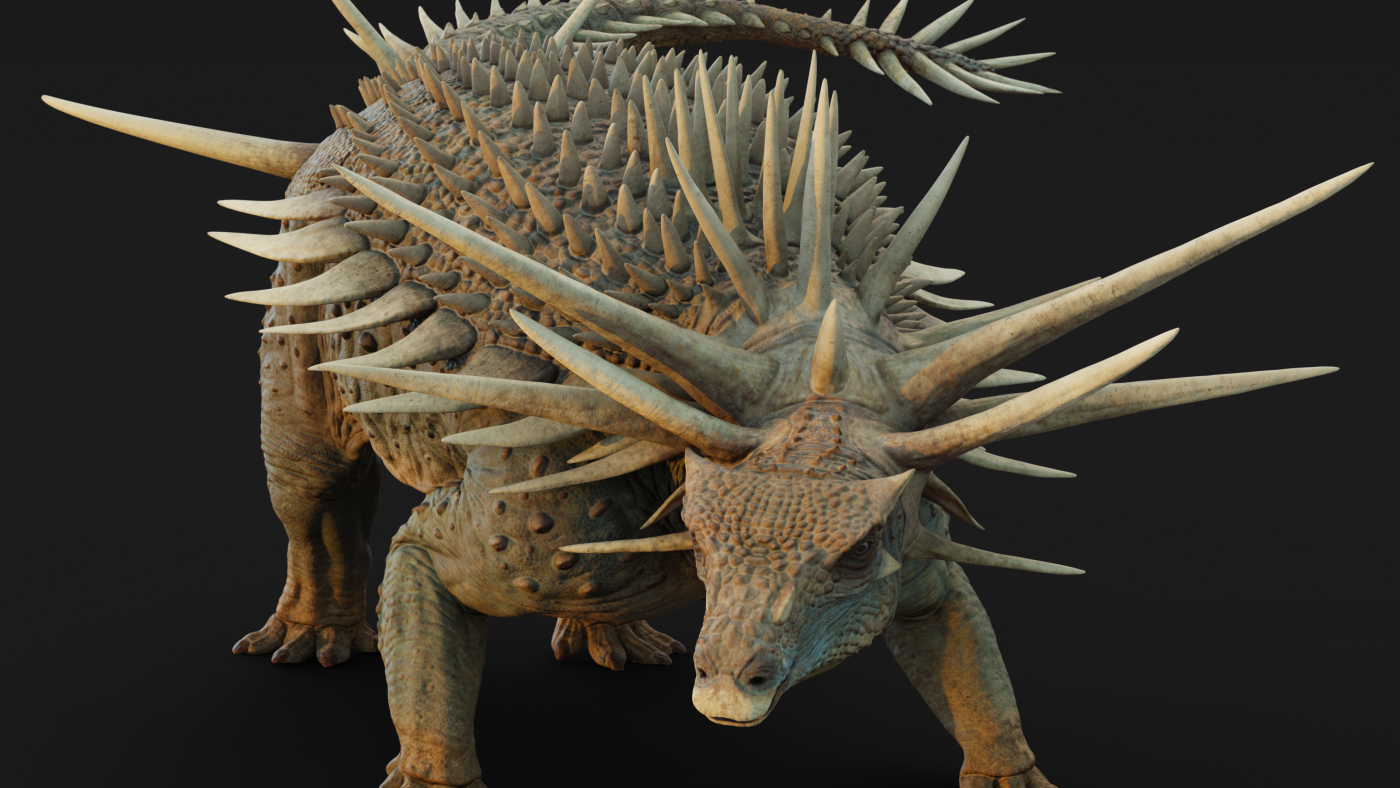
A New Discovery: The Unique Armor of the Ancient Spicomellus
In the heart of Morocco, a fossil discovery has shed light on a dinosaur like no other. The Spicomellus, a herbivore from over 165 million years ago, boasted a neck lined with three-foot-long spikes, a weaponized tail, and intricate body armor, according to recent research.
The town of Boulemane in Morocco is now known for more than just its landscapes, as it is the site where the spiked dinosaur was unearthed. Initially identified in 2021 from a solitary rib bone, this remarkable creature is now understood to have been as large as a small car, with a much more complex armor structure than previously imagined. This finding was published last month in the journal Nature.
Susannah Maidment, co-lead of the research, elaborated on the dinosaur’s armor: “Spicomellus had a diversity of plates and spikes extending from all over its body, including metre-long neck spikes, huge upwards-projecting spikes over the hips, and a whole range of long, blade-like spikes, pieces of armour made up of two long spikes, and plates down the shoulder,” she stated in a statement to London’s Natural History Museum. “We’ve never seen anything like this in any animal before.”
What makes the Spicomellus even more intriguing are the spikes fused to its ribs, a feature not previously observed in any other vertebrate, whether extinct or extant. Richard Butler, a paleobiology professor at the University of Birmingham and co-lead of the project, described his reaction upon first seeing the fossil as “spine-tingling.”
Butler remarked, “We just couldn’t believe how weird it was and how unlike any other dinosaur, or indeed any other animal we know of, alive or extinct.” He added, “It turns much of what we thought we knew about ankylosaurs and their evolution on its head and demonstrates just how much there still is to learn about dinosaurs.”
The intricate bone structure of Spicomellus likely served dual purposes: attracting mates and deterring rivals. This discovery distinguishes it from earlier relatives, which had simpler, more defensively oriented armor.
Additionally, the dinosaur’s tail was found to have fused vertebrae forming a “handle,” suggesting the presence of a club-like weapon—a feature thought to have evolved much later during the Cretaceous period.
“To find such elaborate armour in an early ankylosaur changes our understanding of how these dinosaurs evolved,” Maidment noted. “It shows just how significant Africa’s dinosaurs are, and how important it is to improve our understanding of them,” she emphasized.
This article was originally written by www.npr.org