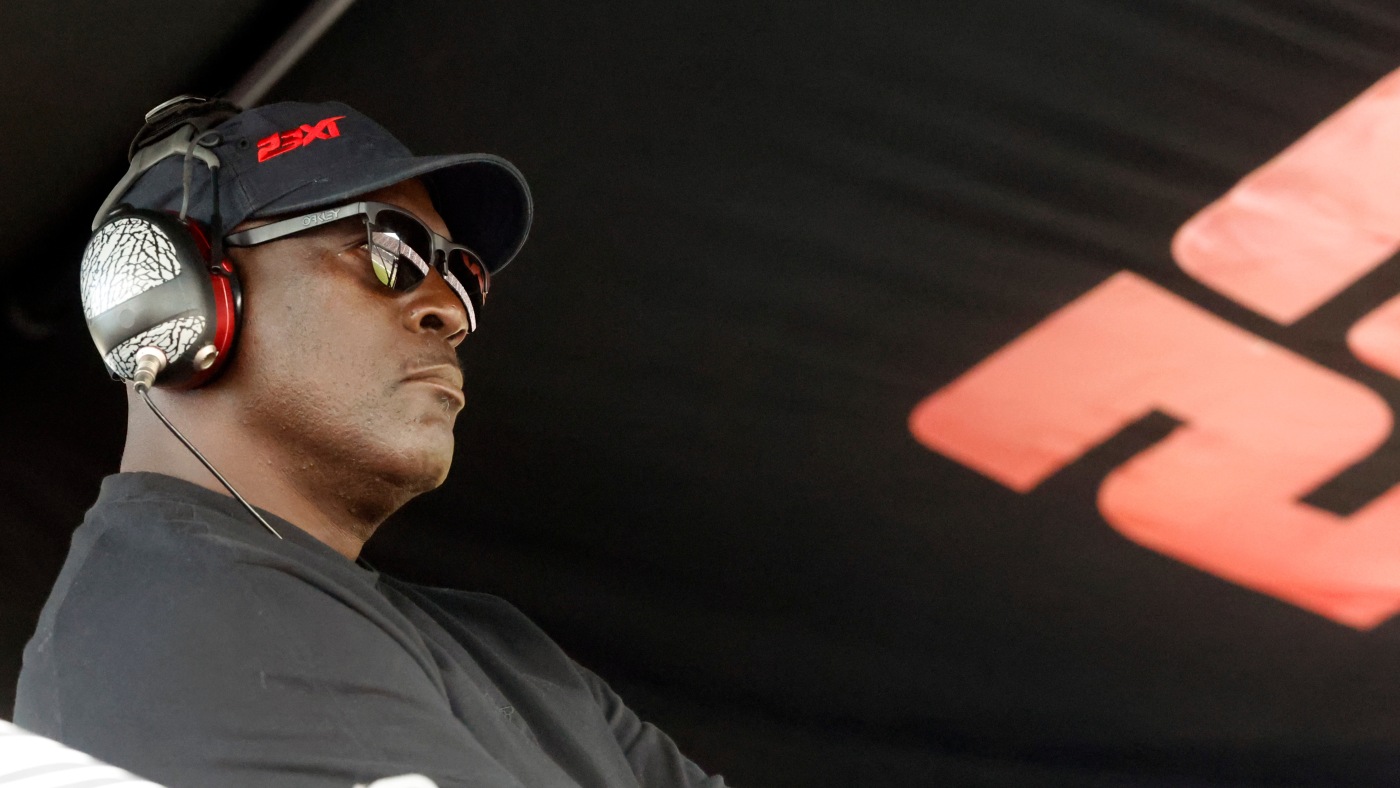

Michael Jordan, co-owner of 23XI Racing, sits in his pit box during a NASCAR Cup Series auto race at Talladega Superspeedway, Sunday, Oct. 6, 2024, in Talladega, Ala.
Butch Dill/AP
hide caption
toggle caption
Butch Dill/AP
CHARLOTTE, N.C. — A legal battle involving Michael Jordan and NASCAR is set to unfold in federal court, sparking a conflict that threatens to disrupt the premier motorsports series in the United States.
The controversy stems from antitrust allegations brought by Jordan-owned 23XI Racing and Front Row Motorsports. These charges have unveiled intimate communications, financial details, and underlying tensions among key figures in the industry.
Denny Hamlin, a three-time Daytona 500 champion and co-owner of 23XI with Jordan, foreshadowed an intense courtroom battle, stating that “the gloves will be off” during the trial in North Carolina’s Western District.
“Our fans have been brainwashed with (NASCAR’s) talking points for decades,” Hamlin wrote on social media. “Lies are over starting Monday morning. It’s time for the truth. It’s time for change.”
NASCAR Commissioner Steve Phelps noted efforts to settle the dispute before the trial began.
What is the lawsuit about?
The lawsuit initiated by 23XI Racing, owned by Jordan, Hamlin, and Curtis Polk, Jordan’s business manager, joined forces with Front Row Motorsports, led by Bob Jenkins. Both entities rejected the charter agreements proposed by NASCAR in late 2024, which they assert fall short of their expectations.
A total of 15 teams were engaged in negotiations for more favorable terms, but only 23XI and Front Row chose to pursue legal action, accusing NASCAR of maintaining a monopoly.
What is a charter?
Introduced in 2016, NASCAR’s charter system mirrors the franchise model prevalent in other professional sports leagues. It ensures a guaranteed entry for cars in the 40-car lineup across all 38 races, alongside a set share of the prize money.
Despite this structure, teams argue the financial model remains unsustainable. The demand for permanent charters, increased revenue share, and a say in governance were left unmet, prompting 23XI and Front Row to decline the agreements. They claim NASCAR’s dominion over the racing series is excessive, citing ownership of tracks, exclusivity clauses, and control over regulations.
The plaintiffs are also seeking substantial compensation for legal expenses and financial losses incurred due to their non-chartered status.
NASCAR’s defense
Founded 76 years ago by the Florida-based France family, NASCAR defends itself by asserting adherence to standard business practices, arguing that the 2025 charter agreement’s increased payouts evidence their non-anticompetitive stance. They highlight the option for cars to compete as “open teams,” vying for one of four nonchartered spots through qualifying.
Although 23XI and Front Row participated as open teams, they argue that the financial toll was immense, with NASCAR’s 2024 earnings surpassing $100 million.
Behind-the-scenes drama
The discovery phase has exposed private communications, shedding light on internal dynamics. NASCAR executives were found criticizing team owners, like Richard Childress, and making derogatory remarks about fans and rival racing series.
Conversely, the president of 23XI was caught making controversial statements about NASCAR’s leadership, while Hamlin’s criticisms of the France family and Jordan’s financial jokes added fuel to the fire.
Who will be in court?
NASCAR intends to call upon prominent team owners Rick Hendrick and Roger Penske. However, both have resisted, filing motions to limit their involvement to charter-related inquiries.
Despite support for the charter system from non-suing teams, many still express dissatisfaction with the 2025 agreements. NASCAR has requested that certain plaintiffs, possibly including Jordan and Hamlin, be excluded from the courtroom to avoid potential jury distraction.
A decision regarding courtroom presence remains pending.
What are some outcomes
A settlement could occur at any stage, even post-ruling and during appeals. Should 23XI and Front Row prevail, the jury will determine financial damages, with Judge Kenneth Bell retaining the authority to adjust or triple the amount. Potential repercussions for NASCAR include mandated sales of assets, restructuring of the charter system, and more.
Conversely, a NASCAR victory might force 23XI and Front Row out of business by 2026, reallocating their charters to eager buyers, including private equity firms.
This article was originally written by www.npr.org