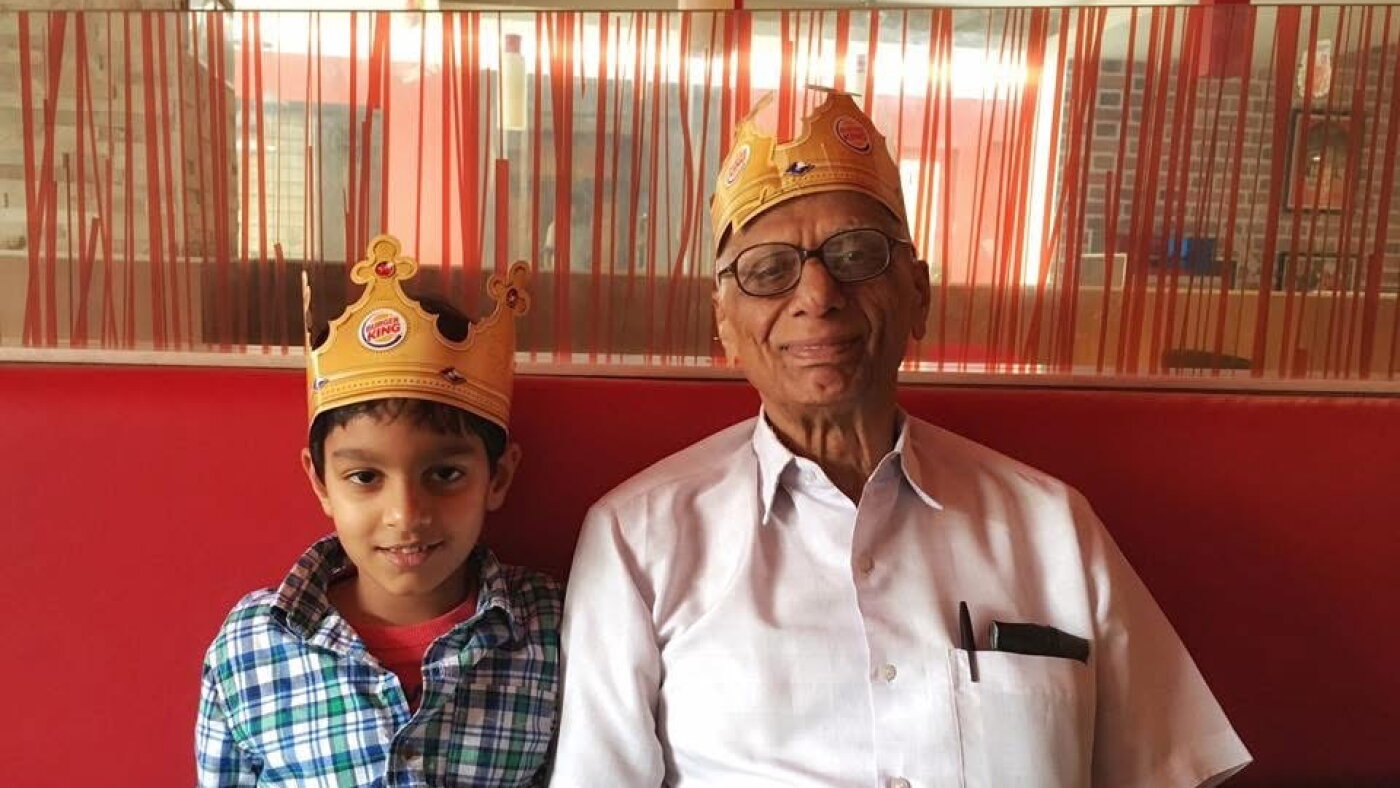

Amit Biligiri (left), with his great-grandfather, B. Raje Urs, on a trip to India.
Anand Biligiri
Anand Biligiri
SAN JOSE, Calif. — In a typical living room scene, Amit Biligiri, a high school junior from Evergreen Valley High School in San Jose, finds himself once again debating with his mother, Kalyani Urs, about sleep schedules. It’s a common conflict many teenagers experience with their parents.
Amit confides that he’s often awake late into the night, to which his mom, who also works late, responds with concern, asking, “Hey Amit, why are you going to sleep so late?” Urs admits that persuading Amit to sleep earlier has been “a constant battle.”
“I was like, ‘I’m not really sleepy,'” Amit recalls telling her. He discovered that teenagers have a delayed sleep cycle, making it healthier for them to sleep and wake up later. However, Urs noted his forgetfulness, pointing out how he often needed reminders for tasks and assignments, suggesting his memory was affected by lack of sleep.
Surprisingly, Amit brought up a vivid memory: “I remember when I had fries with Scooter Muttha,” referring to his beloved great-grandfather. Despite many years since his passing, Amit cherished this memory of sharing fries at a Burger King in Bangalore when he was just six years old. Urs was left speechless, realizing how unpredictable memory can be.
This exchange sparked Amit’s curiosity about the nature of memory. With encouragement from his mom, an NPR enthusiast, he decided to explore this topic for NPR’s annual Student Podcast Challenge.
His efforts paid off in a big way. Among approximately 1,500 participants, Amit’s podcast, What Happens to Memories, earned the top prize in the competition’s eighth year.
The Podcast
“There were entire weeks of my life I barely remember,” begins Amit in his podcast. He reflects on how much of his daily life fades away while certain moments persist.
One such enduring memory is of being six years old in a brightly lit Burger King in India, sharing fries with his great-grandfather, whom he fondly called “Scooter Muttha.” The memory is captured in an old photo, revealing a poignant scene of two generations, one at life’s beginning and the other nearing its end.
Amit muses on why his brain retains this seemingly trivial moment while it discards more recent experiences. In his seven-minute audio story, Amit suggests that memory functions like a construction site managed by the amygdala, rather than a neat filing cabinet.
During sleep, the brain processes memories, keeping some and discarding others. Amit notes that his mom was correct in saying that insufficient sleep hampers this process. Additionally, he argues that modern technology, particularly smartphones, further complicates memory retention by dividing our attention.
“When we experience life through a screen, hunting for the right filter, the perfect caption, we experience it halfway: half-online, half-distracted, half-present. And emotion is exactly what gives memories a better chance of sticking,” Amit explains.
In his podcast, Amit shares insights from volunteering at a senior living community, where he found that residents valued memories of emotional experiences over significant life events. He draws a parallel to his own cherished memory of feeling unconditionally loved by his great-grandfather.
“Science can explain the neurons and the glymphatic system,” he observes, “but it doesn’t fully explain why, years later, seeing an old man on the street makes me feel a sudden pang of warmth and loss.”
Since completing his podcast, Amit has found his mom listening to it in solitude, reflecting on her own connection to her grandfather. Urs admits the podcast brings her closer to him, highlighting the profound impact of cherished memories.
In conclusion, Amit suggests that memories are more than just stored information; they are evidence of what or who truly mattered.
Listen to Amit Biligiri’s What Happens to Memories?
Edited by Steve Drummond.