
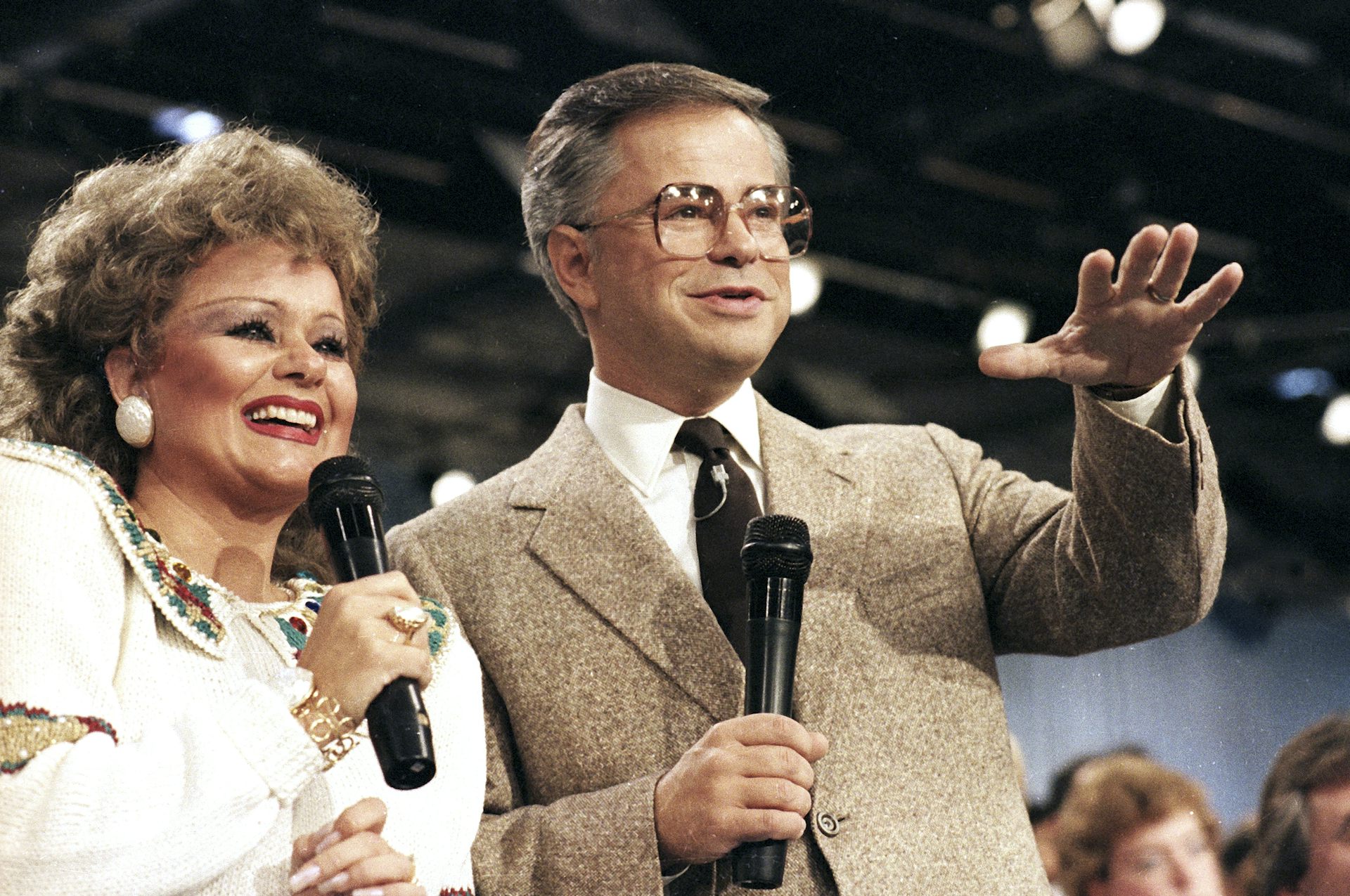
Few chapters in American religious history shaped the political landscape of evangelical voters quite like the rise and fall of Jim Bakker’s PTL empire. As Bakker’s ministry built one of the most influential Christian broadcasting networks in the country, it also helped cultivate a massive, politically engaged evangelical audience — one whose eventual betrayal by PTL’s leaders left lasting scars on public trust that extended well beyond the church pew and into the voting booth.
Bakker, who died on Oct. 5, 2026, at age 86, built PTL — short for “Praise the Lord” or “People That Love” — into a broadcasting and theme park empire starting in the 1970s. Historian John Wigger, who wrote PTL: The Rise and Fall of Jim and Tammy Faye Bakker’s Evangelical Empire in 2017, interviewed dozens of former staffers and supporters of PTL. Their verdict was nearly unanimous: PTL was both the best and worst thing they had ever been part of.
That contradiction — an institution launched with genuine public purpose that eventually collapsed under fraud and self-dealing — offers a window into how concentrated, unaccountable power in religious media can shape and then shatter the civic trust of millions of Americans who were also active participants in the democratic process.
Building an Evangelical Megaphone
In 1974, Jim and Tammy Faye Bakker launched The PTL Club from a converted furniture store in Charlotte, North Carolina. Jim’s blueprint was modeled on The Tonight Show Starring Johnny Carson — he wanted to create a Christian version of late-night television at the height of its cultural influence.
The show became a meeting point between evangelical Christianity and mainstream American pop culture. Evangelical figures including preacher Billy Graham, gospel singer Pat Boone, and televangelist Oral Roberts appeared alongside unlikely celebrities such as singer Little Richard, Black Panther Eldridge Cleaver, and Hustler magazine publisher Larry Flynt. Episodes ranged from Bible passages to candid discussions about marriage, parenting, substance abuse, and depression.
The charismatic and spontaneous Tammy Faye earned a devoted following for her unfiltered honesty. One memorable episode featured a camel brought on set that urinated across the stage. Another had a cast member wearing a dog costume vomit while Tammy Faye performed an entire segment on a merry-go-round. The Bakkers understood that entertainment kept people watching — and that a captive audience could be mobilized.
PTL’s reach expanded dramatically when the Bakkers embraced satellite technology alongside Pat Robertson’s Christian Broadcasting Network Satellite Service. Satellite TV allowed television programming to be distributed across vast distances, bypassing the local broadcast infrastructure that had previously limited audience size. In 1978 — just three years after HBO began continuously transmitting via satellite and a year before ESPN launched — the Bakkers’ ministry started offering 24-hour Christian programming through the PTL Satellite Network.
The network ultimately reached 14 million American homes, with programming visible in 40 countries. That kind of reach, delivered directly into living rooms across the country, gave PTL extraordinary influence over how millions of evangelical Americans understood the world — including, increasingly, the political world.
Prosperity Gospel and the Politics of Faith
The 1980s “Greed is Good” atmosphere provided fertile ground for what is often called the prosperity gospel — the belief that faith brings material wealth and success. Bakker embraced it fully. In his 1980 book, Eight Keys to Success, he wrote:
“God wants you to be happy. God wants you to be rich. God wants you to prosper, even as your soul prospers.”
The Bakkers lived out that message conspicuously. They purchased a 10,000-square-foot home outside Charlotte along with vacation homes in Florida, Palm Springs, California, and Gatlinburg, Tennessee — plus luxury cars, boats, and tailored clothing. For their supporters, such displays were proof the message worked. For a growing evangelical voting bloc that was becoming politically organized in the 1980s, PTL’s vision of faith, success, and national renewal was deeply resonant.
That same evangelical audience would become one of the most consequential forces in American elections for decades to come. PTL helped build and sustain that community — making what happened next not just a religious scandal, but a civic one.
The Fraud Behind the Broadcast
Had Bakker remained focused on television, the PTL empire might have survived. Instead, he channeled broadcasting revenue into Heritage USA, a sprawling Christian theme park along the North and South Carolina border. Bakker sought to build a Christian version of Disneyland, complete with a 500-room hotel, a 5,000-seat television studio, and a $13 million water park, plus an ambitious calendar of worship services, seminars, and concerts.
The project was far beyond PTL’s financial means. The ministry was perpetually broke and leveraged to the point of collapse. To keep money flowing, Bakker fraudulently used funds raised for new projects to pay existing debts — exactly the kind of financial shell game that, in a political or governmental context, would constitute a serious breach of public trust.
On March 19, 1987, the Charlotte Observer reported on Bakker’s December 1980 sexual encounter with a then-21-year-old church secretary named Jessica Hahn. The paper also revealed that PTL had paid Hahn and her representatives $265,000 in hush money. By that point, PTL was $65 million in debt, losing $2 million every month, and sliding toward bankruptcy.
Bakker resigned from PTL in disgrace. The full accounting of the scandal would come in federal court: he was sentenced to 45 years in prison for fraud in 1989. As Jim and Tammy Faye left the courthouse, they sang the hymn “On Christ the Solid Rock I Stand.” The Bakkers divorced in 1992 while Jim was still incarcerated; he ultimately served nearly five years. Tammy Faye died in 2007.
What PTL’s Collapse Meant for Civic Trust
The PTL scandal arrived at a pivotal moment. Through the 1980s, evangelical Christians had become an increasingly organized and powerful political constituency. PTL and similar ministries were not just spiritual institutions — they were community hubs that shaped how millions of Americans understood authority, accountability, and institutional trust. When that trust was shattered by fraud and cover-up, the effects rippled outward.
Wigger noted that nearly everyone he interviewed for his book believed PTL’s founding mission was genuine: spread the gospel to as many people as possible using cutting-edge technology. But somewhere along the way, money and fame stopped being tools for that mission and became the mission itself. The donors who had given to PTL — many of them ordinary working Americans — had been misled about how their contributions were being used, denied the basic transparency that allows people to make informed decisions.
That dynamic — institutions that start with a public-service mission but drift toward opacity and self-dealing — is one that voters and election observers recognize in many corners of civic life. The PTL story is a reminder of what happens when accountability mechanisms fail, when financial disclosures are falsified, and when the people who place their trust in an institution are left with no way to verify whether that trust is warranted.
For the evangelical community that PTL helped build into a voting bloc, the scandal forced a reckoning about whom to trust — in the pulpit and, by extension, in public life. That question remains as relevant to democratic participation today as it was when Jim and Tammy Faye Bakker walked out of a Charlotte courthouse singing a hymn about solid ground.






Comments are closed.