AI Image Manipulation Sparks Misinformation in Minneapolis Shooting Case
Following the tragic event of Renee Good’s fatal shooting in Minneapolis, a digitally altered image of the involved ICE agent went viral, raising questions about the ethical use of AI technology.
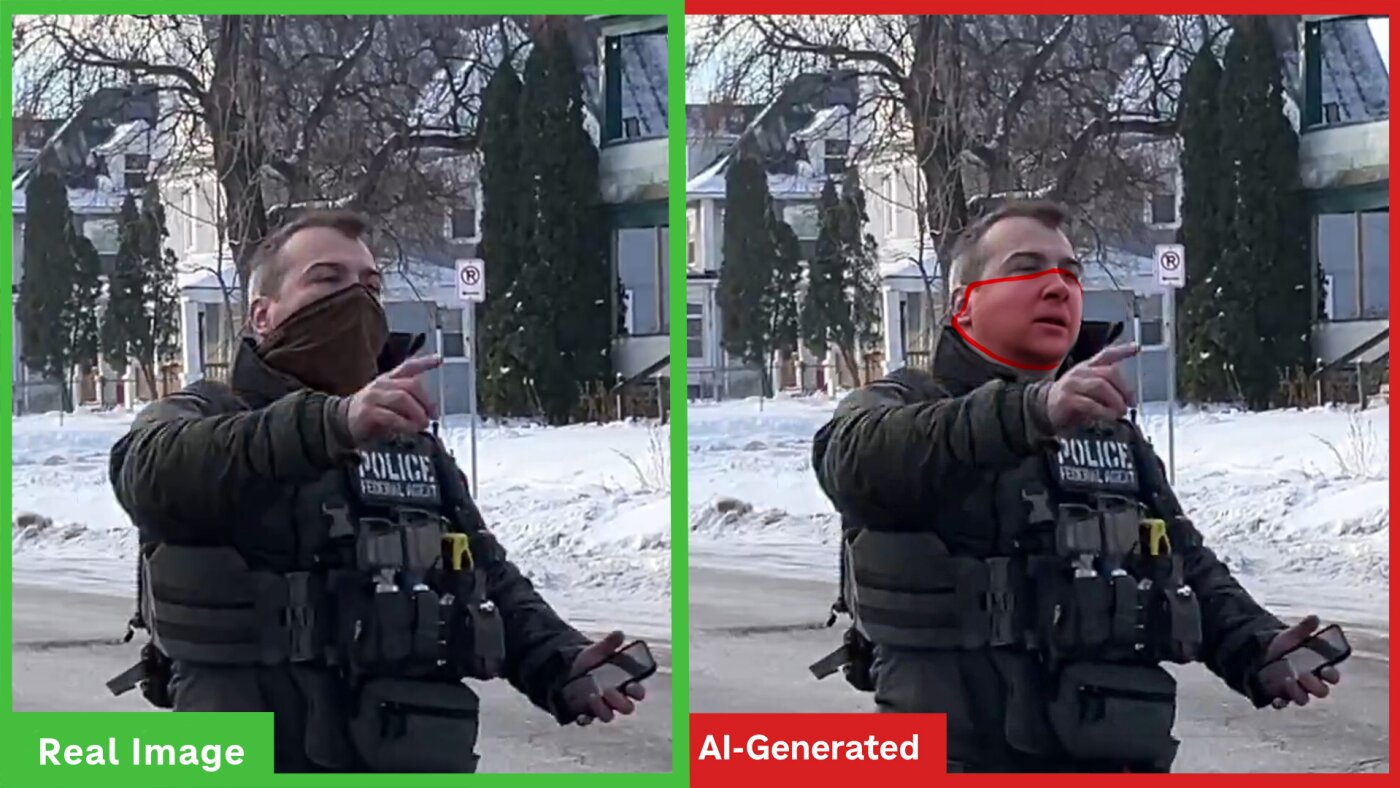
The ICE agent, initially captured masked in eyewitness footage, appeared unmasked in images circulating online. These images are believed to have been generated by the AI chatbot Grok, developed by xAI, after users prompted the bot to “unmask” the agent via social media.
NPR chose to publish both the original and AI-manipulated images to highlight how artificial intelligence is being used to alter real-life evidence. However, experts caution against relying on AI for such purposes, as it may not provide accurate results.
“AI-powered enhancement has a tendency to hallucinate facial details leading to an enhanced image that may be visually clear, but that may also be devoid of reality with respect to biometric identification,” noted Hany Farid, a digital image analysis professor at the University of California, Berkeley, in a statement to NPR.
Despite these warnings, the AI-generated image, attributed to a person named Steve Grove, quickly spread online. By the following day, this led to unwarranted backlash against unrelated individuals sharing that name.
One such individual, Steven Grove, a gun shop owner in Springfield, Missouri, found his Facebook page under attack. “I never go by ‘Steve,'” he explained to the Springfield Daily Citizen. “And then, of course, I’m not in Minnesota. I don’t work for ICE, and I have, you know, 20 inches of hair on my head, but whatever.”
Another person affected was Steve Grove, the publisher of the Minnesota Star Tribune. The media outlet issued a statement addressing what they suspected was a “coordinated online disinformation campaign.”
“We encourage people looking for factual information reported and written by trained journalists, not bots, to follow and subscribe to the Minnesota Star Tribune,” the statement said.
Amidst the misinformation, investigations have confirmed the ICE agent’s name as Jonathan Ross. Court records reveal Ross was previously dragged by a car during a traffic stop in Bloomington, Minnesota, last June.
This article was originally written by www.npr.org