In a significant political maneuver, California voters have taken a decisive step against President Trump’s efforts to influence electoral districts in favor of Republicans ahead of the 2026 midterm elections. This move marks a substantial effort by Democrats to counteract Republican strategies.
The voters in California approved a congressional district map that could potentially secure five additional seats for Democrats in the U.S. House. The ballot included references to Texas, where earlier this year, Trump influenced Republican leaders to redraw districts to favor his party.
Typically, redistricting occurs once every decade following the decennial census. However, Trump has initiated a nationwide redistricting push to maintain the Republican majority in the U.S. House, which currently stands at a narrow margin. This majority is critical for advancing his agenda and shielding him from probes by a Democrat-controlled House.
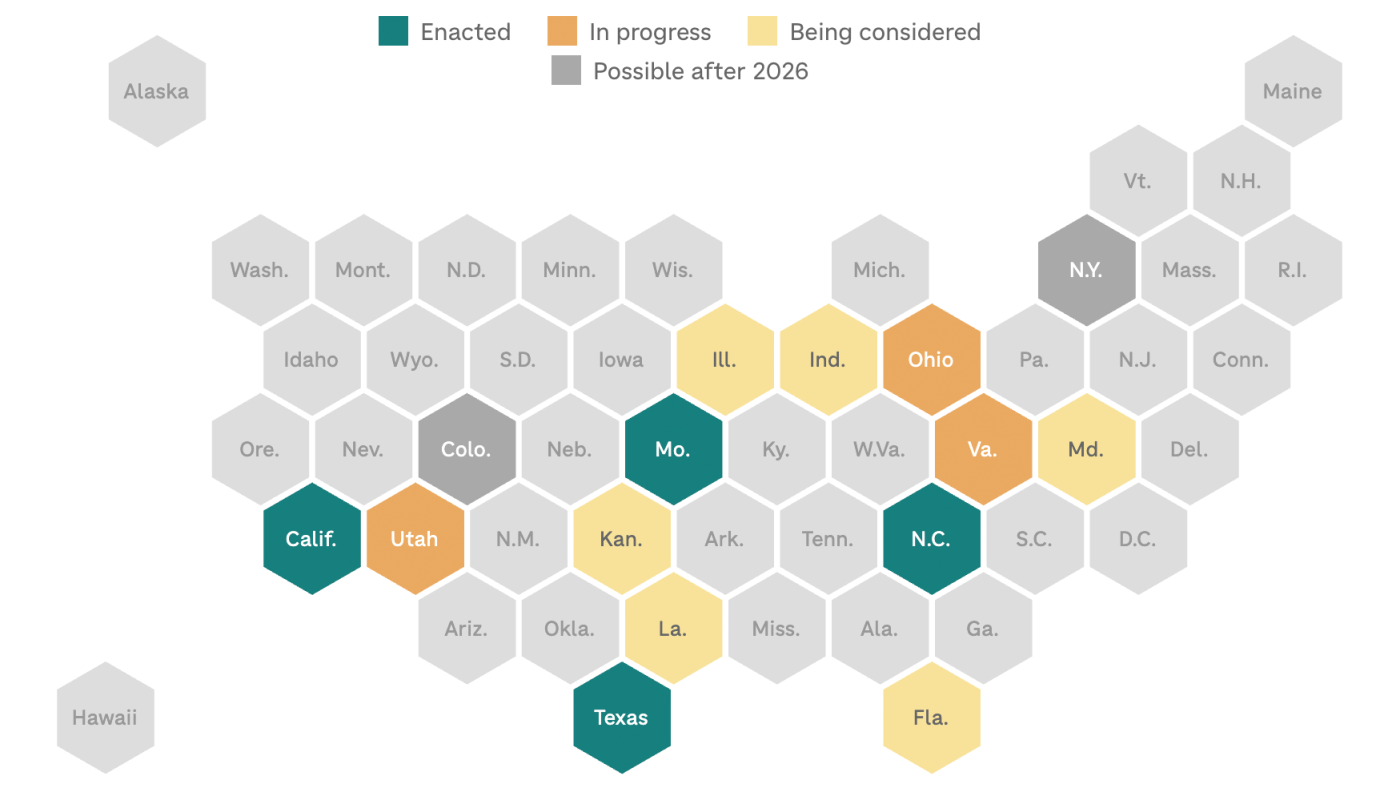
So far, the GOP has gained an edge in five seats in Texas, one in Missouri, one in North Carolina, and a potential net gain of one to two in Ohio.
This could result in the GOP acquiring approximately nine new seats in the upcoming midterms, with additional gains possible if Republicans in states like Indiana, Kansas, Florida, or Louisiana opt to redistrict. However, this scenario is subject to change depending on the outcomes of potential court challenges and other variables.
Meanwhile, Democrats have managed to tilt five seats in their favor in California, with another seat in Utah appearing likely to swing Democratic. In Virginia, Democrats are initiating a redistricting process that could create two or three additional Democratic seats. Maryland and Illinois could each gain one seat, although Democrats have yet to finalize these plans.
How does redistricting work again?
The U.S. House comprises 435 members, each representing approximately 760,000 people. Following the national census every ten years, states redraw district maps based on population changes to determine their allocated seats. The manner in which voter distribution is mapped can significantly influence the number of seats won by Republican or Democratic candidates.
Gerrymandering, where the ruling party manipulates district boundaries to favor a specific party or group, remains legal in many states, potentially weakening voter influence and reducing district competitiveness. This can lead to a more polarized, gridlocked Congress.
While partisan gerrymandering is permissible, it’s illegal to gerrymander in a way that diminishes the voting power of racial groups, often achieved by “cracking” or “packing” communities into districts. Partisan and racial gerrymandering can sometimes overlap.
Trump has lots of places to go for Republican advantages
Trump’s redistricting push comes as Republicans face a challenging trend in the upcoming midterms. Historically, the party in control of the White House loses seats in the U.S. House during midterm elections.
To achieve political gains through redistricting, a party typically needs control over the state legislature, and Republicans hold sway in more states than Democrats. Following Texas’s redistricting, Trump has engaged Republican lawmakers from Indiana and Kansas and has urged action in Florida. Louisiana Republicans are exploring their options.
Some Republicans have hesitated to fulfill Trump’s redistricting ambitions. While Ohio Republicans could enact significant changes when current maps lapse, they have so far agreed to modest changes with Democrats. Kansas Republicans cite insufficient party support to pass redistricting legislation.
Legal challenges may also impact redistricting efforts. A case in Texas is under judicial review, and Republicans have initiated legal proceedings in California. Additionally, a U.S. Supreme Court case could potentially loosen restrictions on racial gerrymandering, which may benefit Republican redistricting efforts.
Aside from California, Democratic-led states are just starting to take steps
Democrats face limited redistricting opportunities, as they control fewer legislatures and often encounter more stringent redistricting restrictions. Some Democratic-led states, like California, utilize redistricting commissions to minimize political influence, necessitating public votes to override these commissions for redistricting purposes.
In other Democratic states, lengthy constitutional or legal processes complicate redistricting. New York cannot complete redistricting in time for the 2026 elections, and Virginia requires additional legislative approval and voter input for redistricting. In Illinois, Democratic Governor JB Pritzker remains undecided on redistricting, given the state’s minimal Republican representation. Maryland, with only one Republican seat, is also under pressure to pursue redistricting.
Critics highlight that some Democratic-majority states, like Massachusetts, have no Republican representation, which they argue exemplifies partisan gerrymandering.
This article was originally written by www.npr.org