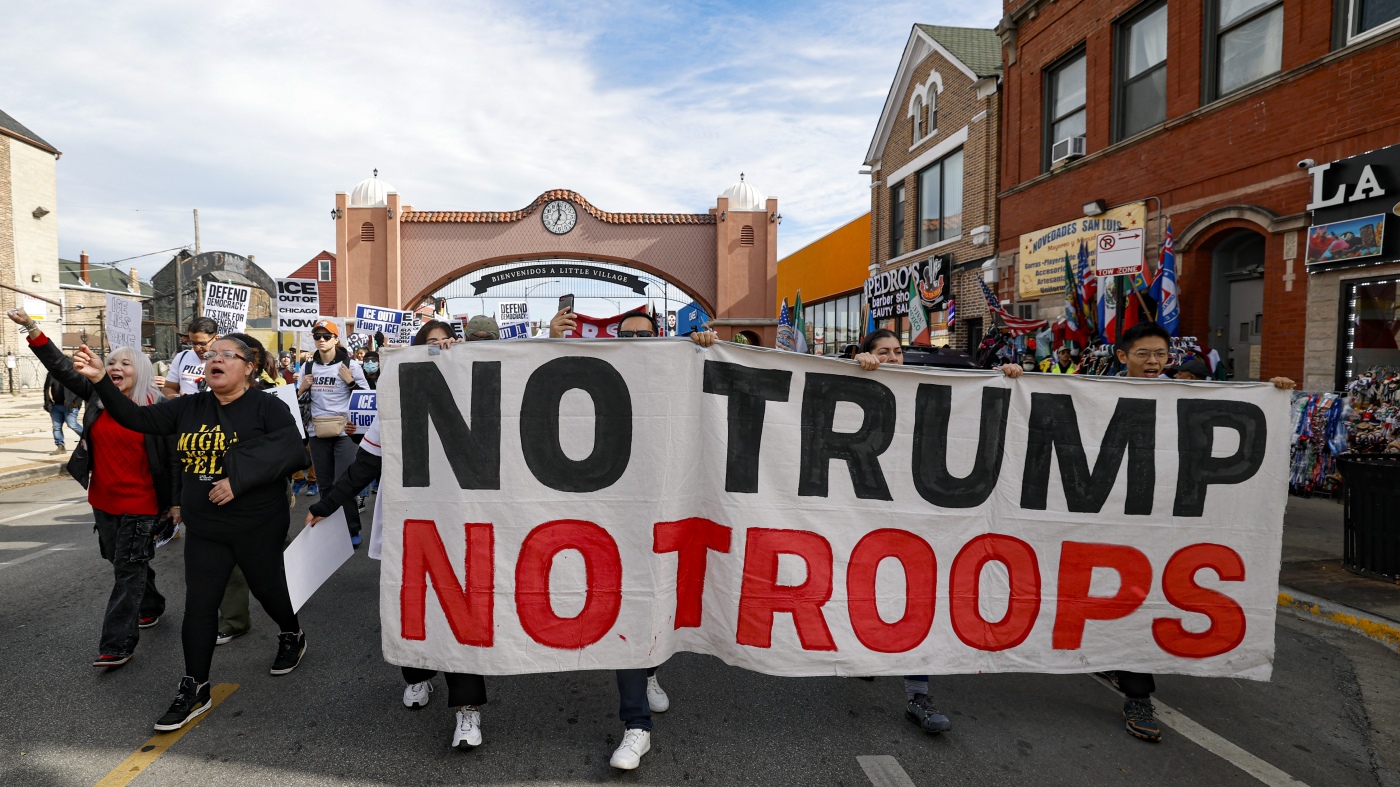

Protesters march against the use of ICE and other federal law enforcement in Chicago on Oct. 25.
Kamil Krzaczynski/AFP via Getty Images
The recent decision by the Defense Department to reduce the number of National Guard troops in Chicago and Portland signifies a shift in response to prolonged legal challenges. These troops had been deployed in response to civil unrest, but legal barriers have stalled their operations.
An anonymous defense official disclosed that 200 National Guard members from California in Oregon, and 200 from Texas in Illinois, are set to return to their states soon. This troop withdrawal was initially reported by ABC News.
In a recent post on X, Northern Command hinted at a strategy to ensure a “constant, enduring, and long-term presence” in these cities.
“Our troops in each city (and others) are trained and ready, and will be employed whenever needed to support law enforcement and keep our citizens safe,” U.S. Northern Command stated.
According to the defense official, the holiday season may have influenced the decision to withdraw the out-of-state troops. While 300 Illinois National Guard members will remain active in Chicago, the Oregon contingent will be downsized to 100.
President Trump has increasingly relied on National Guard deployments over the past six months, citing the need to combat crime, manage protests, and protect federal facilities.
However, state and local officials in Illinois and Oregon have criticized these deployments as excessive, accusing the federal government of overreaching its authority. Legal challenges have repeatedly blocked these troops from operating in Chicago and Portland.
Recently, a federal judge in Oregon permanently blocked troop deployments to Portland, a decision the Trump administration has appealed. Concurrently, the Supreme Court is reviewing an emergency appeal regarding troop deployment in Chicago.
This article was originally written by www.npr.org