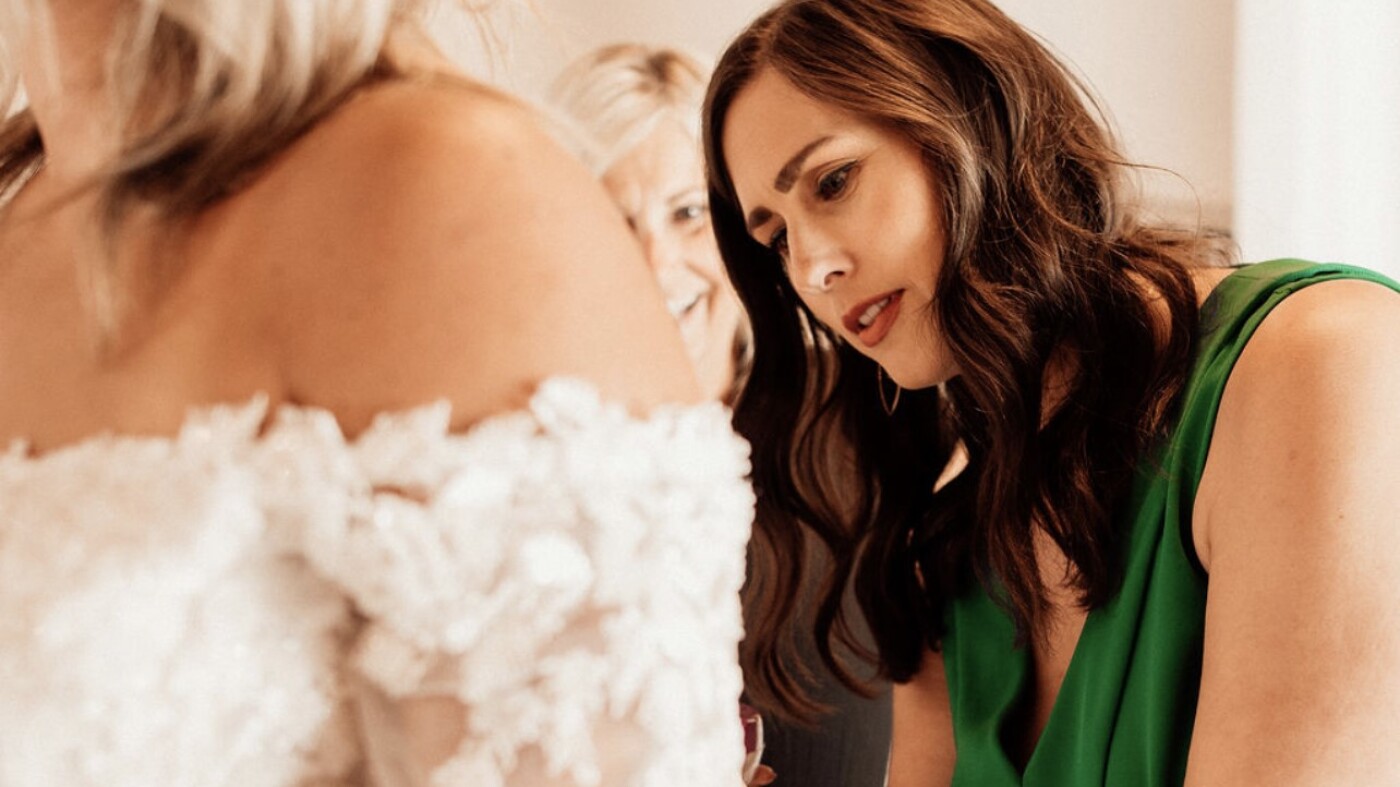

Claire Landgraf helps a bride try on a dress at her shop Finery Bridal Chic in Rochester, Minn.
Becca Haugen/Twelve Ten Photography
hide caption
toggle caption
Becca Haugen/Twelve Ten Photography
In the delicate world of wedding dress shopping, intimate moments can quickly get entangled with global trade policies. Christine Greenberg, co-owner of Urban Set Bride in Richmond, Va., describes how the bridal fitting room has become the latest stage for tariff discussions. She explains, “Talking about money, talking about body image issues,” and the emotional impact of finding the perfect dress.
Despite the desire to keep political discussions out of these personal moments, tariffs have become unavoidable. Most wedding dresses in the U.S. are crafted overseas, predominantly in China, which dominates 90% of the market, according to the National Bridal Retailers Association.
Under the Trump administration, a tariff of 145% was imposed on these dresses, later reduced to 30% until July 9. As discussions continue between the U.S. and China, the financial burden shifts to brides like Jessica Kaplan from Boston, who faced a 10% to 15% surcharge on her gown. “It wasn’t detrimental,” she notes, “but it was definitely a bummer on the day.”
Store owners struggle to budget
Claire Landgraf from Finery Bridal Chic in Rochester, Minn., finds herself in a challenging position. With wedding gowns typically ordered months in advance, anticipating future tariff rates becomes an uncertain task. She worries about imposing additional fees on brides who’ve already reached their budget limits.
The tariffs affect not only dresses but also other bridal essentials like veils, hairpieces, and garment bags. As Greenberg points out, “It adds up very quickly, and we’re a small shop.” Many designers, unable to absorb these costs, have increased their prices, some by as much as 30%.
Double the cost for Made in the USA
Buying a wedding dress made in the USA is a costly affair, often starting at twice the price of imported ones. Despite the push for American manufacturing, the lack of skilled craftsmen makes domestic production unfeasible. As the National Bridal Retailers Association stated, “Unlike other industries, these dresses cannot be made in the United States” due to the absence of skilled labor.
Greenberg, whose father served in the Army, wishes she could stock American-made gowns at affordable prices. However, even major U.S. designers like Maggie Sottero and Allure are advocating for tariff exemptions to prevent business closures.
Saying maybe to the dress
The uncertainty surrounding tariffs has led to hesitation among brides. Landgraf observes more brides making multiple visits before deciding on a gown. The trend is mirrored on social media, where brides share their concerns and explore alternatives, such as custom-made dresses to bypass tariffs.
Tariff-season bride Chelsea Ritchie from Los Angeles considers finding a dressmaker to create her dream gown. Yet, she’s warned of potential surcharges and delays, adding another layer of stress to her wedding planning.
As the industry navigates these financial uncertainties, brides like Ritchie face the challenge of balancing their dream weddings with the realities of a shifting economic landscape.
This article was originally written by www.npr.org