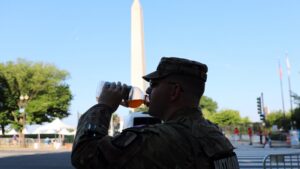
The deployment of National Guard troops across several American cities has sparked controversy, as President Trump’s administration blurs the lines between traditional policing and immigration enforcement. This strategy, which involves National Guard troops assisting with immigration tasks, has raised concerns among local leaders and communities.
President Trump’s decision to deploy the National Guard for immigration enforcement purposes has involved securing federal ICE facilities and, in some instances, protecting ICE agents during raids. Despite the administration’s portrayal of undocumented immigrants as contributors to urban crime, evidence suggests otherwise. NPR’s Sergio Martínez-Beltrán from Chicago and Kat Lonsdorf from D.C. offer insights into this complex situation.
National Guard in Chicago
Sergio Martínez-Beltrán reports from Illinois, where the Texas National Guard, alongside some federalized Illinois guard, is present. However, the troops are not patrolling the streets of Chicago due to a federal court’s temporary block on their deployment. Instead, they have been stationed at an ICE processing facility outside Chicago, an area currently experiencing low activity.
While ICE has initiated a new operation in Chicago claiming it is necessary to combat crime, local leaders dispute this assertion. Chicago’s homicide rate has reached its lowest point since 1965, contradicting the narrative of a crime surge. This conflation of crime and illegal immigration has been a hallmark of Trump’s political strategy, gaining support for his immigration crackdown.
Broader Implications of National Guard Deployments
Kat Lonsdorf highlights the broader pattern of National Guard deployments across various states. In June, Trump federalized California’s National Guard against Governor Gavin Newsom’s wishes, aiming to quell protests related to immigration raids. Similar reasoning applies to Oregon, where the federal court has also halted the Guard’s deployment.
Benjamin Farley from the National Immigration Law Center remarks on the administration’s strategy: “Using the aggressive and sort of brutal approach to immigration enforcement, generating a very expected reaction and then letting that reaction serve as a pretext for the deployment of armed forces.” Federally controlled National Guard units cannot enforce state laws without governors’ consent, limiting their role primarily to federal tasks.
Despite the President’s claims, the National Guard cannot engage in crime fighting alongside local law enforcement. Their legal authority extends only to federal immigration enforcement, as explained by Scott R. Anderson from the Brookings Institution.
Impact on Local Communities
In addition to Chicago, National Guard deployments have occurred in places like Memphis and D.C., where federal agencies have conducted numerous immigration-related arrests. Maria Oceja, a community organizer in Memphis, voices skepticism about the administration’s crime-fighting narrative, asserting that immigrant communities remain wary of the Guard’s presence.
Sergio Martínez-Beltrán shares insights from Chicago residents, including U.S.-born citizens opposing the National Guard’s presence and aggressive tactics. For undocumented immigrants, the fear is palpable, as echoed by Jackson, a Venezuelan immigrant living in Chicago. He describes the anxiety of not knowing whether ICE agents or impersonators are responsible for arrests.
This complex situation continues to unfold, with communities and legal experts closely monitoring the implications of these deployments.
This article was originally written by www.npr.org