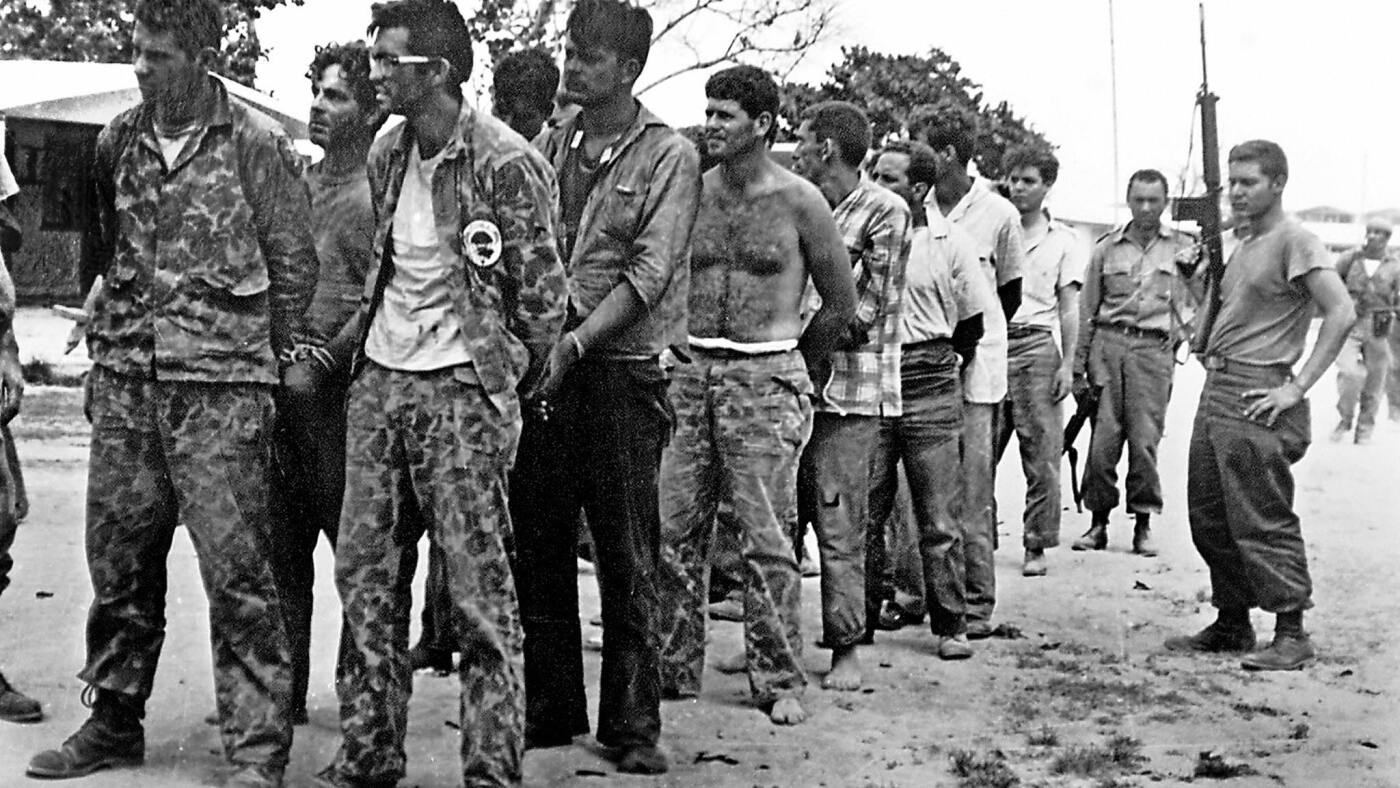

An April 1961 file photo shows a group of CIA-backed Cuban counterrevolutionaries after their capture in the Bay of Pigs, Cuba.
Miguel Vinas/AFP via Getty Images
hide caption
toggle caption
Miguel Vinas/AFP via Getty Images
In a fresh wave of actions, the U.S. government has ramped up pressure on Venezuelan President Nicolás Maduro. This development is part of a long-standing tradition of American intervention in the Caribbean basin, tracing its roots back to the 1823 Monroe Doctrine, which came to full fruition in the 20th century as a means to safeguard U.S. interests and counter communism.

Recent U.S. activities, including strikes on boats allegedly carrying Venezuelan drugs, the seizure of oil tankers, and a CIA strike on a dock in Venezuela, echo the “Big Stick” policy initiated by President Theodore Roosevelt. This doctrine, built upon the Monroe Doctrine, aimed to deter European interference and establish the U.S. as the region’s de facto policeman, employing military force alongside diplomatic pressure.
With the Cuban Revolution and Fidel Castro’s rise to power, U.S. intervention shifted focus to halting the spread of communism. “During the Cold War, intervention was mostly covert. In the 1980s, you begin to see more overt actions,” remarks Eduardo Gamarra, a professor at Florida International University.
Gamarra outlines U.S. policy as one of strategic denial, deterring foreign influence, whether European in the 1800s or Soviet post-World War II.

Historians like Edward Murphy of Michigan State University suggest that U.S. interventions were justified by the Monroe Doctrine to uproot foreign ideologies like communism from the Americas. By the mid-1980s, U.S. policy shifted from Cold War to drug war focus.
American interventions have historically led to unintended outcomes, such as the overthrow of Guatemala’s government in 1954, when a CIA-backed coup ousted President Jacobo Árbenz. This action set a precedent for U.S.-backed authoritarian regimes in the region.

Indigenous women beg in Guatemala in June 2004 in front of a propaganda mural that speaks against U.S. interventions in the region.
Orlando Sierra/AFP via Getty Images
hide caption
toggle caption
Orlando Sierra/AFP via Getty Images
U.S. involvement in the region has often led to complex outcomes. For example, the Bay of Pigs invasion aimed to overthrow Fidel Castro but ended in failure, resulting in a strengthened Cuban-Soviet alliance and the Cuban Missile Crisis.

Fidel Castro’s soldiers at Playa de Giron, Cuba, after thwarting the ill-fated U.S.-backed Bay of Pigs invasion in 1961.
Graf/Getty Images/Hulton Archive
hide caption
toggle caption
Graf/Getty Images/Hulton Archive
Similarly, in the early 1980s, the U.S. invasion of Grenada under President Ronald Reagan demonstrated American resolve against perceived communist expansion in the Caribbean. This intervention ultimately led to a stable political environment in Grenada.
The Nicaraguan Contras, backed by the U.S. despite congressional opposition, mark another example of Cold War interventions. President Reagan’s administration was embroiled in the Iran-Contra affair, a significant political scandal.

U.S. Army Lt. Col. Oliver North, former aide to National Security Adviser John Poindexter, is sworn in on July 7, 1987, before the House and Senate Foreign Affairs Committee hearing in Washington, D.C., on arms sales to Iran and diversion of profits to Nicaraguan Contra rebels.
Chris Wilkins/AFP via Getty Images
hide caption
toggle caption
Chris Wilkins/AFP via Getty Images
In Panama, 1989 saw the U.S. oust Gen. Manuel Noriega, a former ally turned liability due to his drug trafficking activities. This intervention is often cited as a successful American operation, leading to a stable democracy in Panama.
Through these interventions, U.S. policy has sought to shape the political landscape of Latin America, often with mixed results, and continues to influence the region’s current dynamics.
This article was originally written by www.npr.org