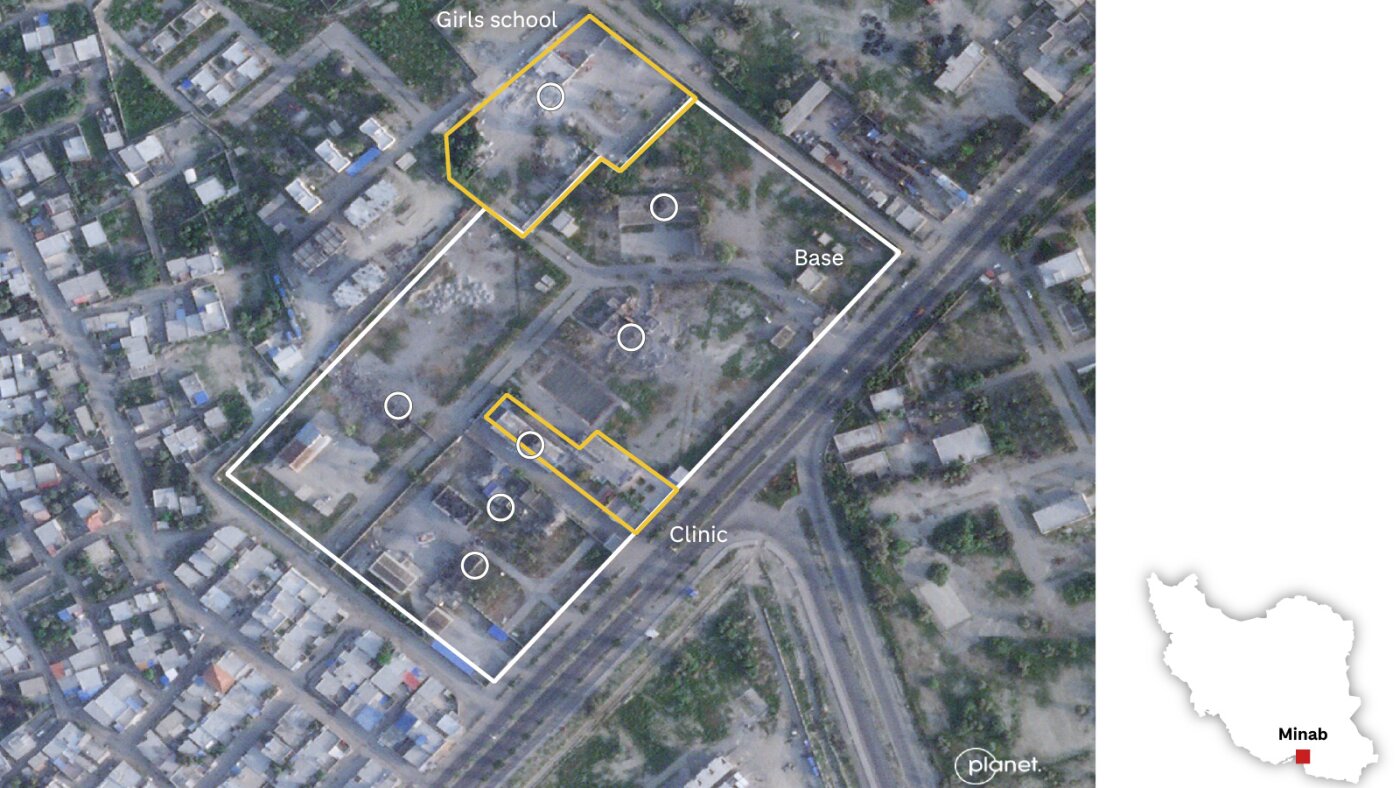
Recent developments have shed new light on a tragic airstrike in southeastern Iran, which resulted in the deaths of approximately 165 individuals, predominantly schoolgirls. A detailed analysis of commercial satellite imagery by NPR reveals that the bombing of an Iranian elementary school was part of a broader assault, targeting not just the school but also nearby structures.
The satellite images, provided by Planet, suggest that the school was unintentionally hit during a precision airstrike aimed at an adjacent Iranian military facility. The evidence points to the possibility that outdated targeting data played a role in the school’s destruction.
Located in the city of Minab, the images also reveal that a health clinic and other nearby buildings were damaged. This analysis was corroborated by three independent experts.
“The strike points ‘look like pretty clean detonation centroids,'” commented Corey Scher, postdoctoral researcher at the Conflict Ecology laboratory at Oregon State University. Scher’s colleague, associate professor Jamon Van Den Hoek, concurred, noting the sites appeared to be detonation points.
Jeffrey Lewis, a professor at Middlebury College and a specialist in satellite imagery, affirmed that the images indicated a precision airstrike, with almost all buildings within the compound being targeted. “The images show ‘very precise targeting,'” Lewis stated to NPR.

A satellite image of an Iranian Revolutionary Guard compound taken on March 4, several days after an airstrike destroyed a school on the edge of the compound. The image reveals that half a dozen other buildings in addition to the school were struck.Planet Labs PBC
Planet Labs PBC
Reports from Iranian state media confirm the death toll of 165, noting that the school was positioned less than 100 yards from an Iranian Revolutionary Guard naval base. Although the school and clinic were within the base’s perimeter, both had been separated by walls.
In response to the incident, Israel has denied any involvement. “We are not aware at the moment of any IDF operation in that area,” said Nadav Shoshani, an Israeli Defense Forces spokesperson, in an interview with NPR.
During a press conference, U.S. Defense Secretary Pete Hegseth commented, “All I know, all I can say, is that we’re investigating that,” emphasizing the U.S. policy of avoiding civilian targets.
Due to Minab’s geographic location, some experts, including Lewis, speculate that the U.S. might be more likely responsible for the strike than Israel, citing the type of munitions and geography as factors.
Esmail Baghaei, spokesperson for Iran’s Foreign Ministry, asserted that the strike was “deliberate,” accusing the U.S. and Israel of intending to divert Iranian forces through rescue operations.
However, Lewis argues that an error is more plausible, given that the school and clinic were formerly part of the military base. Changes to their status were made between 2013-2016 and 2022-2024, respectively.
He added, “It’s possible that the target didn’t get updated,” highlighting the complexity of maintaining accurate target data in military operations.
The Pentagon has yet to provide further information following NPR’s request for comments on the strike.
NPR’s Arezou Rezvani and the NPR RAD team contributed to this report.
This article was originally written by www.npr.org