St. Paul Students Return to School Amid Lingering Immigration Concerns
In St. Paul, Minnesota, students are stepping back into classrooms after an extended period of remote learning, facing an atmosphere still charged with anxiety due to recent immigration enforcement actions. At a Spanish immersion school, the return is bittersweet as many grapple with the aftermath of heightened immigration raids.

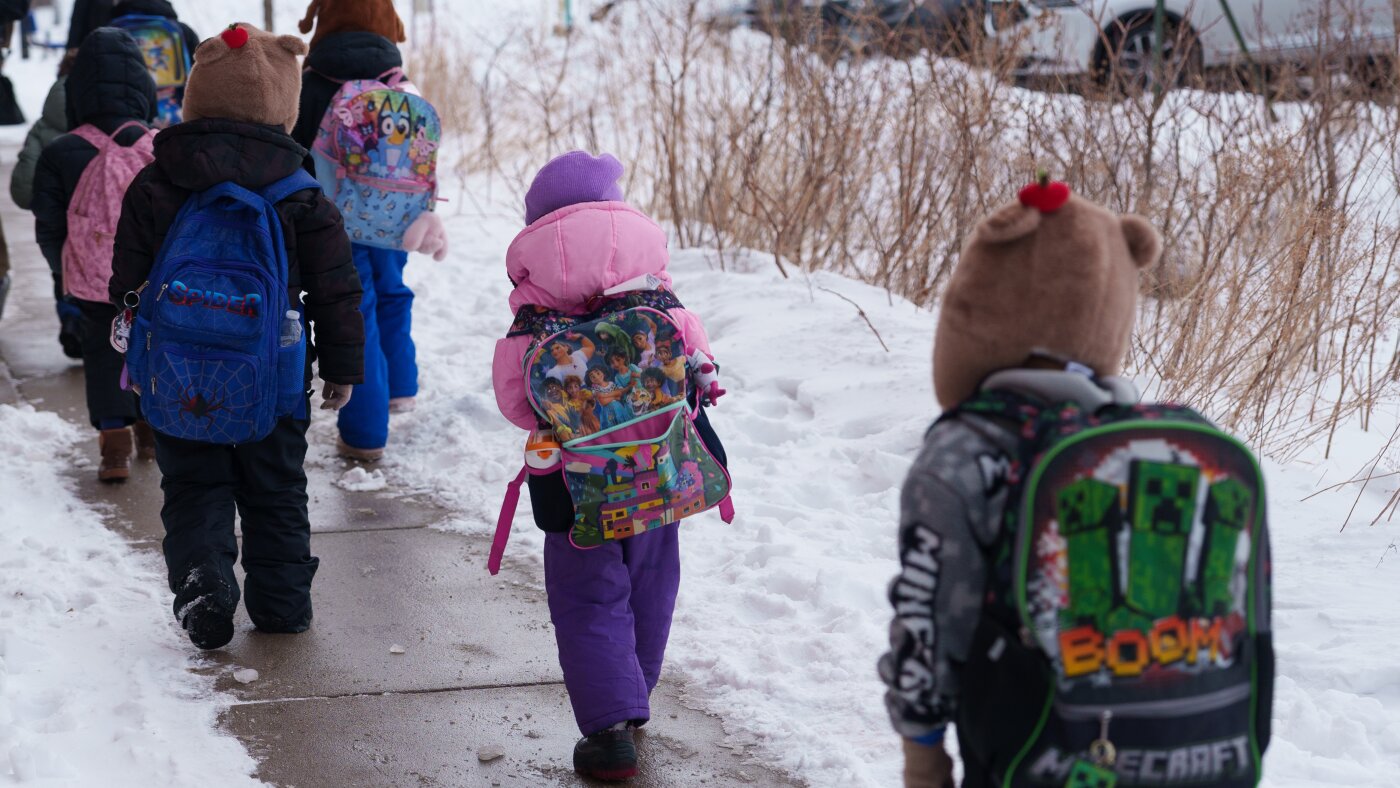
Students walk from the bus to their elementary school in St. Paul, Minn., on March 18. For many students, it was the first week back after nearly two months of online learning. Tim Evans for NPR
Finding Lessons in Literature
In a classroom setting that feels both familiar and foreign, fifth graders at the school immerse themselves in the classic tale of Don Quixote, guided by their teacher, Ms. A. Amidst flags representing Latin American countries, students explore themes of chivalry and imagination.
Ms. A encourages them to consider the notion of “enchantment,” prompting one student to describe it as akin to magic. The lesson goes beyond the literal, as Ms. A aims to connect the narrative to their own experiences.
“With Don Quixote, it’s like seeing how this knight, it’s not just that he is crazy and out of his mind, but also that he just wants to do good in the world,” she says.

Ms. A, a teacher at the elementary school, stands for a portrait in her classroom in St. Paul, Minn., on March 18. She says she wants to create a space for students to feel safe and loved. Tim Evans for NPR
Amid the backdrop of ICE operations, Ms. A strives to offer her students a semblance of normalcy, aiming to help them process recent events. “You can’t always fix the world’s problems, but you can try to help others,” she explains, hoping her students internalize this message.
Community Response and Lingering Fears
The community has been deeply impacted by the immigration operations, with many families choosing to relocate to perceived safer areas. The school itself had to adapt by offering a virtual learning option, which saw a significant uptake.
The psychological impact on students was evident. “In person, they would talk and participate and ask questions and all of that. They went online and they didn’t say a word,” Ms. A notes.
Hopewell Hodges, a researcher at the University of Minnesota, emphasizes the importance of stable environments for children’s development. “The young ones are often developmentally bearing the brunt of conflicts and tensions and stresses that originate in the adult world,” she says.

Amanda, the principal of the elementary school, sits for a portrait in her office in St. Paul, Minn., on March 18. She says many students are coming to school with heightened anxiety in the aftermath of the ICE surge. Tim Evans for NPR
Principal Amanda notes the anxiety levels among students. “They are fearful that their parents are going to be taken while they are in school,” she says. Despite the return to in-person learning, the presence of ICE remains a source of concern.
As a precaution, community members guard the school grounds, and a classroom is repurposed as a hub for distributing essential supplies to families in need.
Katherine, a parent volunteer, underscores the community’s commitment: “It’s the right thing to do. I mean, it’s our community. These are our friends, our neighbors. And they need help. So we help.”

Signage bars federal immigration agents from entering the elementary school without a judicial warrant. Tim Evans for NPR
Amidst these challenges, students like Camila, who recently returned to in-person learning, find solace in the presence of friends. “It felt good because I got to see my friends again,” she shares, highlighting the importance of peer support.
As the school community navigates these uncertain times, efforts to foster a sense of security and belonging continue, with Ms. A and others dedicated to making the classroom a refuge of normalcy and support.
This article was originally written by www.npr.org