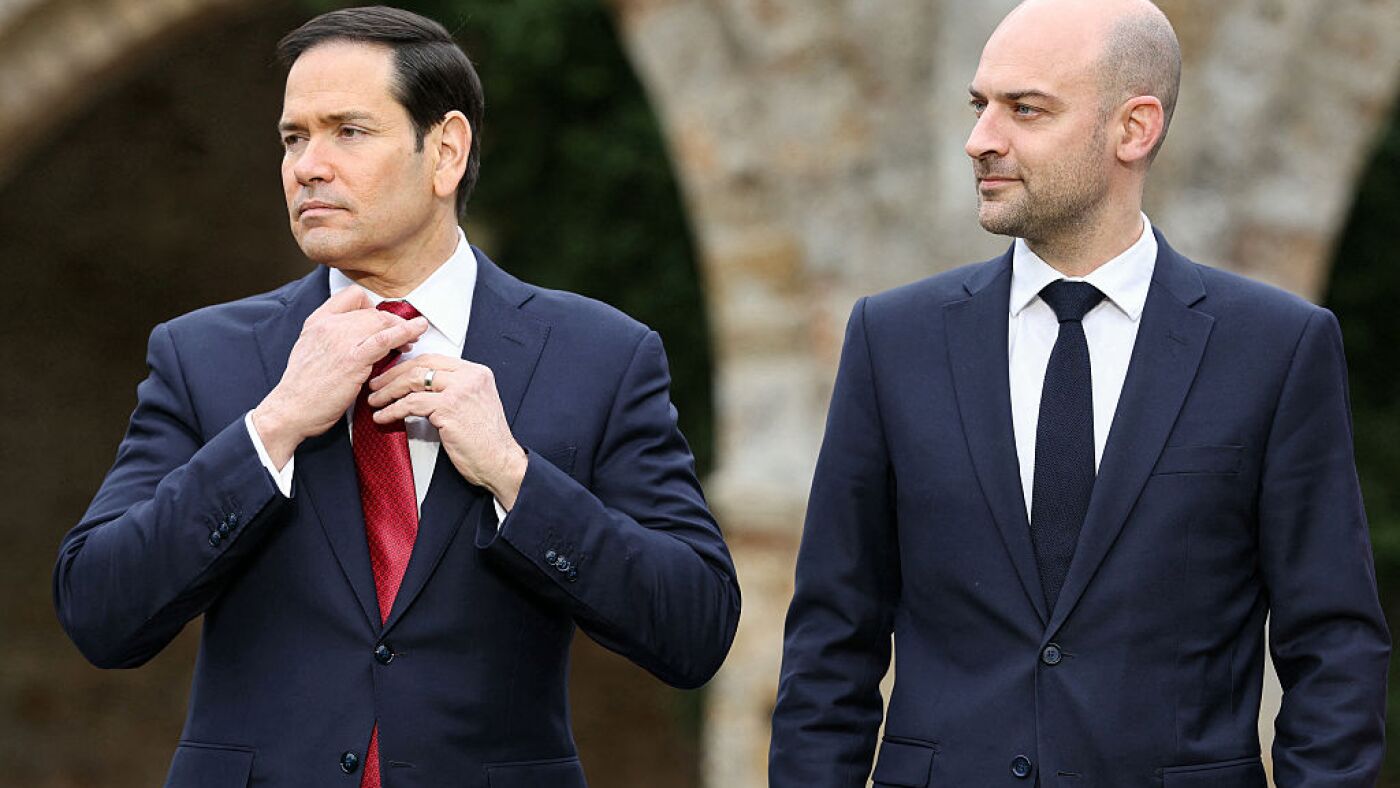

US Secretary of State Marco Rubio (L) and France’s Foreign Affairs Minister Jean-Noel Barrot pose for a family photo during a G7 Foreign Ministers’ meeting at the Vaux-de-Cernay Abbey in Cernay-la-Ville outside Paris, on March 27, 2026.
Alain Jocard/AFP via Getty Images
Alain Jocard/AFP via Getty Images
Amid escalating tensions, G7 leaders convene in France to tackle global security challenges. U.S. Secretary of State Marco Rubio aims to rally support for the Trump administration’s aggressive stance on Iran.
The meeting occurs shortly after President Trump’s ultimatum to Iran, demanding the reopening of the Strait of Hormuz with a deadline set for April 6, or face severe consequences.
“Talks are ongoing and, despite erroneous statements to the contrary by the Fake News Media, and others, they are going very well,” Trump stated.
Rubio’s diplomatic mission follows Trump’s rebuke of NATO, criticizing the alliance for not supporting the U.S. in its efforts to reopen the vital Strait of Hormuz, which has been obstructed by Iran.
Trump’s warning to NATO, declaring the U.S. would “never forget” its lack of assistance, highlights the strained transatlantic relations.
European nations, caught off guard by Trump’s Iran strategy, express reluctance to engage in a potential prolonged conflict. Germany’s defense minister criticized the lack of a clear exit strategy from Washington.

Iranian women mourn during a funeral for victims of the Middle East war at the Behesht Zahra cemetery in southern Tehran on March 26, 2026.
AFP via Getty Images
AFP via Getty Images
Updates from the conflict’s 28th day reveal ongoing developments in the Middle East.
To explore specific coverage areas, follow the links below:
G7 meeting | Zelenskyy in Middle East | Attacks continue | Global economy
Iran to dominate G7 meet
Foreign ministers from the UK, France, Germany, Italy, Japan, Canada, and the EU convene in France.
The aim is to bridge the widening gap between the Trump administration and its Western allies. Rubio urged nations to “step up” against the Strait of Hormuz blockade.
“Very little of our energy comes through the Strait of Hormuz. It’s the world that has a great interest in that, so they should step up and deal with it,” Rubio conveyed before traveling to Europe.

(From L) Ukraine’s Foreign Minister Andriy Sybiga, Germany’s Foreign Minister Johann Wadephul, Britain’s Foreign Secretary Yvette Cooper, US Secretary of State Marco Rubio, France’s Foreign Affairs Minister Jean-Noel Barrot, Canada’s Foreign Minister Anita Anand, Italy’s Foreign Minister Antonio Tajani, Japan’s Foreign minister Toshimitsu Motegi and EU High Representative and Vice-President for Foreign Affairs and Security Policy Kaja Kallas pose for a family picture during a G7 Foreign Ministers’ meeting at the Vaux-de-Cernay Abbey in Cernay-la-Ville outside Paris, on March 27, 2026.
Alain Jocard/AFP via Getty Images
Alain Jocard/AFP via Getty Images
Kaja Kallas, the EU’s foreign policy chief, emphasized the need for de-escalation in the Middle East, noting the war’s widespread impact.
She highlighted that “at the same time, we can’t overlook Ukraine,” acknowledging the interconnectedness of the conflicts.
As Europe manages Russia’s aggressive actions in Ukraine, the U.S. has distanced itself from peace talks. Meanwhile, Russia launched one of its largest drone attacks on Ukraine.
Zelenskyy in Middle East
Ukrainian President Volodymyr Zelenskyy’s unexpected visit to Saudi Arabia underscores Ukraine’s drone expertise and its potential benefits for Gulf nations.
“Important meetings are scheduled. We appreciate the support of those who are ready to work with us to ensure security, and we support them too,” he stated on X.
In a video message, Zelenskyy emphasized Ukraine’s experience in integrating drones with defense systems.
He told Le Monde that he seeks Middle Eastern support in exchange for bolstering Ukraine’s defense capabilities.
Attacks continue on all fronts
Despite Trump’s claims of progress in negotiations with Iran, military actions persist, with Pakistan mediating talks. The IDF reported strikes on Iranian missile production sites.

Israeli soldiers grieve during the funeral of Staff sergeant Ori Greenberg, 21, at the Mount Herzl military cemetery in Jerusalem on March 26, 2026.
Odd Andersen/AFP via Getty Images
Odd Andersen/AFP via Getty Images
The IDF declared successful strikes on Iranian infrastructure and weapon production sites, focusing on ballistic missile facilities.
Additionally, the Israeli Air Force targeted Iranian fire arrays, including missile storage sites, in Western Iran.
In Lebanon, the Israeli military issued evacuation orders as they advanced against Hezbollah.
Concurrently, Israel faced missile attacks from Iran.

A Hezbollah flag is seen in a destroyed car after an Israeli airstrike in Nabi Chit (Al-Nabi Shayth), Lebanon, on March 26, 2026.
Fabio Bucciarelli/Middle East Images/AFP via Getty
Fabio Bucciarelli/Middle East Images/AFP via Getty
Gulf states also experienced collateral damage. Iran’s Revolutionary Guard attacked U.S. bases in the UAE, Bahrain, and Kuwait using missiles and drones.
Kuwait reported drone attacks on its port, Bahrain activated sirens, and Qatar briefly heightened security alerts.
Global economy hit hard
The conflict and Iran’s blockade of the Strait of Hormuz, a crucial oil passage, raise global economic concerns.
Wall Street faced its largest single-day decline since the conflict began, as oil prices surged. Asian markets also saw declines.
Asian countries reliant on the Strait for energy are implementing contingency plans. Japan plans to lift coal-fired plant restrictions, and Vietnam waived an environmental fuel tax to lower petrol prices.
The Philippines declared an energy emergency, prompting transport worker protests.
Finland’s President Alexander Stubb warned in Politico that the Iran war could lead to a global recession, surpassing the economic impact of the COVID-19 pandemic.
Contributions to this report were made by Eleanor Beardsley in Paris, Emily Feng in Van, Turkey, Michael Sullivan in Chiang Rai, Thailand, and Kate Bartlett in Johannesburg.
This article was originally written by www.npr.org