After an epic voyage that pushed the boundaries of human space travel, the Artemis II mission has successfully concluded with the safe return of its astronaut crew. This mission not only took them around the moon but also positioned them farther from Earth than any prior crewed mission.

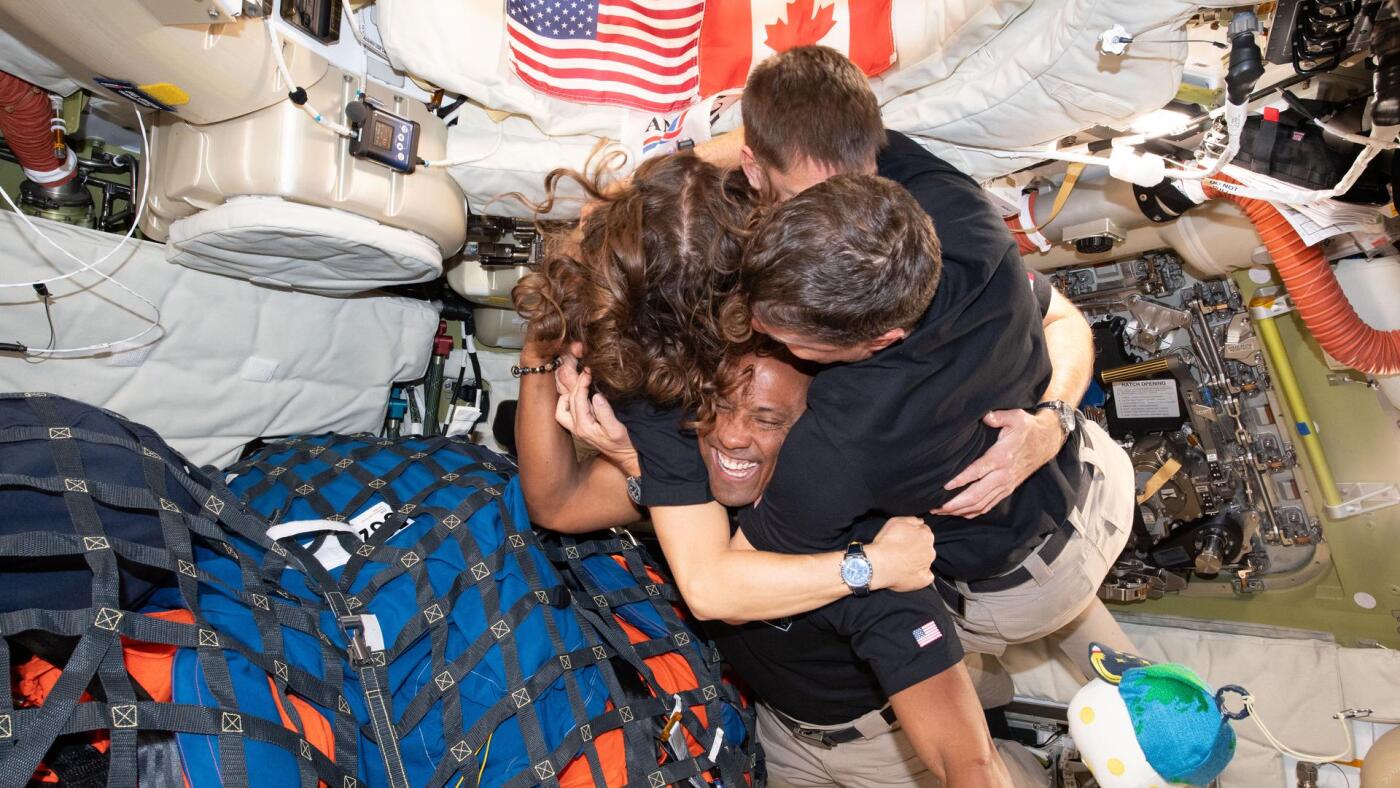
The Artemis II astronauts share a group hug aboard the Orion capsule.
The crew, composed of NASA astronauts Reid Wiseman, Victor Glover, Christina Koch, and Canadian Space Agency astronaut Jeremy Hansen, safely splashed down in the Pacific Ocean near San Diego at 8:07 p.m. on Friday. The USS John P. Murtha was on standby to aid in their recovery.
Navigating the return to Earth required the Orion capsule to endure extreme conditions, including temperatures reaching approximately 5,000 degrees Fahrenheit. The spacecraft had to decelerate from speeds of nearly 25,000 miles per hour, equivalent to over 30 times the speed of sound, to a manageable 19 mph before making contact with the ocean.
Describing the re-entry, Victor Glover, a NASA astronaut on the Artemis II crew, likened it to “riding a fireball through the atmosphere.” Despite the challenge, Glover emphasized its importance, stating, “We have to get back. There’s so much data that you’ve seen already, but all the good stuff is coming back with us.”
On their journey, the astronauts circled the moon on April 6, capturing photographs and conducting observations of the lunar surface. The data collected during this mission will be analyzed by teams on the ground.
Contributors to this report include Nell Greenfieldboyce and Brendan Byrne from Central Florida Public Media.
This article was originally written by www.npr.org