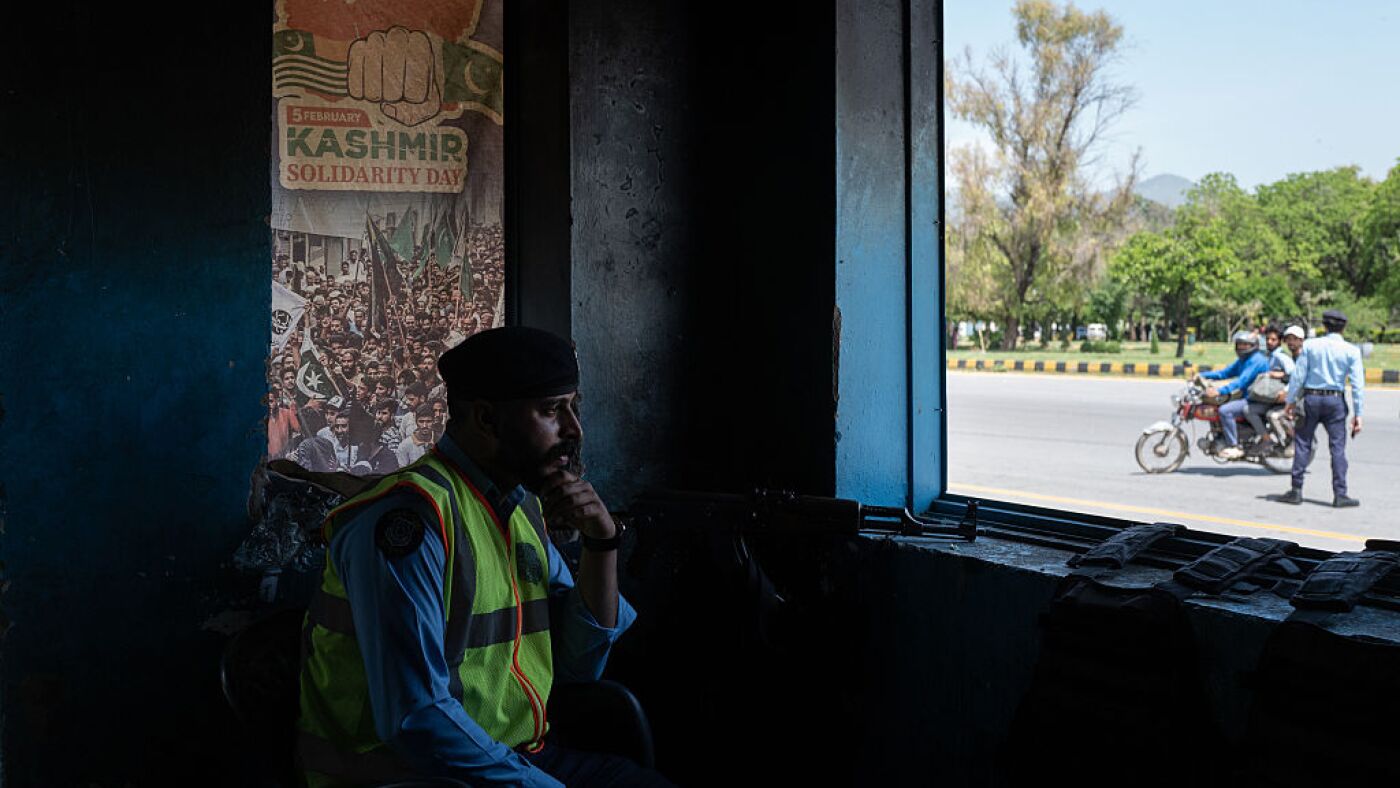

A member of Pakistani security personnel looks over a checkpoint from a police booth amid heightened security ahead of a potential meeting between U.S. and Iranian officials in Islamabad, on Monday.
Rebecca Conway/Getty Images
hide caption
toggle caption
Rebecca Conway/Getty Images
The diplomatic landscape in Islamabad could soon witness significant developments as Vice President Vance is poised to arrive for a crucial meeting with Iranian officials. This visit comes as a two-week ceasefire between the U.S. and Iran approaches its end.
However, the path to diplomacy remains uncertain. According to Iranian state media, there have been no confirmed Iranian delegations heading to Islamabad “so far.” President Trump, speaking with CNBC, emphasized that he does not want an extension of the ceasefire.
Trump further stated to Bloomberg News that the ceasefire is set to expire on Wednesday evening Eastern time.
Iran’s chief negotiator, Mohammad Bagher Qalibaf, accused the U.S. of coercion, noting Iran’s preparations to “reveal new cards on the battlefield” and declaring on social media, “We do not accept negotiations under the shadow of threats.”

Representatives from more than a dozen foreign diplomatic missions, United Nations offices and the media view damage at sites previously targeted by U.S.-Israeli strikes in Tehran, Iran, on Monday.
Majid Saeedi/Getty Images
hide caption
toggle caption
Majid Saeedi/Getty Images
Islamabad remains prepared to host the talks, though there has been no formal indication from Pakistan’s government on the progress of its mediation efforts. The initial round of discussions a week ago concluded without a consensus, with Vice President Vance blaming Iran for not accepting U.S. conditions on nuclear enrichment plans.
What is the U.S. asking Iran to do?
The U.S. demands primarily focus on control over the Strait of Hormuz and the future of Iran’s nuclear capabilities. The Trump administration seeks the restoration of commercial shipping through this vital waterway, which sees approximately 20% of the world’s crude oil and natural gas transit.
Since the war’s onset on February 28, Iran has leveraged control over the strait, imposing tolls on commercial vessels as a condition for reopening. Mark Freeman, from the Institute for Integrated Transitions, noted that “the weaker party gains just by virtue of entering into a negotiation process,” during a conversation with NPR.
The disruption of the Strait of Hormuz has impacted global markets, with gas prices in the U.S. rising above $4 per gallon. Additionally, Washington insists on limitations to Iran’s nuclear program, demanding Tehran’s acceptance of constraints on nuclear enrichment.
In a conversation on The John Fredericks Show, President Trump asserted Iran would return to negotiations, yet emphasized the nation “will not have a nuclear weapon.” He added, “They’re going to negotiate. And if they don’t, they’re going to see problems like they’ve never seen before.”

A commercial vessel is seen off the coast of Dubai, United Arab Emirates, on Monday.
AFP via Getty Images
hide caption
toggle caption
AFP via Getty Images
Trump has reiterated that a key objective of the conflict with Iran is to prevent Tehran from acquiring nuclear weapons. In a previous interview, he claimed Iran was “going to attack first” without citing specific intelligence.
Vice President Vance explained the breakdown of the first ceasefire talks, citing Iran’s unwillingness to forgo nuclear arms aspirations. He stressed, “The simple fact is that we need to see an affirmative commitment that they will not seek a nuclear weapon, and they will not seek the tools that would enable them to quickly achieve a nuclear weapon.”
For Iran, Lebanon and end to U.S. blockade remain key demands
For Tehran, the extension of the ceasefire hinges on the cessation of the U.S. naval blockade on Iranian ports and assurances that the conflict between Israel and Hezbollah will not resume.
Recently, Israel and Lebanon agreed on a 10-day ceasefire to halt hostilities between Israel’s military and the Iranian-backed Hezbollah. This ceasefire continues to hold.

Mourners carry the flag-draped caskets of members of the Iran-backed militant group Hezbollah who were killed in southern Lebanon during their funeral in the Kafaat area, in Beirut’s southern suburbs, on Monday.
Fadel Itani/AFP via Getty Images
hide caption
toggle caption
Fadel Itani/AFP via Getty Images
Iran had previously refused additional negotiations unless Israel ceased its attacks on Hezbollah in Lebanon. Meanwhile, Israel has resolved to maintain its military presence in southern Lebanon, while Hezbollah insists on the Lebanese people’s “right to resist” Israeli forces.
The conflict between Israel and Hezbollah erupted shortly after the commencement of the war on February 28, with Hezbollah launching rockets into northern Israel as a sign of support for Tehran. Israel’s military responded with airstrikes and a ground invasion of southern Lebanon, creating a “buffer zone” to mitigate Hezbollah threats to Israeli border communities.
As a result of Israeli strikes, over 2,300 people have died, and more than a million have been displaced in Lebanon. In contrast, Hezbollah’s actions have resulted in the deaths of 12 Israeli soldiers and two civilians, according to Israeli reports.
Iran views the lifting of the U.S. blockade of its ports as a prerequisite for further diplomatic engagement. After the initial ceasefire talks, the U.S. military initiated a blockade of Iranian ports, aiming to pressure Iran into reopening the Strait of Hormuz and curbing its war efforts. The U.S. has turned back 27 ships since the blockade’s inception. However, Lloyd’s List reports the movements of “shadow fleet” vessels in and out of Iranian ports.
Iran briefly reopened the key shipping route before reinstating control over the strait, citing the ongoing U.S. blockade as the cause. Additionally, Iran has signaled a desire for financial relief, including access to $6 billion in frozen assets, and has expressed reluctance to negotiate while under U.S. military and economic pressure.
Rebecca Rosman contributed to this report from London.