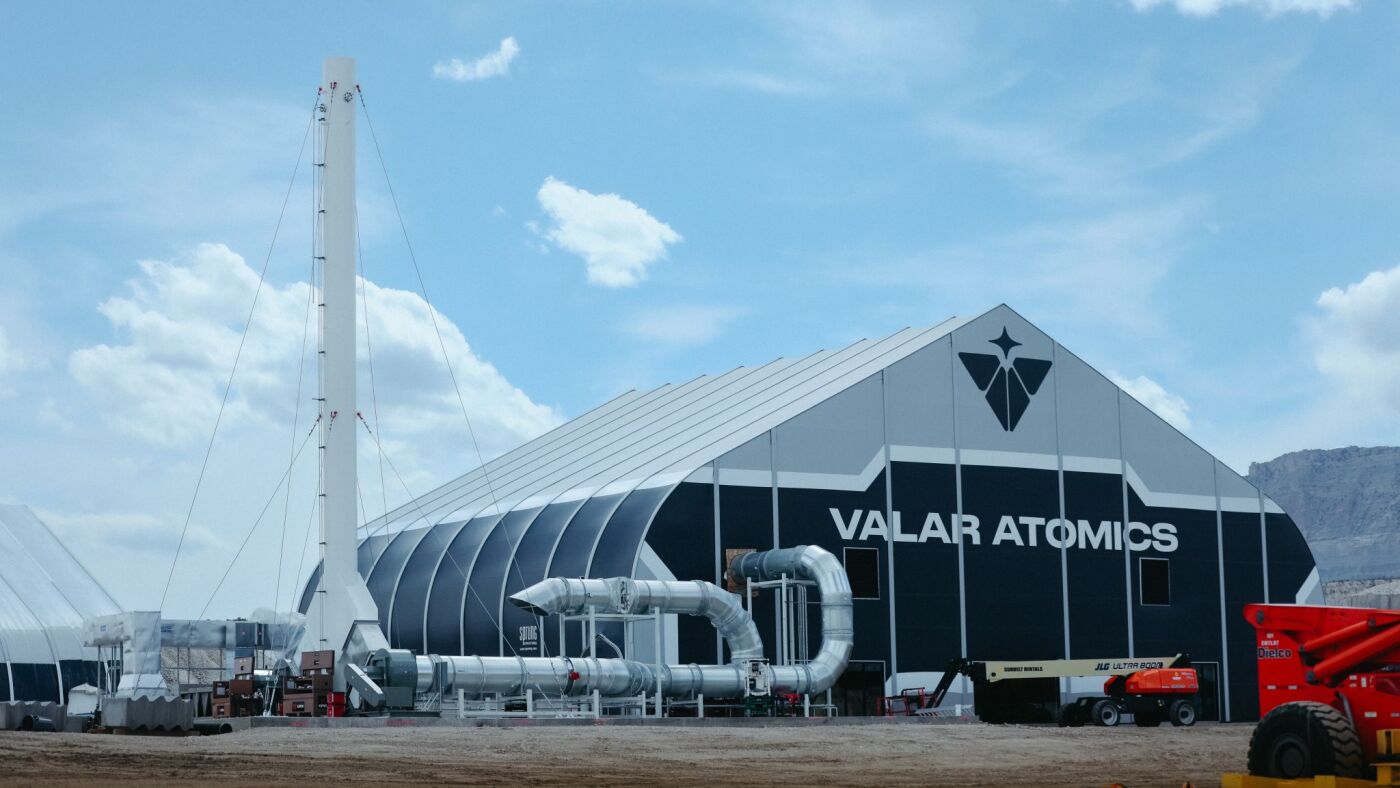

Valar Atomics was one of the first companies to bring its new nuclear reactor online. It built its experimental design in a tentlike structure in the Utah desert, and on June 18 it went critical (nuclear-speak for switched on). Valar Atomics hide caption
toggle caption
Valar Atomics
In a bold move, President Trump aimed to revolutionize the nuclear sector with a target for American firms to construct at least three experimental nuclear reactors by 2026. This initiative, unveiled through an executive order, led to the introduction of the Department of Energy’s Reactor Pilot Program. This program was designed to expedite the development of test reactors by significantly reducing regulations.
This initiative has led to a competitive surge in the nuclear industry, with two companies already achieving the milestone of reactor activation, or “going critical,” ahead of the deadline.

Antares Nuclear revealed on June 4 that its reactor had gone critical, while Valar Atomics announced its success on June 18. The latter’s reactor, situated in the Utah desert, is currently generating tens of kilowatts of heat.
As the deadline approaches, other companies are also closing in on the goal, marking a swift progression within the industry.
“We haven’t done anything this fast, basically ever,” remarked Nick Touran, chief nuclear officer at Ocean Atomics, a company keen on introducing nuclear power to civilian vessels. Although not part of the program, Touran has been closely monitoring its progress.
Touran believes this pilot initiative could significantly boost the nuclear industry in the United States.

President Trump displays an executive order regarding nuclear reactor testing in the Oval Office of the White House on May 23, 2025. The executive order stipulates that the president hopes to see reactors online by July 4 of this year. Evan Vucci/AP hide caption
toggle caption
Evan Vucci/AP
“I’m just excited that we’re now actually building these little reactors and trying it out and we’re going to look at what the economic story is and find out if there’s a market,” Touran said. “It’s going to be so much better than sitting there talking about it like we did for the last 40 years.”
Yet, the rapid pace of development has raised concerns. Edwin Lyman, director of nuclear power safety at the Union of Concerned Scientists, described the initiative as “essentially an exercise in public relations,” and criticized the reduction of regulations, suggesting it dismantles decades of safety advancements.
“This is taking us back to the 1950s, and that is not progress,” he stated.
Building the Core
Activity is bustling at the Department of Energy’s Idaho National Laboratory, where several firms have established operations. Radiant is one such company, aiming to create compact reactors for various applications. Rita Baranwal, the firm’s chief nuclear officer, mentioned their reactor assembly inside the DOME, a specialized secure facility.
“By July 4, we’re tracking to get the reactor into DOME and to initiate the testing,” Baranwal mentioned to NPR. She noted that while Radiant’s reactor might not go critical by the deadline, full operations are anticipated soon. “The only thing we will not be doing at [Idaho National Laboratory] this summer is generating electricity,” she stated.
Radiant’s reactor differs significantly from existing large reactors, utilizing small nuclear fuel balls akin to “gobstoppers,” allowing for higher temperatures and reduced meltdown risks. The company plans to manufacture numerous compact, mobile reactors using this innovative fuel.
“We have broken ground on our factory to mass-produce reactors. We’re targeting around 50 per year,” she added. (Currently, 96 reactors are operational across the U.S.).

Aalo Atomics’ Critical Test Reactor stands inside the company’s facility in Idaho Falls, Idaho. The reactor will test the nuclear core of what the company hopes will eventually be a 10-megawatt sodium-cooled reactor. Aalo Atomics hide caption
toggle caption
Aalo Atomics
Safety Concerns
The rapid construction of reactors has come with trade-offs. This year, NPR reported that the Energy Department overhauled its safety and security protocols to facilitate regulatory approvals. The department, however, maintains that these changes did not compromise safety, dismissing the eliminated regulations as “unnecessary.”
Public consultations were bypassed, and the new reactors were exempted from environmental reviews, raising eyebrows among critics.

This has led to skepticism about the program’s intentions.
“Yes, of course, if you bend all the rules, you can do things quickly,” commented Lyman, criticizing the Energy Department’s rule modifications.
While the test reactors are operational, Lyman cautions, “that should not be confused with anything related to a nuclear power reactor that’s capable of producing electricity in a stable and safe way.”
Lyman expressed concerns that deregulation could weaken safety protocols, especially as these mass-produced reactors might soon be deployed nationwide without adequate oversight.