
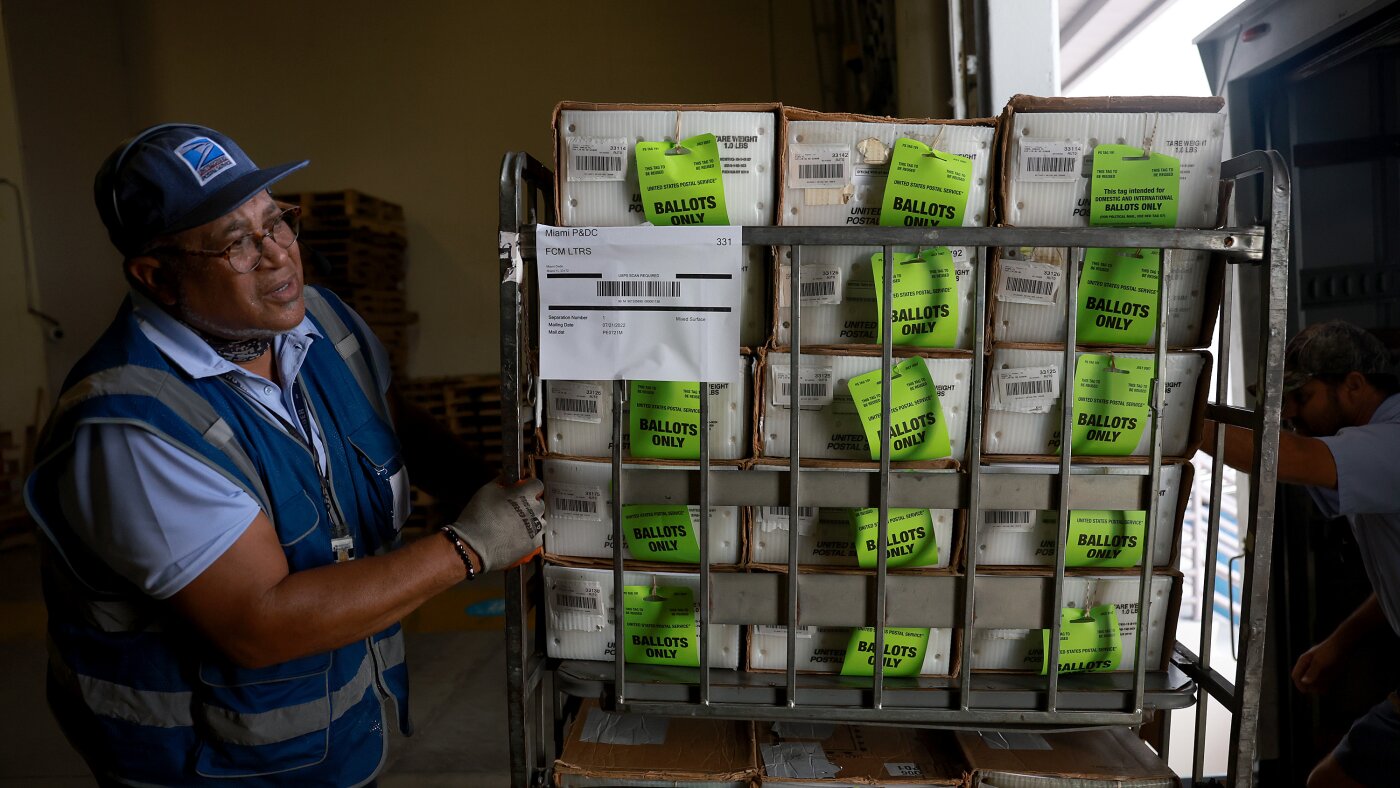

A U.S. Postal Service worker loads mail-in ballots onto a truck in 2022 in Miami.
Joe Raedle/Getty Images
Joe Raedle/Getty Images
In a recent development in the ongoing legal disputes over mail-in voting, a federal judge in Boston has provided a temporary advantage to the Trump administration. The judge, Indira Talwani, has overturned her previous nationwide ruling that halted the U.S. Postal Service from implementing directives outlined in President Trump’s executive order concerning mail-in voting for the upcoming midterm elections.
The decision by Judge Talwani opens the door for the Supreme Court to potentially reconsider the executive order. So far, the Supreme Court has only addressed procedural issues and has not yet ruled on the legality of Trump’s directives.
Previously, the Supreme Court had intervened to pause an earlier ruling by Judge Talwani, which was limited to 23 states and Washington, D.C., predominantly led by Democrats. The justices determined that the judge’s decision was premature as the USPS had not yet finalized a plan to execute Trump’s directives.
In her latest order, Judge Talwani referenced the Supreme Court’s reasoning, agreeing to lift her nationwide injunction. This decision came after the USPS released a final rule for federal ballot mail on August 21.
The rule includes a contentious provision requiring states to provide lists of absentee voters to the USPS, aligning with Trump’s executive order. This move has sparked debates, with critics claiming it exceeds presidential power as defined by the Constitution, which allocates authority over federal election rules to the states and Congress.
President Trump has defended his executive order, stating it aims to prevent illegal voting by non-citizens, an issue that numerous studies suggest is rare. However, opponents argue that the USPS lacks the authority to regulate mail-in voting.
The exact impact of Trump’s directives on the mail-in voting process for the midterms remains uncertain, with the election just weeks away. The executive order is anticipated to encounter further legal challenges, as various lawsuits from Democratic states, voting rights organizations, and others progress through the courts.
As these legal battles continue, challengers are urging Judge Talwani and another federal judge in Washington, D.C., to block the USPS from executing its finalized plan. Any rulings are expected to be appealed to the Supreme Court.
Editor’s note: USPS is a financial supporter of NPR.




Comments are closed.