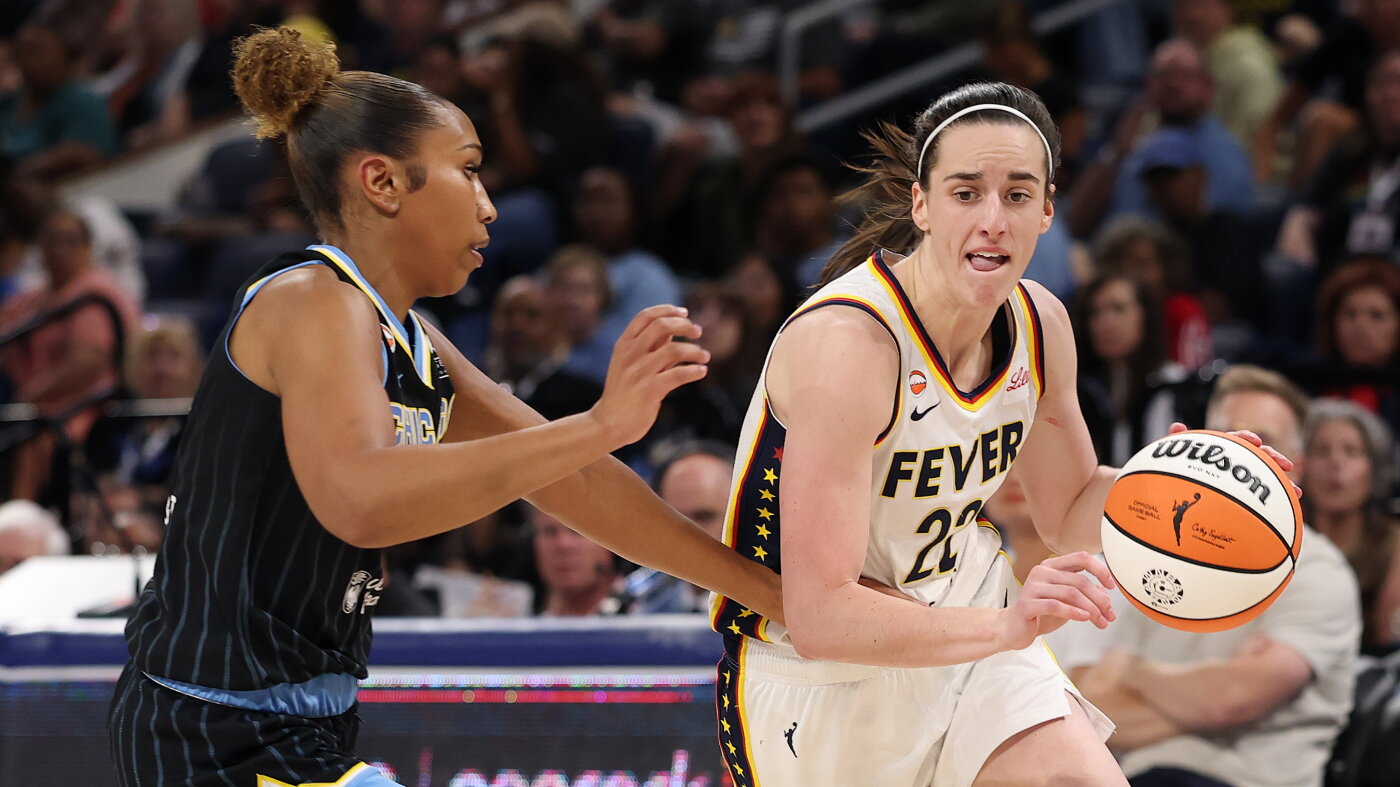

Caitlin Clark of the Indiana Fever, right, drives to the basket against Sydney Taylor of the Chicago Sky on Aug. 23.
Michael Reaves/Getty Images
hide caption
toggle caption
Michael Reaves/Getty Images
The WNBA is experiencing unprecedented growth, with both viewership and team valuations on the rise. The league’s recent $3.1 billion media rights deal marks a significant milestone.
Sabreena Merchant, a journalist from The Athletic, believes the league is thriving. “There’s so much talent. The quality of play in the league is better than it ever has been,” she notes. However, the league is also navigating controversies, with Fox News focusing extensively on cultural tensions related to race and transgender athletes.
“Everything in the WNBA seems to take on a political lens far beyond what is actually happening on the court,” Merchant says. “And I think it’s because people see an opportunity to use the league as a political prop.”
The Chicago Sky is taking measures to secure its players off the court, seeking advice from national security experts. Meanwhile, league commissioner Cathy Engelbert has announced her impending resignation.
“There is just a lack of control of the narrative of the WNBA, and I don’t think the commissioner is entirely to blame,” Merchant says. But, she adds, “I think they want a commissioner who is better able to control the story around the WNBA and prevent it from being a political prop in all of these culture wars.”
Interview highlights
On why physicality in the WNBA has become a talking point
Misogyny plays a role in objections to the physicality of women’s sports, Merchant suggests. Some believe women need protection from physical exertion and competition. This sentiment underpins critiques of women in professional athletics.
On claims that Indiana Fever player Caitlin Clark, who is white, gets special treatment from the league and from the NBA
Caitlin Clark has been transformative since joining the WNBA in 2024, drawing record viewership and attention. Her presence has been pivotal, and NBA Commissioner Adam Silver has publicly acknowledged concerns about her treatment. However, some players feel that certain individuals have better access to opportunities within the league.
On the perception that Black players on opposing teams disproportionately defend Clark
Merchant notes a perception among some fans that Black players defend Clark more aggressively due to her media attention. However, statistics show she draws more fouls than other guards, indicating her active play rather than bias in defense.
On the WNBA’s history and Caitlin Clark’s impact
The WNBA has long been a space for marginalized communities, especially Black and LGBTQ women. Clark, a white, straight player, has introduced a new fanbase without these identities, creating a shift within the league’s dynamics.
On Sophie Cunningham’s statement on trans women in WNBA
Sophie Cunningham of the Indiana Fever expressed her belief that trans women should not compete in women’s sports, a stance that has sparked debate. The WNBA has no formal policy for transgender athletes, and the league has not yet faced eligibility issues in this area.
On concerns about the quality of the officiating in the WNBA
Officiating in the WNBA is widely criticized for not matching the league’s play quality. The league lacks full-time officials, and many referees juggle roles in different leagues, contributing to inconsistencies.
On WNBA players supplementing their salaries overseas
Historically, WNBA players have earned more abroad than domestically, often playing year-round to supplement their incomes. The new collective bargaining agreement aims to address this by increasing average salaries to around $600,000, with revenue-sharing components that tie salary increases to league revenue growth.
Monique Nazareth and Susan Nyakundi produced and edited this interview for broadcast. Bridget Bentz, Molly Seavy-Nesper and Beth Novey adapted it for the web.
This article was originally written by www.npr.org