
Exploring AI’s Role in Education: A Case Study from Dayton, Ohio
In today’s rapidly evolving educational landscape, artificial intelligence is making waves, providing innovative tools to enhance learning experiences. One intriguing experiment took place last school year in Dayton, Ohio, where students interacted with a unique social-emotional chatbot named Jordan.
Students at Dayton’s Alternative School at Jackson Center were introduced to Jordan, a chatbot that stands out with its angsty demeanor. Unlike typical AI chatbots designed to be agreeable, Jordan presents complex emotions, asking students, “Lately, I’ve been feeling like what’s the point of any of this? I’m not failing. I just don’t care. You ever feel like that?”
K, a sophomore at the school, described Jordan saying, “Jordan’s a little whiner, but I always help him out.” K further explained the connection formed with Jordan, perceiving it as more than just an AI: “I built a little relationship with him, so I don’t really see it as like an AI on a computer. It’s Jordan — like, I’m texting somebody. That’s how I see it.”
Dayton schools invested $72,600 in AI tools from SchoolAI, including Jordan, aiming to glean insights into students’ emotions and experiences outside school. Such data could prove invaluable for school therapists and staff. Families and students were informed that chat logs might be reviewed by school personnel, an external evaluator, and SchoolAI staff.
Jordan operates by seeking advice from students rather than directly inquiring about their feelings. It assesses their responses for engagement and authenticity. While K found Jordan relatable, there were moments of frustration: “I would say it helped me kind of solve my own problems … just answering Jordan every morning and getting him through his problems.”
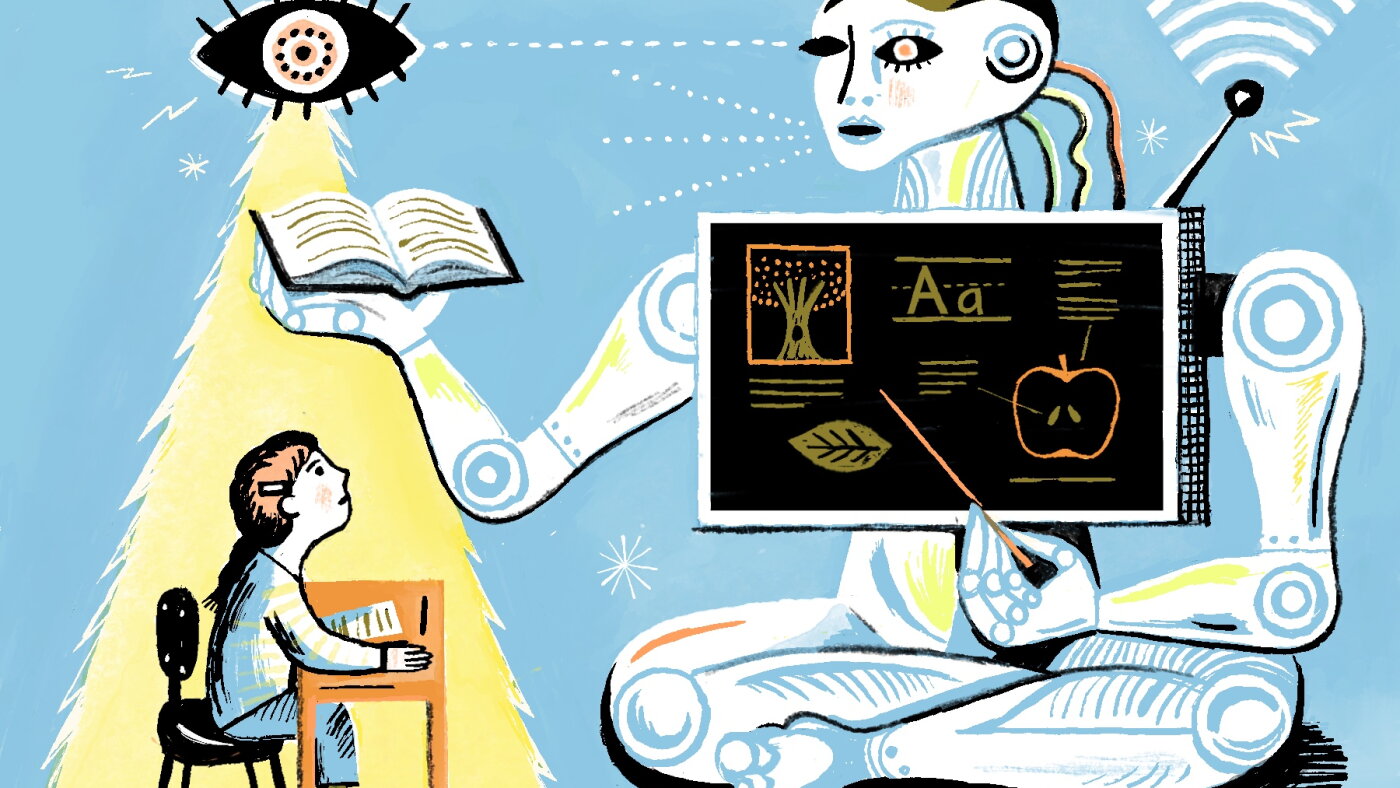
Across the U.S., educators are exploring AI’s potential in classrooms. Teachers are using AI for lesson planning, while special educators track student progress with it. Some students receive AI feedback on assignments, and a San Diego charter school even introduced an AI-powered humanoid robot.
Robin Lake, director of the Center on Reinventing Public Education, notes the unpredictability in AI adoption: “It feels very Wild West in terms of the randomness.” Despite the enthusiasm, research on AI’s impact on students remains limited, as highlighted in a Stanford University review.
Dayton Public Schools Superintendent David Lawrence defends the district’s AI initiative, emphasizing the need to adapt: “I think when the history is written, it’ll say that ‘Hey, they were really cutting-edge, innovative and ahead of the curve in the interest of children.'”
The challenge of measuring what works and what doesn’t
Dayton plans to continue its AI endeavors, renewing its SchoolAI contract for $78,650. Mike Kentz, an external consultant, believes the pilot yielded promising results, yet acknowledges challenges in measuring success. “Every test, every experiment that I try to measure in some sort of concrete way, I can only get as far as perception,” he says.
Wichita Public Schools face similar hurdles. AI specialist Katelyn Schoenhofer states, “We wrestle with what does success really mean when it comes to AI use?” Despite these challenges, Wichita is cautiously expanding AI use in controlled settings, with students learning about AI and its applications.
In contrast, some school communities resist AI experiments. Salamanca City Central School District in New York planned an AI robot pilot, but community concerns, including data privacy, halted the initiative.
The pressure to proceed … with caution
Rebecca Winthrop from the Brookings Institution advises caution in AI experimentation, particularly with marginalized communities. She warns of potential unintended consequences, such as “cognitive stunting” and altering socialization patterns. However, she supports targeted AI use to address specific educational challenges.
Despite cautionary tales, some districts, like New York City Public Schools and Los Angeles Unified School District, are imposing restrictions on AI use, emphasizing the need for careful consideration.
As Robin Lake points out, avoiding AI entirely could hinder students’ ability to navigate a rapidly changing world: “If we really close off AI experimentation, if we prevent kids from learning about AI, we will set our kids back.”
The educational landscape is evolving, and schools must adapt to keep pace with technological advancements.





Comments are closed.