
As Fall Arrives, Aroostook County, Maine Becomes a Battleground for Senate Race

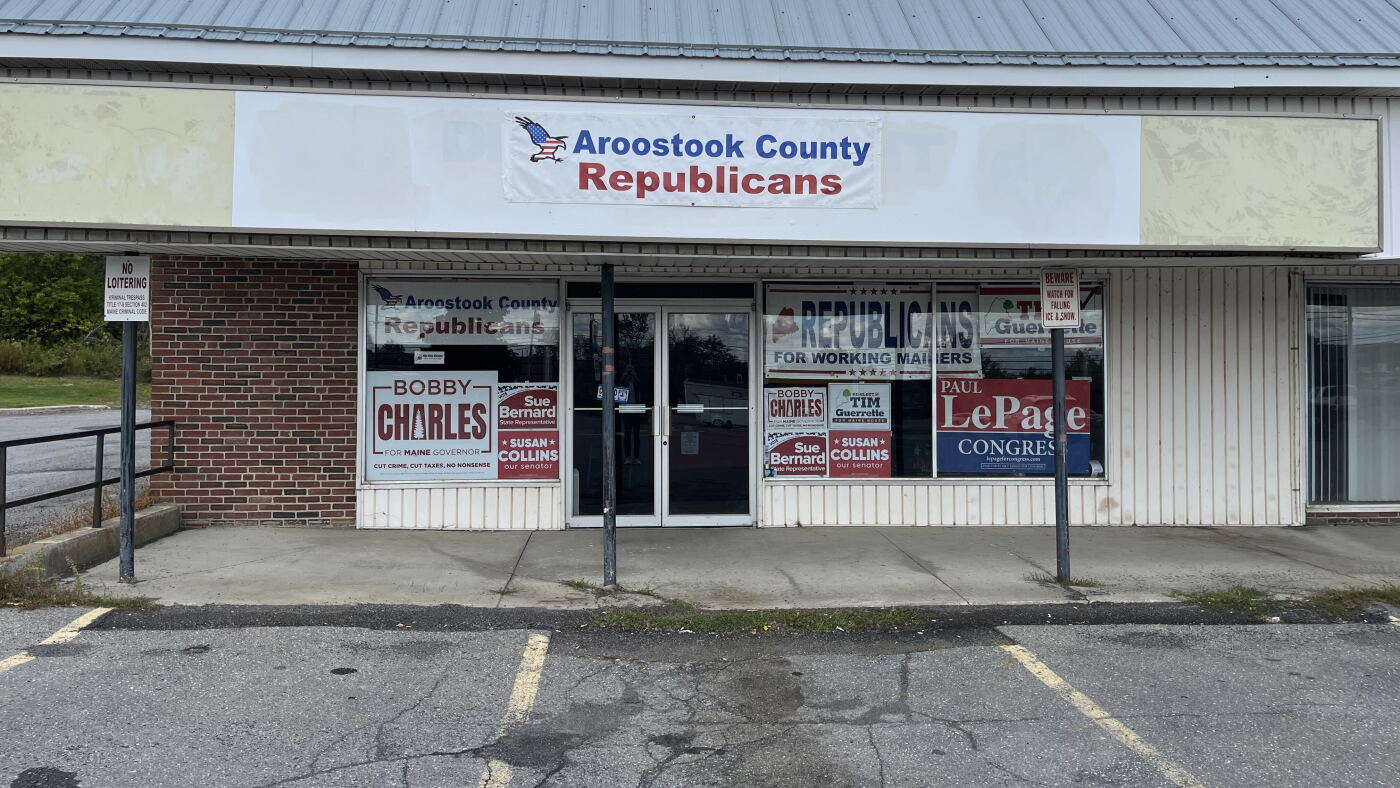
Campaign signs fill the windows of the Aroostook County Republican campaign headquarters in Caribou, Maine. Luke Garrett / NPR News
Luke Garrett / NPR News
In Aroostook County, Maine, where the vibrant hues of fall have arrived early, the U.S. Senate race is heating up. This region is home to both Republican Sen. Susan Collins and her Democratic contender, Troy Jackson. Campaign signs in red, white, and blue line the roads, adding to the seasonal display along the well-traveled U.S. Route 1.
This road, significant to both candidates, connects their hometowns—Collins hails from Caribou, while Jackson originates from Fort Kent, about 40 miles apart.
Andrew Smith, director of the University of New Hampshire Survey Center, highlights the competitiveness of the race, describing it as a statistical “toss-up.” The outcome could hinge on Aroostook County voters, who previously supported Obama in 2012 and Trump in 2016.
“If the rural voters come out and vote strongly, they’ll likely vote for Susan Collins,” Smith noted. “If Susan Collins is going to be successful, she’s really going to have to get those blue collar rural voters out to the polls and that’s going to be a challenge.”
Both candidates face challenges in rallying enthusiasm among their supporters. Jackson entered the race following the withdrawal of the original Democratic nominee, Graham Platner, amid controversy.

A campaign sign sits on a lawn along U.S. Route 1 in Aroostook County, Maine. Luke Garrett / NPR News
Luke Garrett / NPR News
Christopher Lydon, Aroostook County Republican Committee Chair, expresses confidence in Collins’ chances, citing her consistent record in the Senate. “I think the base is still there with [Collins] and she does a lot for the state,” Lydon remarked from the Republican headquarters in Caribou. “She’s been very active this time with the parades and getting out there. So I think despite what the other side might say, I think people are there with her. I think she’s got a good chance of winning again.”
Collins has triumphed in five Senate elections, with Aroostook County supporting her with double-digit margins each time. However, Matt Schlobohm, Executive Director of the Maine AFL-CIO and a Jackson supporter, predicts a shift this year.
“I think the sixth will be different,” Schlobohm said. “I mean, I think Troy will win Aroostook County. I think he will win this race.”
Schlobohm, who first met Jackson as a union organizer for loggers 25 years ago, has been actively involved in his campaigns for Maine’s state House and Senate.

Campaign flyers and signs lay stored at the Maine Democratic Coordinated Campaign Office in Presque Isle, Maine. Luke Garrett / NPR News
Luke Garrett / NPR News
Schlobohm criticizes Collins for her support of the war in Iran, linking it to rising gas prices that burden Mainers. “Folks in Aroostook County and all over Maine drive a lot. The price of gas is through the roof. Susan Collins voted and supported this foolish, reckless war in Iran that has directly made life harder for working Mainers,” he remarked.
Republican Party county chair Lydon defended the president’s actions, viewing the situation as temporary. “That’s a temporary thing,” Lydon said. “I think the president is doing something that needed to be done, that’s carrying on a lot longer than he thought it would.”

A life-sized cardboard cutout of President Trump is propped up in the Aroostook County Republican headquarters in Caribou, Maine. Luke Garrett / NPR News
Luke Garrett / NPR News
However, Lydon acknowledges the political challenges posed by the war’s impact. “People are angry about the price of gas and, I mean, heating oil is coming up in the winter,” Lydon said. “But in the long run, it should be better for the world.”
Sabrina Haney, a 54-year-old Caribou resident, has lived in the area for three decades and is concerned about rising gas prices. “When I moved up here 32 years ago, it was $0.99 a gallon,” she recalled. “And now, I’ve seen it go up to $5 a gallon. So it just needs to come down. Maine is a poor state.”

Sabrina Haney, 54, stands next to Skonieczny’s vegetable cart in Caribou, Maine. Luke Garrett / NPR News
Luke Garrett / NPR News
Haney, a Trump supporter, also worries about trade tensions with Canada and how tariffs affect local farmers. “We’re only about maybe 10 minutes from the border,” she said. “It hurts because Canada, the people, used to come here and spend their money and now that they put tariffs on there, they’re just going to cut back and stay in their own country.”
Brandon Goding, a 43-year-old cinema owner in Fort Kent, shares concerns about the economic impact of rising fuel costs. “Last winter, we raised our prices up to $12 [a ticket] trying to help us out with the fuel costs to heat this place,” Goding said. “And that kind of priced some people out. So we dropped it back down to eight.”

Brandon Goding, 43, stands in the center aisle of one of his two movie auditoriums at Fort Kent Theater. Luke Garrett / NPR News
Luke Garrett / NPR News
Heating oil prices have surged by 74% over the past year, according to the Maine Department of Energy Resources. Goding is apprehensive about the upcoming winter. “I’m definitely scared for the winter,” he said. “My tank is full right now from the summer and we do have heat pumps, but they’re older. They only do so much in these big open spaces.”
Goding is uncertain about his ability to sustain his business, balancing mortgage payments and high heating costs. “With the habits of people coming out to theaters, I’m not really sure how I’m going to cover that,” he expressed. “So it would be nice if we had a candidate that would bring oil prices down.”
He remains undecided between Collins and Jackson. “Having Troy Jackson be so close here, normally I would go more liberal, but I hear all these bad stories about him, but that’s because [we are] in a conservative area,” Goding explained. “I do like Susan Collins. She has gone against Trump here and there, but she doesn’t do it enough.”
This article was originally written by www.npr.org




Comments are closed.