
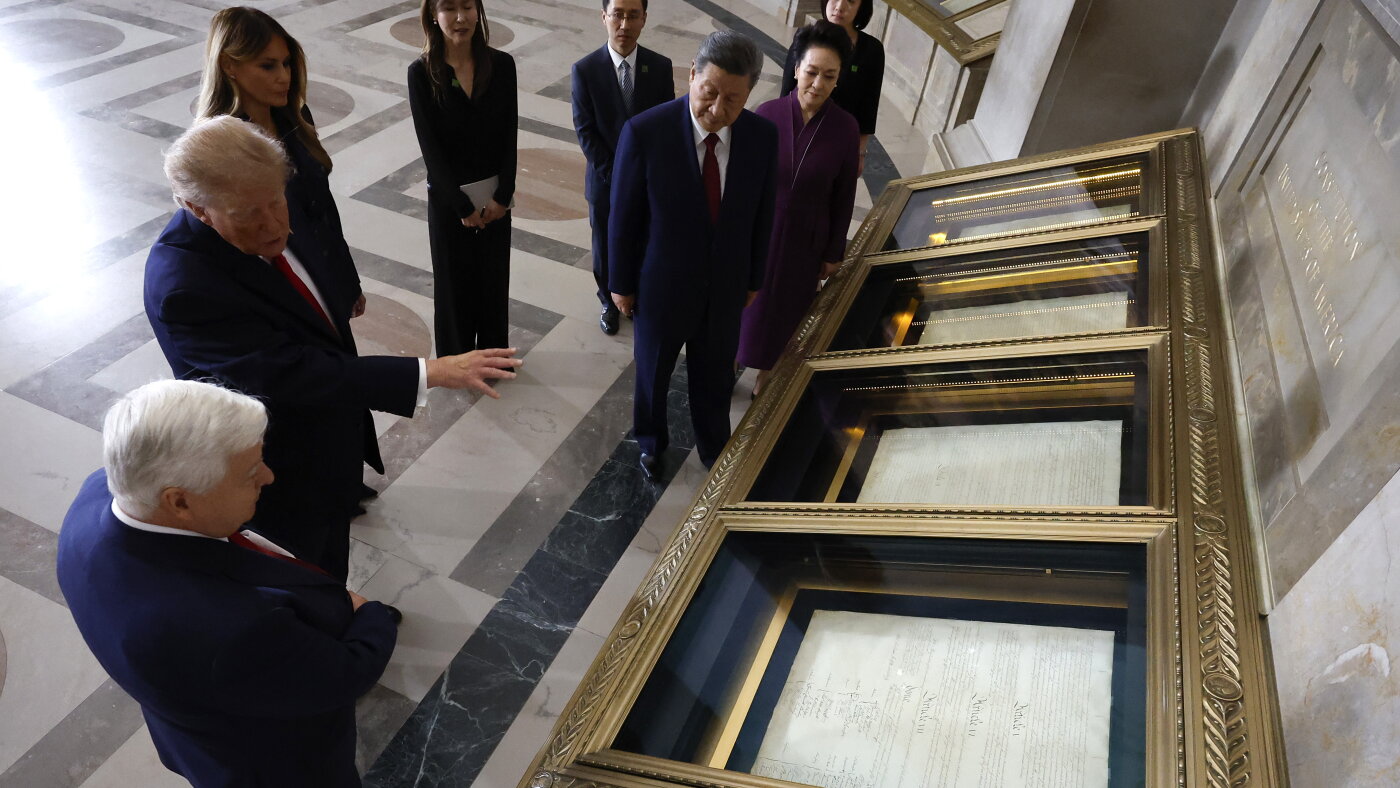
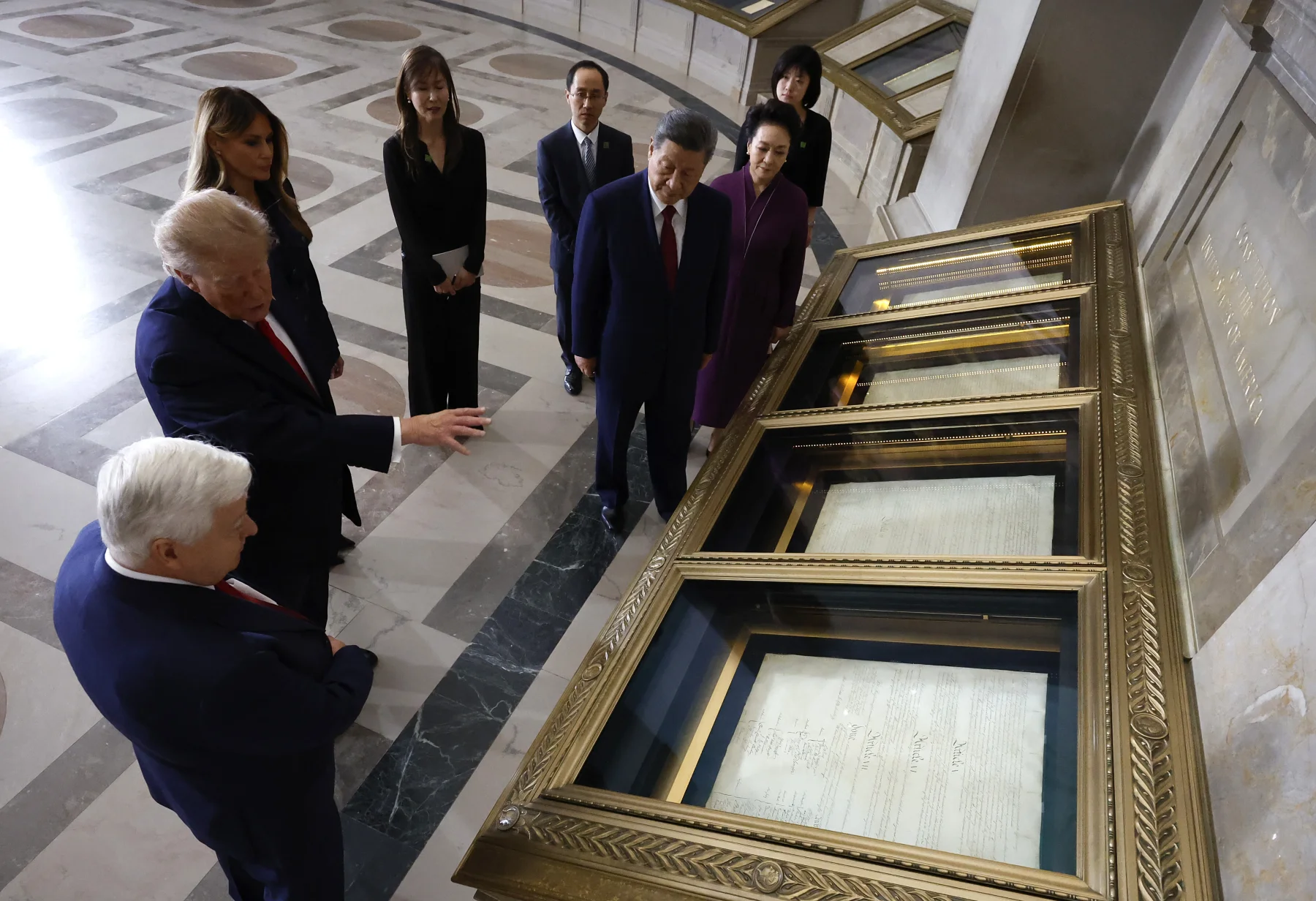
U.S. President Donald Trump (2nd-L) speaks to Archivist of the United States Bradford Wilson (L) as he views the U.S. Constitution during a tour of the National Archives Museum alongside first lady Melania Trump, President of China Xi Jinping and first lady of China Peng Liyuan on September 25, 2026 in Washington, DC.
Kevin Dietsch/Getty Images
hide caption
toggle caption
Kevin Dietsch/Getty Images
As anticipation built for a historic meeting between President Trump and China’s Xi Jinping, the National Archives Museum in Washington, D.C. was a flurry of last-minute preparations.
On the museum’s main floor, a prominent display featuring a brick from the Great Wall of China and a 19th-century scroll from a Qing emperor was swiftly dismantled due to unexpected changes in the event schedule, as confirmed by a Chinese diplomat who spoke under anonymity.
The abrupt alteration stemmed from China’s dissatisfaction with the inclusion of the Treaty of San Francisco of 1951 in the planned display, according to multiple sources familiar with the situation.
Beijing’s objection to the Treaty of San Francisco lies in the fact that China was not a signatory. The treaty, which was instrumental in ending World War II hostilities between Japan and the Allied Powers, leaves Taiwan’s status unresolved—a contentious point for China, which regards the island as part of its territory.
“It is a point of contention for the Chinese because they were not signatories to the Treaty of San Francisco, and they do not like the fact that the treaty of SF leaves undetermined Taiwan’s political status,” stated Ryan Hass, an expert on Taiwan and China at the Brookings Institution.
While the meeting between Trump and Xi was intended to foster dialogue on historical ties between the U.S. and China, the last-minute changes underscore the delicate nature of Taiwan’s role in U.S.-China relations. The U.S. officials responsible for planning the visit had considered displaying other documents impacting Taiwan, such as the Six Assurances and the Three Communiques, though these were ultimately excluded.
The sensitivity surrounding Taiwan was evident as Chinese diplomats discovered the documents scheduled for display only a day before the visit. Uncertainty lingered until 90 minutes before the leaders’ arrival at the Archives, reflecting the ongoing complexities in historical interpretation between the two nations.
During the visit, Xi Jinping commended the U.S. for its foundational history, remarking on the “founding spirit” of the nation’s 250-year legacy. President Trump acknowledged the long history of China, noting, “Ours goes 250 years, which is great, and we’re proud of it, but theirs goes 6,000 years.”

Comments are closed.