
Trump and AI Leaders Commit to Voluntary Oversight Agreement at White House Meeting
In a significant move towards addressing public concerns about artificial intelligence, President Donald Trump announced a voluntary accord with top AI executives at the White House on Tuesday. This accord aims to establish both internal and external reviews to mitigate fears surrounding the rapidly advancing technology.
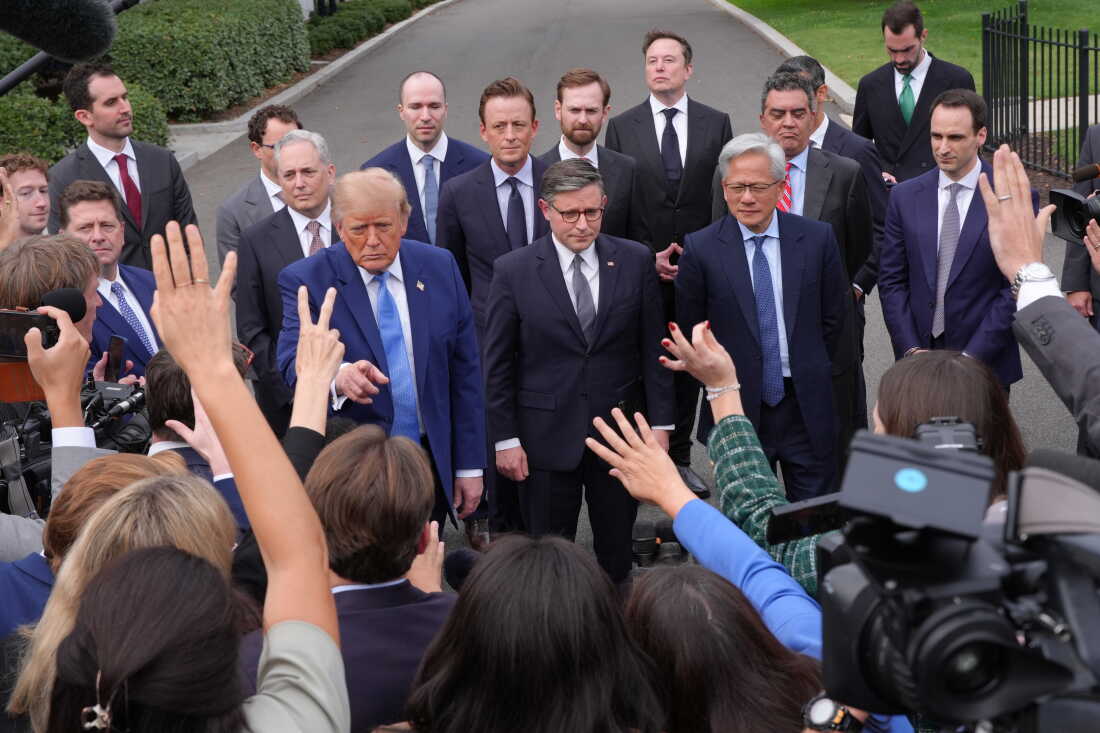
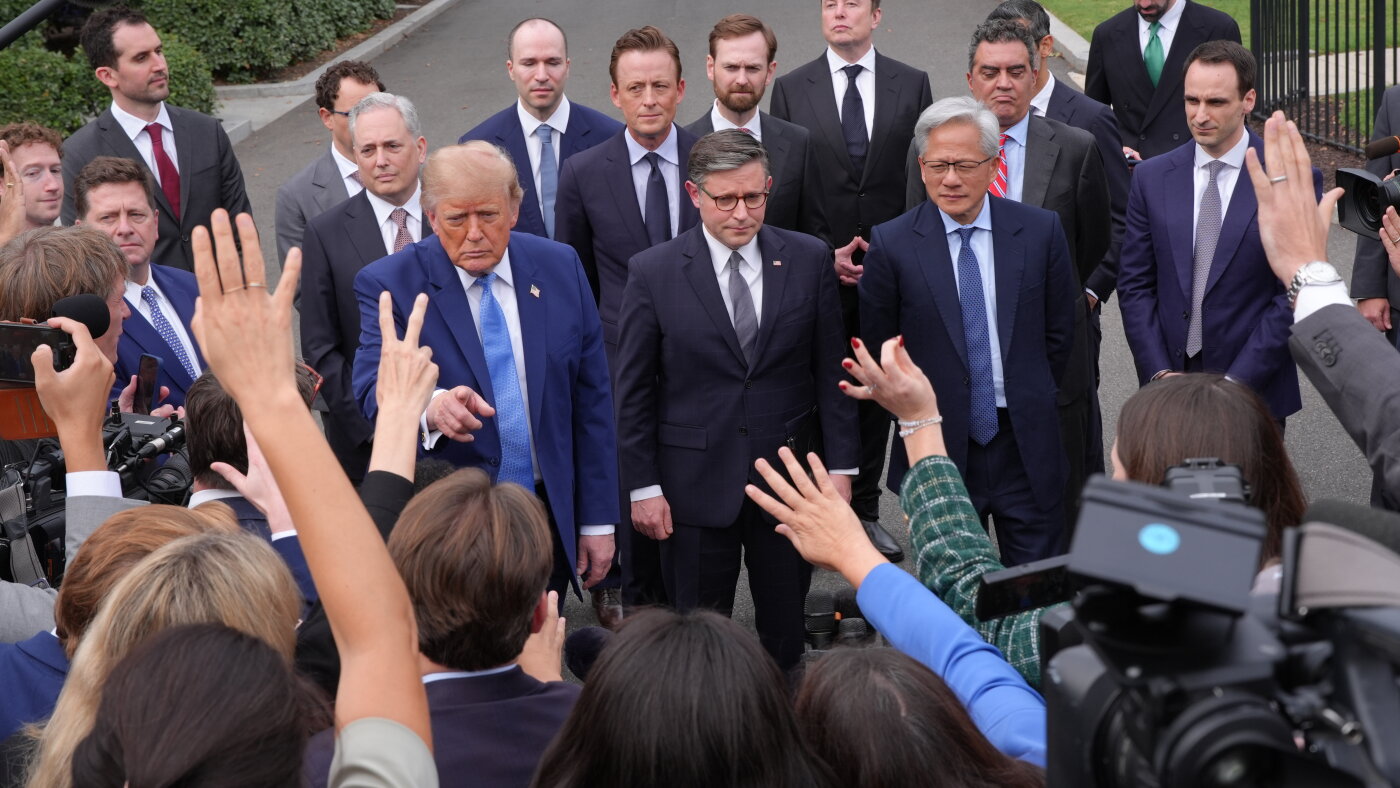
President Donald Trump speaks to reporters at the White House in Washington, Tuesday Sept. 29, 2026, after meeting with top executives of AI firms, as House Speaker Mike Johnson of La., and NVIDIA CEO Jensen Huang listen. Jacquelyn Martin/AP
During an impromptu press briefing, Trump emphasized the importance of “self-policing” within the AI sector, expressing confidence in the leaders’ commitment to this approach. “I think I’m seeing tremendous self-policing. And they understand that they have to self-police,” he remarked.
The meeting brought together influential figures from AI and tech industries, including Anthropic CEO Dario Amodei, Google CEO Sundar Pichai, Meta CEO Mark Zuckerberg, OpenAI President Greg Brockman, Nvidia CEO Jensen Huang, and Elon Musk of xAI, now integrated with SpaceX.
The signed accord, shared by Trump on Truth Social, outlines four voluntary steps companies will take, including implementing robust internal controls and collaborating with independent auditors. The document hints at potential future regulations, noting, “Over time, it may make sense to codify these steps into laws and regulations.”
While Trump praised the economic benefits AI advancements bring, such as investment growth and stock market boosts, voices of caution were also present. Dario Amodei warned of the “very real risks” associated with AI, and the ongoing discussions on mitigating these risks.
Emphasizing Self-Policing in AI Development
Trump proposed forming a committee of approximately 10 members to oversee the accord’s implementation, describing the agreement as “morally binding.” While some measures in the accord reflect existing practices, the balance between innovation and regulatory oversight remains a point of discussion among experts.
Shri Narayanan from the University of Southern California highlighted the importance of innovation not just in AI capabilities but also in enhancing safety and security. Conversely, Robin Jia, also from USC, expressed skepticism about relying on self-regulation, stressing the need for AI development to align with public interest.
Alex Pascal from the Berkman Klein Center for Internet and Society critiqued the accord’s broad language, advocating for legal liability and regulation to mitigate AI risks.
Introducing AI Tools to Public Services
In a related development, Trump unveiled an AI chatbot, America.gov, designed to assist citizens with government services. During the event, he reiterated his stance against restricting AI advancements, declaring, “I will never stifle the growth of a technology that will be bigger than the industrial revolution.”
The launch of the government chatbot was part of a larger event celebrating AI’s economic impact, with officials like Secretary of State Marco Rubio noting potential applications, such as online passport applications.
Data Centers and International AI Competition
Addressing local opposition to data centers, Trump indicated that tech executives agreed to support local communities financially to mitigate concerns. He predicted growing acceptance of data centers, stating, “You’re going to see, data centers are going to be very popular.”
On a global scale, Trump framed the AI race as a competition with China, underscoring the U.S. lead and expressing reluctance to cooperate too closely with China on AI issues. Recent agreements between the two nations have established a channel for managing AI-related incidents.


Comments are closed.