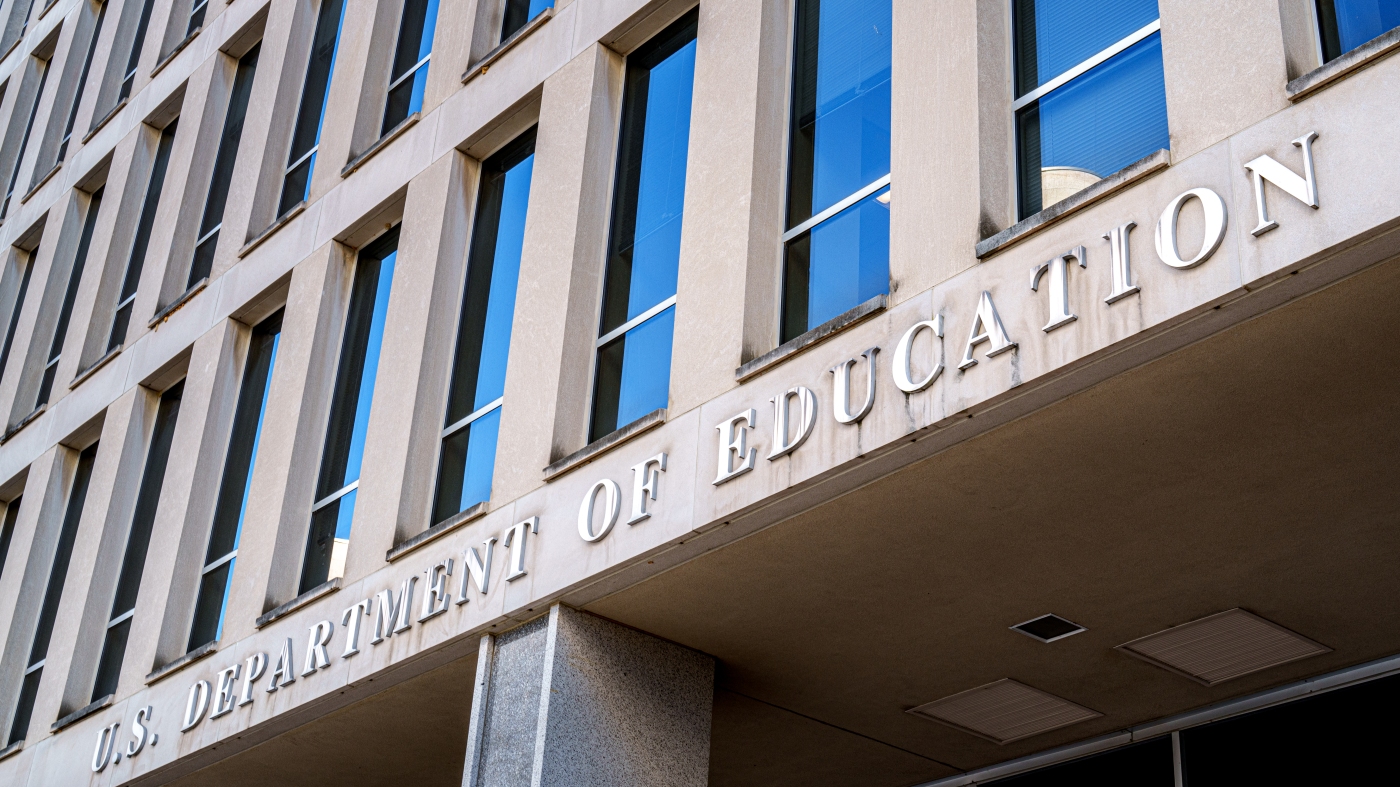

The entrance of the U.S. Department of Education headquarters in Washington, D.C.
J. David Ake/Getty Images
hide caption
toggle caption
J. David Ake/Getty Images
Facing a fiscal reevaluation, the Trump administration has put a temporary hold on over $6 billion in educational grants. These funds, crucial for various educational programs, were initially approved but are now under review, which could potentially disrupt school district plans for the upcoming academic year.
State education officials were informed by the U.S. Education Department that the department is currently reassessing the funding for the fiscal year 2025 for certain grant programs, including Title I-C, II-A, III-A, IV-A, and IV-B. “Given the change in Administrations, the Department is reviewing the FY 2025 funding for the [Title I-C, II-A, III-A, IV-A, IV-B] grant program(s), and decisions have not yet been made concerning submissions and awards for this upcoming year,” the message stated.

The delay in grant distribution, confirmed by The School Superintendents Association (AASA), has raised concerns among educational leaders. Tara Thomas from AASA stated, “This is definitely unprecedented to my knowledge.” She highlighted the necessity of reliable funding for effective school planning and budgeting, pointing out that such interruptions can significantly disrupt schools nationwide.
The Education Department has not responded to requests for comments, but it emphasized in its communications to state officials its commitment to aligning taxpayer resources with the President’s priorities and legal obligations.

The grants undergoing review support a variety of educational initiatives, including programs for migrant education, English language learners, and before- and after-school activities. The largest funding under scrutiny is approximately $2.2 billion designated for teacher professional development, which is vital for enhancing teacher effectiveness.
This is not the first attempt by the Trump administration to reassess these programs; the FY 2026 budget proposal had initially suggested eliminating these five grants.
Programs like Title I, which aids districts in lower-income areas, and IDEA, which supports students with disabilities, have so far remained unaffected by these recent developments.
Among the impacted programs is the 21st Century Community Learning Centers grant, which facilitates academic enrichment activities. In a low-income district in Maine, 90 miles from Portland, this grant funds diverse extracurricular activities that are otherwise financially out of reach, including outdoor adventures and robotics.
Dawn Fickett, who oversees the program in the MSAD 54 district, told NPR about the potential loss of these crucial activities. She emphasized the importance of engaging students in joyful learning and keeping them positively occupied.
Reporting contributed by: Jonaki Mehta