Good morning. You’re reading the Up First newsletter. Subscribe here to get it delivered to your inbox, and listen to the Up First podcast for all the news you need to start your day.
Key Developments Today
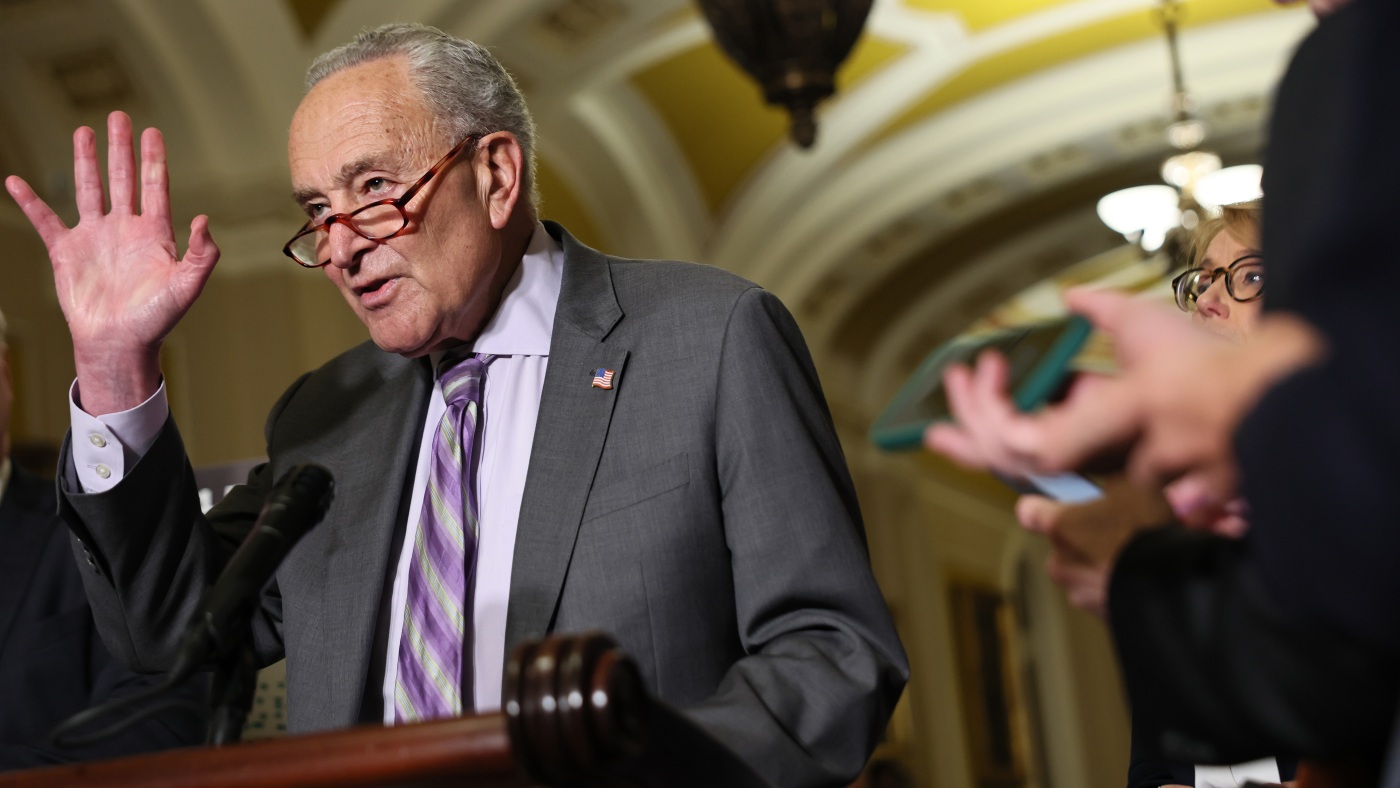
In a significant move, the Senate has approved a bill to retract $9 billion in federal funding from NPR, PBS, their affiliated stations, and foreign aid programs. According to Senate Majority Leader John Thune, R-S.D., this is the first rescission package to pass in over 30 years. The House is anticipated to vote on the measure later today, marking a potential victory for President Trump and DOGE’s agenda of reducing government expenditure.

Senate Minority Leader Chuck Schumer, D-N.Y., arrives to speak with reporters about Senate Republicans’ efforts to claw back $1.1 billion of funding authority from the Corporation for Public Broadcasting and about $8.3 billion from foreign aid programs targeted by DOGE, at the Capitol in Washington, Tuesday, July 15, 2025.
J. Scott Applewhite/AP
J. Scott Applewhite/AP
- 🎧 Democrats are calling it a dark day, asserting the bill will negatively impact Americans reliant on public broadcasting and harm the U.S.’s global leadership reputation. NPR’s Deirdre Walsh informed Up First that the package was reduced from $9.4 billion by eliminating a $400 million cut to PEPFAR, a program tackling HIV/AIDS. Republican senator Lisa Murkowski, who opposed the rescission, highlighted an Alaska public radio station’s emergency alert as a crucial service at risk.
Note: Under NPR’s protocol for reporting on itself, no corporate official or news executive reviewed this story before it was posted publicly.
President Trump has not ruled out the possibility of firing Federal Reserve Chair Jerome Powell before his term ends in May. The president’s dissatisfaction with Powell stems from his reluctance to lower interest rates. The Federal Reserve’s cautious stance on interest rates is due to its assessment of tariff impacts on inflation. Trump believes Powell’s decision is detrimental to the economy.
- 🎧 NPR’s Deepa Shivaram notes that Trump could potentially dismiss Powell, but only with legitimate cause, such as fraud. While the Supreme Court ruled in May that the president could dismiss heads of independent agencies without cause, the Fed’s unique structure as a “quasi-private entity” complicates this. Paul Schiff Berman from George Washington University suggests the Court might support Trump if he provides a valid reason, although he believes the damage to the Fed’s independence has been done.
The United Nations Security Council will convene today to address the Middle East conflict. This meeting follows Israel’s airstrikes on Syria’s capital, Damascus, targeting the Defense Ministry headquarters and nearing the presidential palace. The strikes signify a significant escalation against Syria’s new government post-civil war.
- 🎧 Israel claims its strikes targeted Syrian military sites to support Druze minority militias in Sweida, southern Syria. Interim Syrian President Ahmed al-Sharaa accuses Israel of attempting to incite chaos in the country. NPR’s Ruth Sherlock explains Israel’s strategic decision, rooted in distrust of al-Sharaa’s Islamist government and concerns about the Syrian army nearing the Israeli border.
Today’s Listen

The songs made by Wet Leg, fronted by Rhian Teasdale (left) and Hester Chambers sound like they come from nowhere, and also everywhere.
Hollie Fernando/Courtesy of the artist
Hollie Fernando/Courtesy of the artist
The indie-rock band Wet Leg gained notoriety three years ago with the release of “Chaise Longue,” earning international acclaim and festival invitations. Their debut album, which followed, won two Grammy awards. Now, Wet Leg is set to release a second album, Moisturizer. Rhian Teasdale, the band’s singer, shared with Morning Edition how their new music reflects a softer tone while retaining its playful spirit. Listen to Teasdale discuss the band’s journey and hear snippets from the new album.
Deep Dive

Newly-minted graduates are also encountering some storm clouds in the job market.
Spencer Platt/Getty Images
Spencer Platt/Getty Images
The U.S. unemployment rate remains low, yet job creation is sluggish and current employees are hesitant to change jobs. This scenario has made launching careers challenging for new college graduates. Economists suggest this trend is typical for recent grads, marking one of the toughest job markets since the pandemic. Alongside federal job cuts, tech and consulting firms are also downsizing after rapid expansions. Employers are generally wary of hiring amid uncertain trade and tax policies. Discover more about current job market dynamics for recent graduates.
3 Things to Know Before You Go

Greg Swan, whose son Drew died as a result of a fentanyl-related substance, looks on as U.S. President Donald Trump speaks in the East Room of the White House. The president signed the HALT Fentanyl Act, which aims to permanently classify all fentanyl-related substances as schedule I controlled substances and aid law enforcement in prosecuting trafficking and manufacturing offenses.
Anna Moneymaker/Getty Images North America
Anna Moneymaker/Getty Images North America
- The White House revealed that a national grant program for fentanyl overdose prevention, currently underfunded by approximately $140 million, will be funded incrementally rather than via a single annual payment.
- This week sees a lull on the Billboard charts due to limited new releases, yet Drake’s single, “What Did I Miss?” made a noticeable impact. Other records also rose on the charts.
- Driven by curiosity, NPR’s Windsor Johnston went on a date with an AI companion using Replika, an app for designing ideal AI partners. Discover how her experience unfolded.
This newsletter was edited by Obed Manuel.