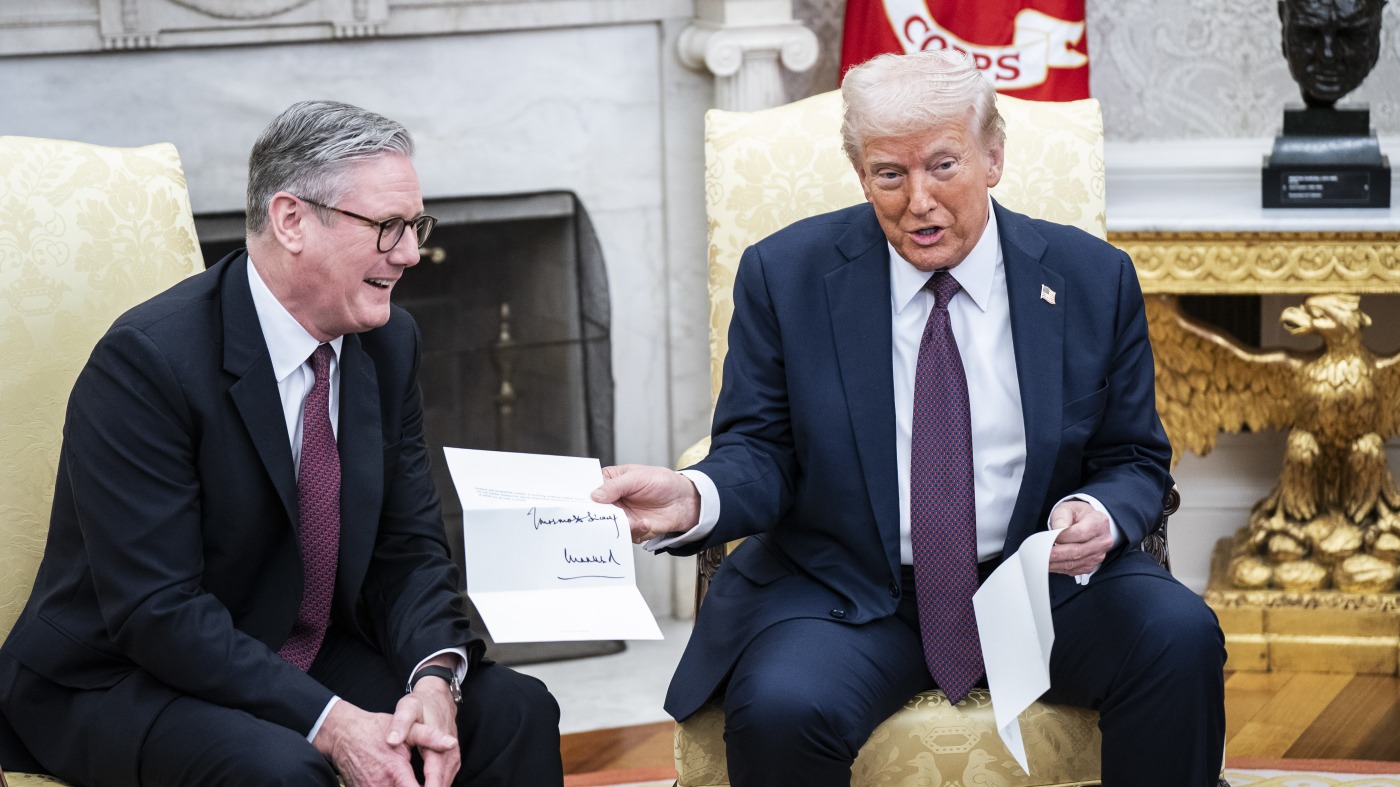

President Trump is given a letter from King Charles III, by British Prime Minister Keir Starmer in the Oval Office at the White House on Feb 27.
Jabin Botsford/The Washington Post via Getty Images
hide caption
toggle caption
Jabin Botsford/The Washington Post via Getty Images
In the world of diplomacy, a curious phenomenon has emerged surrounding President Trump’s interactions with international leaders. British Prime Minister Keir Starmer’s February visit to the White House, where he presented a letter from King Charles III inviting Trump for a second state visit, highlighted a trend of pronounced flattery.
“This is really special. This has never happened before,” Starmer noted, emphasizing the unprecedented nature of the invitation as a symbol of strong U.S.-U.K. relations.
In July, Israeli Prime Minister Benjamin Netanyahu delivered another notable letter to Trump, this time nominating him for the Nobel Peace Prize. “It’s nominating you for the Peace Prize, which is well deserved and you should get it,” Netanyahu stated, a gesture that Trump met with enthusiasm.
Such interactions exemplify the shift in global leaders’ approach to President Trump during his second term. “He’s back, and he’s powerful,” commented Kurt Volker, a former diplomat, noting the strategic use of praise to influence Trump’s actions. Volker highlighted NATO’s commitment to increasing defense spending as a result of Trump’s leadership.
The White House has seen an upsurge in international visits, reaching 23 leaders seeking favorable trade agreements. “The results speak for themselves,” said Anna Kelly, a White House spokesperson, noting the economic and diplomatic successes under Trump’s leadership.
According to Ivo Daalder, a former U.S. ambassador to NATO, foreign leaders have learned to appeal directly to Trump, recognizing his desire to be seen as a singularly influential figure. “He alone decides,” Daalder remarked, highlighting the necessity of flattery in negotiations with Trump.
The European Commission President Ursula von der Leyen recently praised Trump as a “tough negotiator and deal maker” before finalizing a trade agreement, echoing Trump’s own language in their announcement of the “biggest deal ever made.”
The strategy of appealing to Trump’s ego extends to NATO, where Chief Mark Rutte’s flattering text to Trump preceded a significant defense spending commitment by alliance members, further solidifying Trump’s influence in international diplomacy.
This approach, however, has not come without domestic repercussions for some leaders, as criticism arises regarding their overt admiration for Trump. Yet, the effectiveness of this strategy in achieving diplomatic goals remains evident.