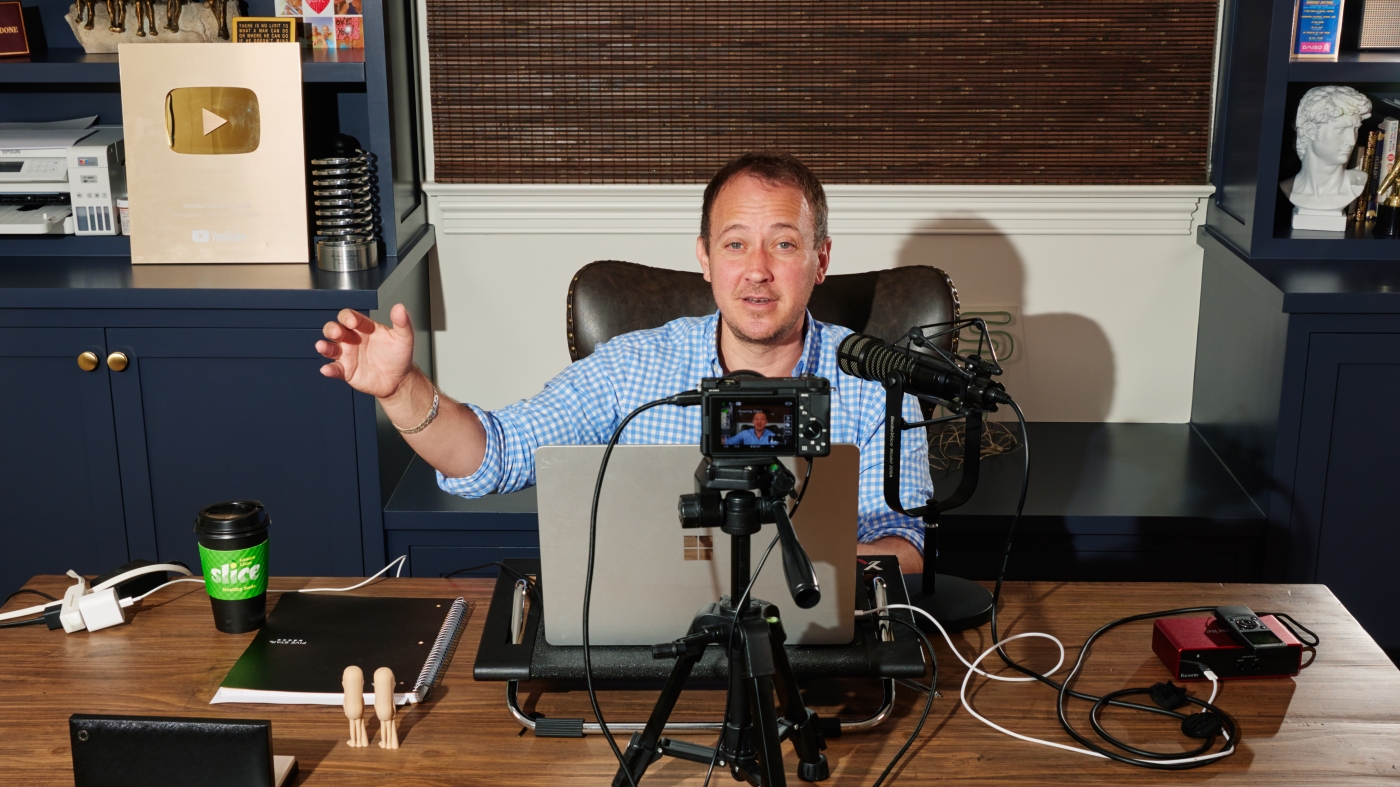

Ben Meiselas in his home studio in Los Angeles. His left-leaning media outfit MeidasTouch has surged in Donald Trump’s second term, appealing to progressives outraged by the president.
Maggie Shannon for NPR
hide caption
toggle caption
Maggie Shannon for NPR
Ben Meiselas can be found pacing outside his home in the Verdugo Mountains foothills of Los Angeles, juggling a phone conversation with one hand and a Starbucks coffee in the other. Despite having 588 unread text messages, his thoughts are preoccupied with his demanding YouTube production schedule.
He reveals, “We will have already had a video up at 4 a.m., 5:30 a.m., 7, and 8:30 is coming,” emphasizing the hectic pace of content creation.
Inside his home, his three Maltese terriers scurry about as he heads to his office, a space equipped with a laptop, tripod-mounted camera, and bright lighting. Here, he delivers daily critiques of President Trump’s actions, drawing on skills he developed during his previous career as a trial lawyer. “The best opening statements I’ve ever given were not scripted. The best closing arguments were not scripted,” he shares.
He quickly records a 14-minute video critiquing the day’s news, primarily focusing on Trump. After sending it to his team for editing, he brainstorms video titles with MeidasTouch staffers, eventually choosing “Trump has DISASTER THURSDAY as WALLS CLOSE IN,” a title in line with MeidasTouch’s all-caps style, reminiscent of Trump’s own social media posts. “You have to fight fire with fire these days,” says Meiselas, chuckling.
‘I think we need the opposite of Joe Rogan’
MeidasTouch stands out in a conservative-dominated online streaming world, often labeled as “the manosphere,” a network of male-targeted content creators led by figures like Joe Rogan. It ranks among the few left-leaning video podcasts on YouTube’s charts, occasionally surpassing Rogan’s top spot on the platform’s podcast charts. Meiselas, however, resists being labeled as the left’s Rogan, asserting, “People wanted me to be that. I think we need the opposite of Joe Rogan.”

MeidasTouch posts videos on YouTube about every 90 minutes and pushes its content on other platforms, including Instagram, TikTok and Substack.
Maggie Shannon for NPR
hide caption
toggle caption
Maggie Shannon for NPR
MeidasTouch’s content strategy is unapologetically partisan, akin to an intensified MSNBC. However, Meiselas distances himself from cable news, noting that he doesn’t engage in debates with political adversaries, suggesting people are weary of cable news-style political debates.
“They still think that people want to see the split screen. Here’s the left. Here’s the right. Watch them fight. Let’s go to a commercial break. People don’t want to see that, I think, any more,” Meiselas comments.
Despite this, millions continue to watch cable news daily, but MeidasTouch remains a strong competitor. YouTube analytics shared with NPR reveal that the MeidasTouch channel garners approximately 300 million views monthly, comparable to Fox News and MSNBC on YouTube.
Alongside his brothers Brett, a former video editor for The Ellen DeGeneres Show, and Jordy, who previously worked in marketing, Meiselas and a team of roughly 30 contributors — including former Trump lawyer turned critic Michael Cohen — produce videos every 90 minutes and disseminate content across platforms like Instagram, TikTok, and Substack.

Jordan Meiselas, Ben Meiselas and Brett Meiselas at the 29th Annual Webby Awards on May 12, 2025 in New York City.
Dave Kotinsky/Getty Images
hide caption
toggle caption
Dave Kotinsky/Getty Images
Other progressive media entities such as Pod Save America, More Perfect Union, and the Young Turks are also gaining traction during Trump’s second presidency. However, it is the Meiselas brothers’ engaging personalities, voluminous content, algorithmic savvy, or a combination of these factors that position MeidasTouch as a leader in the field.
Meiselas explains that viewers appreciate his focus on Trump’s speech tangents, which he says mainstream media often overlooks. He criticizes media outlets for editing speeches to give Trump favorable soundbites, claiming that his approach offers a more comprehensive view. “They would say, ‘Donald Trump is talking about making things affordable.’ And I’d watch these speeches and be like, ‘Literally did you watch these speeches that I just watched?’ That’s not what he said. Maybe that was thirty seconds. Why’d you do his work for him? You edited the speech to give him the best 30-second soundbite,” he said. “That was the craziest speech I’ve ever seen.”
From political ads to streaming powerhouse
Originally from Long Island, the 40-year-old Meiselas, along with his brothers, transitioned from his legal career into media, gaining prominence by representing high-profile clients like Colin Kaepernick and filing a class-action lawsuit for Fyre Festival attendees.
During Trump’s first term, amid the pandemic, the brothers launched a political action committee and produced viral political ads mocking Trump, as reported by CNN. They eventually transformed this political effort into a rapid-response anti-Trump news organization, which has gained momentum during Trump’s second term.
MeidasTouch is generating millions annually in advertising revenue, appealing to frustrated progressives who feel neglected by traditional media. “The audience is moving in these directions. And a number of mainstream news organizations just are not equipped to appeal to them on the kinds of terms as those people might want,” notes Bill Grueskin, a journalism professor at Columbia University and former The Wall Street Journal editor.

Meiselas sees his role as not just an updated version of a political shock jock, but as someone who is informing the public.
Maggie Shannon for NPR
hide caption
toggle caption
Maggie Shannon for NPR
During Trump’s initial term, media outlets like The Washington Post and MSNBC experienced a “Trump bump” by challenging the president and his policies. Now, online streamers are emerging as the primary beneficiaries, according to Grueskin. “There are just multiple sources of outrage every day,” he explains. “And outrage is a very powerful driver of subscriptions, of loyalty, of people’s time.”
Edward Wasserman, a journalism professor at the University of California, Berkeley, adds that online streamers, unbound by traditional journalism standards, can provide more contentious and intense commentary than most mainstream outlets. “I don’t think the media are able to do that. They can provide the ammunition for that kind of attack on Trump, but they can’t really give it a voice the way these podcast people can,” Wasserman notes.
Meiselas perceives his role as not merely a political shock jock but as an independent voice informing the public about the happenings in Washington. He believes audiences will continue to engage with his media outlet even after Trump’s presidency ends, as there will always be threats to democracy, freedoms, and rights. “I don’t think that the idea of being updated and consuming news and being knowledgeable is ever going to go away. Unfortunately, there’s always going to be threats to democracy, to peoples’ freedoms, to peoples’ rights,” Meiselas states, echoing his past as a civil rights lawyer. “There’s the day-to-day response of trying to put out fires, but then there’s the generational building. We’re trying to keep this network building.”