In a move that has sparked debate over constitutional law and public safety, Washington, D.C. has initiated a lawsuit to challenge President Trump’s assertion of control over the city’s police force. This legal contention highlights the ongoing tension between local and federal authorities.
SCOTT SIMON, HOST:
The effort by President Trump to assume complete control of Washington, D.C.’s police department has been temporarily halted by local officials. Following a court session, the Trump administration retracted its proposal to appoint an emergency police chief. Brian Mann from NPR provides the details.
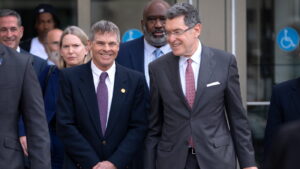
BRIAN MANN, BYLINE: The dispute over policing authority in the capital reached a new level when U.S. Attorney General Pam Bondi appointed Terry Cole, the head of the Drug Enforcement Administration, as D.C.’s emergency police chief. This appointment was intended to grant the White House full command over the city’s police operations. However, D.C.’s Attorney General, Brian Schwalb, promptly filed a lawsuit, denouncing the move as illegal.
(SOUNDBITE OF ARCHIVED RECORDING)
BRIAN SCHWALB: The authority to appoint a chief of police sits squarely with the mayor. The right to control the local policing of our city sits with the mayor and the chief of police.
MANN: After extensive discussions, Judge Ana Reyes has advised both parties to reach a settlement. Although federal representatives did not give comments post-hearing, Schwalb mentioned that the attorneys for Bondi and the U.S. Justice Department agreed to reconsider their stance.
(SOUNDBITE OF ARCHIVED RECORDING)
SCHWALB: The hostile takeover of our police force is not going to happen. Very important win for home rule today.
MANN: The relationship between federal authorities and Washington’s police department remains uncertain. D.C. Mayor Muriel Bowser addressed concerns on Friday about the increased presence of federal agents and national guard troops.
(SOUNDBITE OF ARCHIVED RECORDING)
MURIEL BOWSER: D.C. residents are worried and concerned, and we have a surge of federal officers. While we aren’t controlling them, we do have the ability to influence how they’re being deployed.
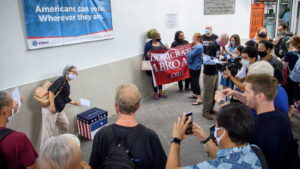
MANN: Bowser has expressed a desire to avoid conflicts with the forces deployed by the Trump administration, yet tensions escalated as federal agents proceeded to clear more homeless encampments on Friday.
(SOUNDBITE OF PROTEST)
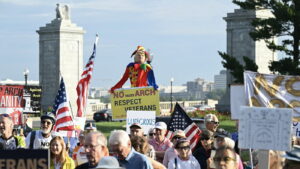
UNIDENTIFIED PROTESTERS: (Chanting) Free D.C. Free D.C. Free D.C.
MANN: Demonstrators gathered near the federal courthouse, urging the withdrawal of federal forces. Keya Chatterjee, leader of the activist group Free D.C., voiced the community’s disapproval.
(SOUNDBITE OF ARCHIVED RECORDING)
KEYA CHATTERJEE: It’s not our D.C. values to have illegal checkpoints all over our community. This is a hostile takeover of our community, and we will not allow it, right?
UNIDENTIFIED PERSON: We will not.
MANN: Despite data from the U.S. Justice Department indicating a decline in crime rates, Trump has maintained that a crime emergency declaration was essential to reestablish order. He criticized local leadership for the situation.
(SOUNDBITE OF ARCHIVED RECORDING)
PRESIDENT DONALD TRUMP: This dire public safety crisis stems directly from the abject failures of the city’s local leadership.
MANN: Trump dismissed the crime statistics and advocated for more aggressive policing under his administration.
(SOUNDBITE OF ARCHIVED RECORDING)
TRUMP: They fight back until you knock the hell out of them.
MANN: While Republicans in Congress have supported Trump’s narrative of D.C. as a lawless area, Democrats have introduced a resolution to overturn the emergency declaration, though it is unlikely to pass. Maryland Congressman Jamie Raskin commented on the situation.
JAMIE RASKIN: There’s plainly no emergency. The president has talked about graffiti. He’s talked about seeing homeless people on the street and considering that an eyesore.
MANN: Policing experts are expressing concern over the implications of Trump’s actions. Rosa Brooks, a former reserve officer and Georgetown Law professor, emphasized the risks of unclear command structures among armed personnel.
ROSA BROOKS: I think it’s actually quite dangerous, right? Whenever you have lots and lots of armed people and lack of clarity about who’s in charge, you have a really risky situation.
MANN: Brooks is also apprehensive about the use of National Guard troops for policing, and Trump’s desire to extend such measures to other cities.
BROOKS: You know, it’s both a huge, huge, huge waste of federal resources, and it’s quite scary, the idea of troops on the street stopping you because you committed a traffic violation. It’s unprecedented.
MANN: With the deployment of numerous federal agents and troops, further demonstrations and protests are anticipated.
Brian Mann, NPR News, Washington.
Accuracy and availability of NPR transcripts may vary. Transcript text may be revised to correct errors or match updates to audio. Audio on npr.org may be edited after its original broadcast or publication. The authoritative record of NPR’s programming is the audio record.