The Unforeseen Drama of Missouri’s Redistricting: A Mid-Decade Twist
In a surprising political maneuver, Missouri has joined Texas in redrawing its congressional districts ahead of the 2026 elections, a move driven by pressures from former President Trump. This unexpected shift has sparked debates and legal challenges, as Democrats and Republicans clash over the implications of such redistricting.

Buddy and Josh in the spotlight in the 1997 Walt Disney movie, Air Bud. Walt Disney Pictures
Initially, the thought of Missouri Republicans revisiting congressional mapmaking seemed unlikely, especially given the contentious redistricting in 2022 that fractured the state legislature. However, the political landscape shifted dramatically, leading to a new map aimed at unseating Democratic Congressman Emanuel Cleaver and bolstering Republican influence in the U.S. House.
Missouri’s approach, however, has not been without controversy. The decision to redraw the lines has prompted a series of legal actions challenging the legality of mid-decade redistricting. One key argument revolves around the constitutional interpretation of when and how often redistricting can occur.
The Unexpected Influence of Air Bud
In a twist reminiscent of the 1997 film Air Bud, Missouri Republicans are defending their actions with a creative argument: “There’s nothing in the Missouri Constitution that says lawmakers can’t redistrict mid-decade.” This has been dubbed the “Air Bud Rule,” likening it to the film’s scene where a rule book failed to prevent a dog from playing basketball.
The analogy has gained traction among politicians. Republican Secretary of State Denny Hoskins acknowledged the similarity, joking that if the courts uphold the map, it should be called the “Air Bud Clause.”
Meanwhile, Democratic state Rep. Mark Boyko and attorney Chuck Hatfield have criticized this reasoning, arguing that such logic doesn’t belong in Missouri’s legal framework.
Potential Referendum Complications
Beyond legal challenges, the redistricting may face a public referendum, threatening its implementation. If opponents gather enough signatures by Dec. 11, the new map could be subject to a statewide vote, potentially nullifying the Republican effort.
Many Missouri lawmakers were reportedly unaware of this possibility, which has injected further uncertainty into the political process. The referendum has energized Missouri Democrats, providing a rallying point after recent electoral defeats.
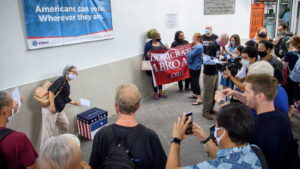
“We need transparency,” said Jefferson City resident Frida Tucker. “We need to stop the power grab. We don’t need to do it every three years, OK?”
This unfolding saga underscores the importance of attention to detail in legislative processes and highlights how unexpected cultural references can influence political strategies.
“`