In a political landscape marked by significant shifts, President Trump’s 2024 re-election campaign promised a sweeping transformation of Washington. His commitment to being the sole problem-solver for America’s challenges has been a focal point of his presidency. As 2025 draws to a close, questions arise about the reality of these bold promises.
Power Consolidation
Throughout his presidency, Trump has concentrated efforts on centralizing executive power to an unprecedented degree. This involved leveraging the informal Department of Government Efficiency (DOGE), overseen by Elon Musk, and making significant structural changes, including the demolition of the East Wing of the White House for a new ballroom. Trump utilized executive orders extensively to challenge media and law firms and exert pressure on higher education institutions through grant threats.
Tamara Keith and Domenico Montanaro, senior correspondents from NPR, discussed the ramifications of Trump’s approach. Montanaro remarked, “He’s really pushed the limits and bent the guardrails of the presidency.”
Government Restructuring
Elon Musk’s DOGE initiative and Budget Director Russell Vought’s focus on reducing government size have led to a dramatic restructuring of several federal agencies. Notable changes included the dismantling of the U.S. Agency for International Development and the transformation of the U.S. Institute of Peace into the Donald Trump Institute of Peace. The White House recently stated, “federal employment is now at the lowest level since 2014, down by 271,000 jobs since President Trump took office. Promises made, promises kept.”
Congress and Legislative Dynamics
With Republican control of Congress, legislative actions largely mirrored Trump’s agenda. Significant policies included making first-term tax cuts permanent and implementing tax exemptions on tips and overtime. However, despite these legislative victories, Congress has struggled with issues like healthcare subsidies, leading to rising costs.
Montanaro highlighted the exception of Republican resistance regarding the Epstein files and healthcare subsidies. This pushback reflects some internal party tensions despite the otherwise strong alignment with Trump’s policies.
Judicial Oversight and Supreme Court Dynamics
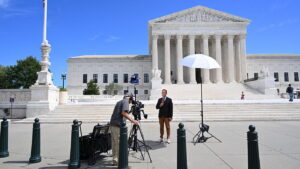
President Trump’s influence extended to the judicial branch, notably through the appointment of three justices, creating a 6-3 conservative majority in the Supreme Court. This shift has allowed significant expansions of presidential power, with the court granting immunity for official acts during his second term. Current cases challenging birthright citizenship and tariff policies remain pivotal in determining judicial limits on presidential authority.
Keith observed, “Trump has led unilaterally in an area that typically would require some congressional involvement,” emphasizing the president’s independent approach to policy-making.
Public Opinion and Approval Ratings
Despite executing much of his agenda, public approval has waned. Recent polls indicate only 38% approval of Trump’s overall performance, with even lower ratings for economic management. While initial support from Latinos, driven by economic concerns, contributed to his re-election, dissatisfaction has grown as economic challenges persist.
Keith concluded, “What we’re seeing here with these approval ratings is really the answer to the question of what happens if you only govern for your base and yourself.”