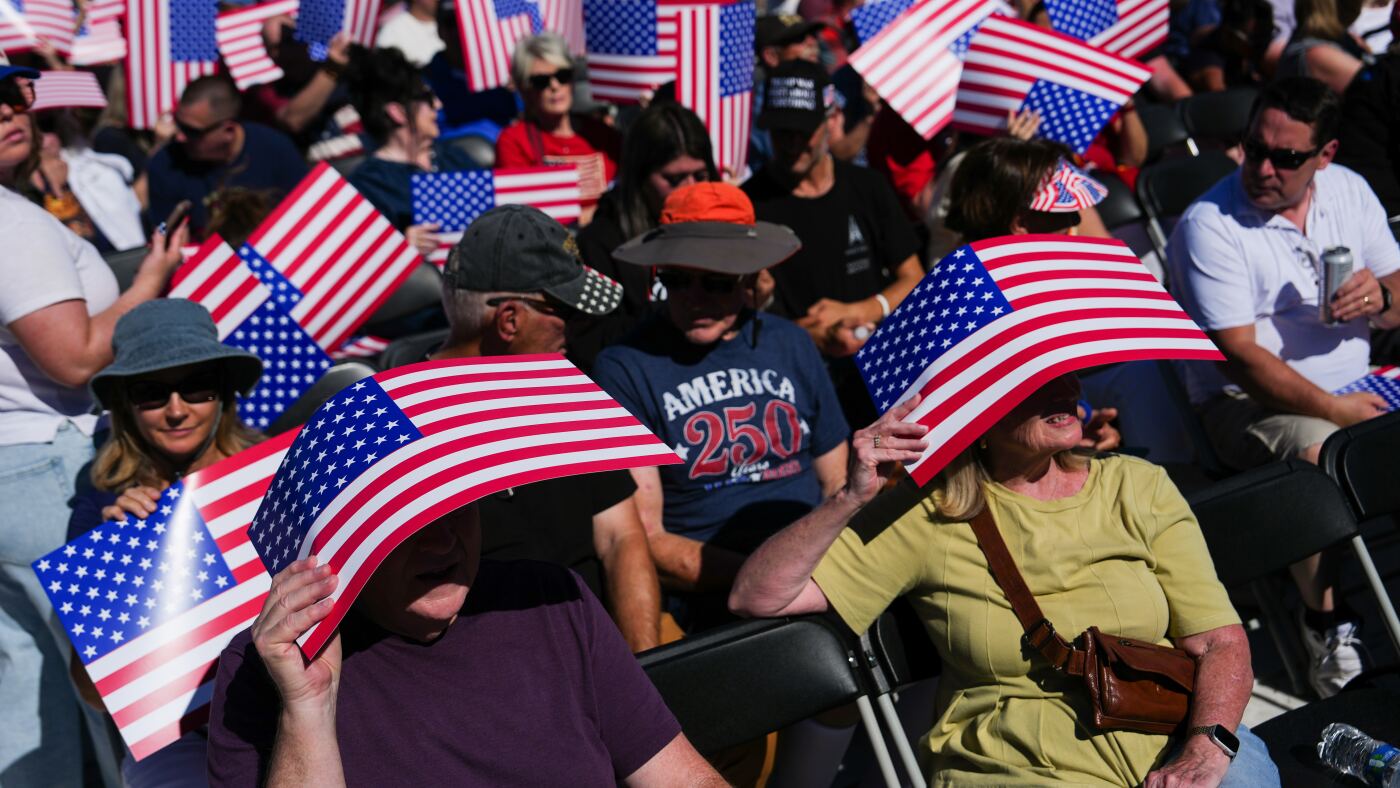
The United States of America marks its 250th anniversary, a milestone prompting Americans to reflect on the nation’s history. Across the country, from cities to rural areas, celebrations and reflections are as diverse as the nation itself.
Celebrations in the “City of Presidents”
In Cuba City, Wisconsin, known as one of the “City of Presidents,” the streets are adorned with patriotic decorations. Red, white, and blue shields representing each U.S. president line Main Street, a tradition that dates back to 1976. Donna Rogers, president of the project, recalls its inception during the bicentennial celebration. She admits, “I was raising three little boys and working at John Deere, so I didn’t really pay too much attention to community service at that time.”
Now, Rogers is deeply involved in the celebrations, which include a parade and a mac-and-cheese festival – a nod to some of the founding fathers’ favorite foods. “Our nation’s 250th birthday,” she notes, is among the most significant events in history alongside the signing of the Declaration of Independence and the abolition of slavery.
Fostering Civics Engagement in Georgia
In Georgia, middle school students participated in the National Civics Bee state finals, answering questions about U.S. governance. Ella Hummel, a 9th grader, plans to advance to the national finals. Her grandmother, Peggy Farmer, reflects on the sense of unity reminiscent of the bicentennial celebrations in 1976, when she says, “It’s a togetherness type of thing that’s really not around all the time now.”
Farmer is optimistic that future generations, like her granddaughter, will bring positive change to the country.
Patriotism and Progress in Texas
In Houston, Texas, county commissioner Rodney Ellis celebrates with a mix of patriotism and concern for the future. “We should be celebrating that America is a process,” he believes, emphasizing the importance of acknowledging historical truths and working toward progress. Ellis has witnessed significant changes, including an increase in Black representation in Congress from 18 in 1976 to 67 today. However, he remains cautious about recent setbacks in areas like environmental protection and civil rights.
Ellis maintains that American progress often involves steps forward and backward, but insists, “you don’t give up.”
Intertwining Cultures in Wisconsin
In Milwaukee, Gissell Vera celebrates her dual heritage with a Fourth of July carne asada cookout. As a U.S. citizen from a mixed-status family, she embraces both her American and Mexican identities, stating, “I am proud to be from here and from there.” Despite ongoing concerns about immigration reform, Vera and her family choose to live without fear.
Reexamining American Myths in the Mountain West
Historian Megan Kate Nelson uses America’s 250th anniversary to challenge traditional narratives of westward expansion in her book, “The Westerners.” By highlighting figures like Polly Bemis and María Gertrudis Barceló, Nelson aims to broaden the understanding of American history beyond the conventional stories of white pioneers.
Nelson stresses the importance of acknowledging diverse experiences, such as those of Sacagawea, who played a crucial role in the Lewis and Clark expedition.
Historic Celebrations in Rhode Island
Bristol, Rhode Island, hosts the country’s oldest Independence Day celebration, now in its 241st year. Over 100 volunteers help organize festivities, including a parade, a beauty pageant, and a gala ball. Heidi Vermilyea, responsible for parade souvenirs, shares, “I’ve missed the parade once when I was in Europe for the Fourth of July, but otherwise, I have been either watching the parade or working the parade my whole life.”
Vermilyea sees patriotism as “just loving your community,” a sentiment echoed by the town’s enduring commitment to the celebration.
Contemplating Complex Histories in Oregon
In Oregon, Pulitzer Prize-winning writer Mitchell S. Jackson reflects on how learning about America’s history of slavery and racism has complicated his relationship with the country. Having lost his right to vote as a young man, Jackson questions the significance of the 250th anniversary, noting that true freedom in America only began with the 14th amendment and the Civil Rights Act.
For Jackson, loving America involves being critical and honest about its history. He believes that understanding the nation’s complex past is a collective responsibility.
This article was originally written by www.npr.org