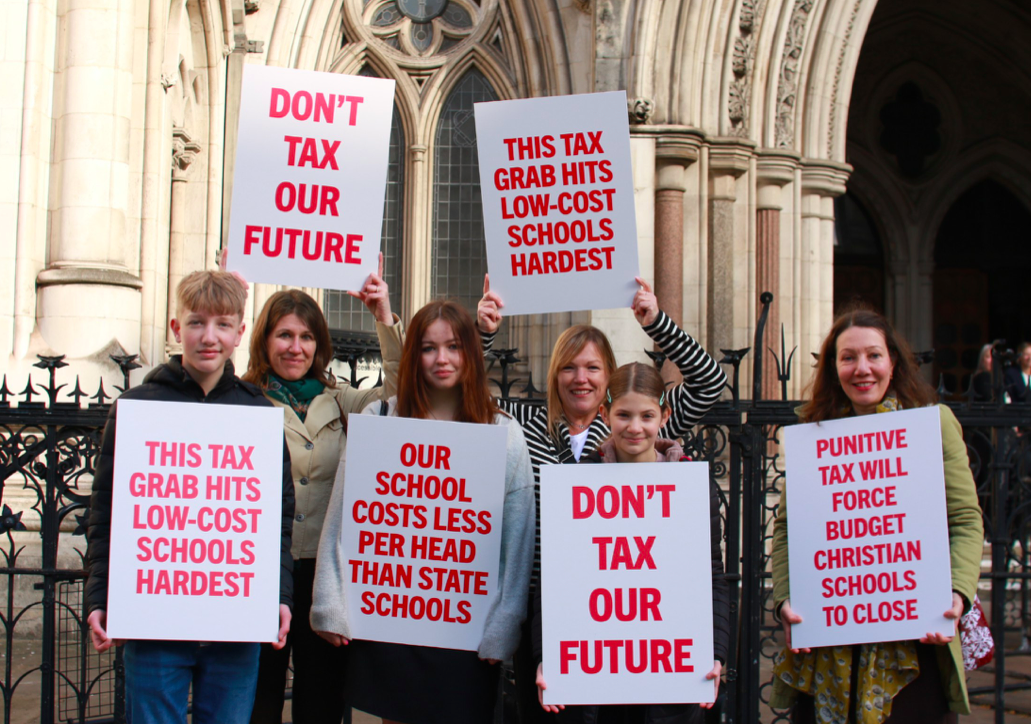
(Photo: Christian Legal Centre)
The UK Supreme Court has taken a significant step in the ongoing debate over educational finance by allowing an appeal from a coalition of Christian schools, parents, and students. This appeal challenges the imposition of VAT on private school fees, a move that has sparked widespread concern among those affected.
This legal challenge, backed by the Christian Legal Centre, aims to examine whether the VAT policy disproportionately affects families and educational institutions. The appeal will scrutinize the policy’s proportionality, especially its impact on Christian schools and families with modest financial means.
A Supreme Court panel comprising Lord Reed, Lord Hamblen, and Lord Richards has granted permission to appeal on the crucial issue of proportionality. This development highlights the importance of assessing the balance between the policy’s fiscal objectives and its impact on affected parties.
The schools involved in this case include Emmanuel School in Derby, The Branch Christian School in Yorkshire, The King’s School in Hampshire, and Wyclif Independent Christian School in South Wales. These schools, alongside parents and students, argue that the VAT policy places undue financial burden on Christian educational institutions and families.
Critics of the policy contend that it is applied uniformly without considering individual circumstances or providing transitional arrangements for currently enrolled students, leading to financial stress and educational disruption.
A focal point of the legal debate is whether the courts have adequately weighed the proportionality of the policy, factoring in its impact on families and schools against the government’s fiscal goals.
Caroline Santer, headteacher at The King’s School, Hampshire, expressed optimism, stating, “We are encouraged that the Supreme Court will now examine this case properly.” She emphasized the difficult choices families face and the pressure on schools due to the VAT policy.
The legal team representing the schools argues that a 2025 Court of Appeal decision overemphasized public finance considerations, neglecting the adverse effects on students and educational institutions.
The challenge also touches on broader issues of parental choice and religious freedom in education. Families opting out of the state system are still burdened by taxes while facing additional costs, raising questions about fairness.
Stephen White, a parent from Bradford involved in the case, shared his perspective, noting, “This case has always been about ordinary families like mine.” He highlighted the sacrifices made to provide a Christian education and the difficult choices imposed by the policy.
Jill Holt, headteacher at The Branch Christian School, echoed these concerns, saying, “The addition of VAT places an impossible burden on many of them. We hope the Supreme Court will recognise how damaging this policy is in practice.”
Recent analysis by The Times indicates a rise in independent school closures following the VAT charge introduction, with 71 closures in 2025 compared to 58 in 2024.
Michelle Daniells, founder and chief executive of the Association for Families of Independent Schooling (AFIS), commented, “For many families, choosing a faith-based education is not a luxury but a deeply held conviction. Policies like this risk narrowing genuine parental choice and increasing disruption for children.”
Andrea Williams, chief executive of the Christian Legal Centre, stated, “At its heart, this challenge is about whether the state can impose a blanket policy that disproportionately harms families who are simply seeking to educate their children in accordance with their Christian faith. This is about fairness, freedom, and ensuring that the power of the state is exercised within proper limits.”
This article was originally written by www.christiantoday.com