AI Revolutionizes Special Education by Streamlining Paperwork
In a small town in Northern California, the daily grind of a special education teacher is being transformed by artificial intelligence. Mary Acebu, who has been teaching at Riverview Middle School for a decade, is leveraging AI to manage the paperwork that once consumed her days, allowing her to focus on meaningful interactions with her students.

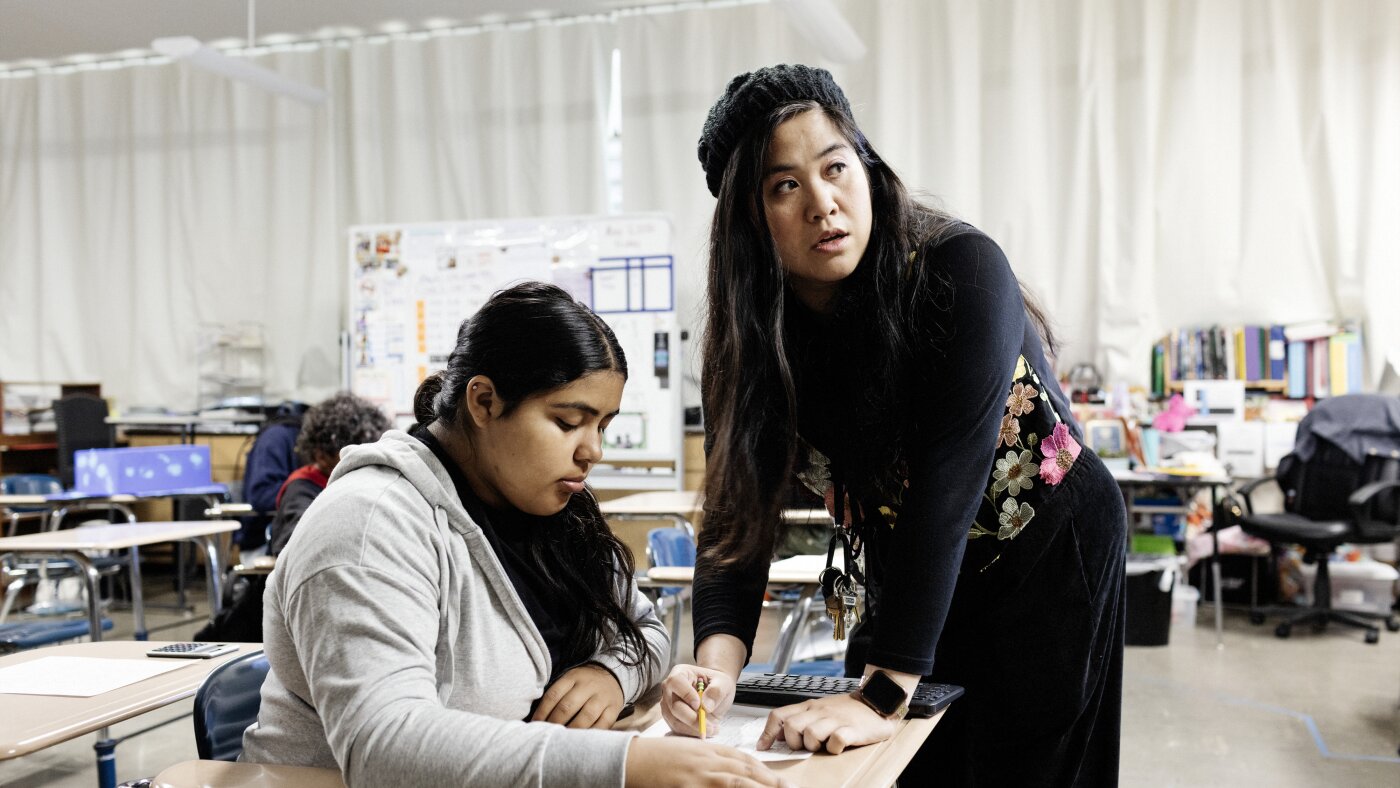
Mary Acebu, a special education teacher at Riverview Middle School in Bay Point, Calif., works with a student during a math lesson. She says using AI to help with the paperwork part of her job allows her to spend more time interacting with her students in a meaningful way. Talia Herman for NPR
Editor’s note: NPR uses only the first names of minors in this story because it discusses their learning disabilities and placement in special education.
BAY POINT, Calif. — In the past, mornings for Mary Acebu began before dawn, as she prepared for her day at Riverview Middle School. The long hours often extended into the night, with additional paperwork brought home.
“I don’t do that anymore,” she laughs. The shift began when Acebu started using AI to streamline her tasks, focusing on student interaction rather than being tied to her computer.
Special education teachers across the U.S. face similar challenges. In the 2024-25 school year, 45 states reported shortages in this field. The administrative burden, particularly the paperwork for individualized education programs (IEPs), contributes significantly to this issue.
According to a survey by the Center for Democracy and Technology (CDT), 57% of special education teachers utilized AI to assist in creating IEPs during the 2024-25 school year, a notable increase from the previous year.
While the CDT highlights concerns over privacy and ethical issues with AI, studies from institutions like the University of Virginia and the University of Central Florida suggest AI can enhance the quality of IEPs.
Olivia Coleman from UCF notes, “The more face time a student with a disability has with a teacher, that often yields better outcomes for them.” Acebu’s experience with her student King, who progressed from non-reader to reading, underscores the importance of applying IEPs effectively.
What IEPs are and why they matter
Each student in Acebu’s class has a unique learning path, detailed in their IEP — a federally mandated document for over 8 million students with disabilities in the U.S. These plans are crucial for setting and achieving personalized educational goals.

Mary Acebu has been a special education teacher for a decade at Riverview Middle School. She is part of a task force that is working on an AI policy for her school district.
Talia Herman for NPR
IEPs require setting annual goals based on the student’s current skills and the desired progress for the year, explains Danielle Waterfield, Coleman’s research partner at UVA. Despite the workload, teachers see them as vital for ensuring quality education for students with disabilities.
Acebu emphasizes the individuality of each student, stating, “The key term is ‘individualized.’ No two kids are the same.” Crafting IEPs demands comprehensive knowledge of education law and policy, along with personal understanding of each student’s needs.
Using AI — with a ‘human touch’
Acebu took courses on AI use and her district began collaborating with companies like MagicSchool AI and Google to provide educational AI tools. These tools are designed to protect sensitive student data, a major concern for educators like Acebu.
She has customized chatbots to assist with tasks ranging from worksheet creation to IEP goal development. However, she insists on the importance of a “human touch” in finalizing the outputs.

King, an eighth grader, went from not being able to read to reading confidently since he joined Acebu’s class last year. She says that has been possible, in part, because AI has given her more time to work directly with students in the classroom and less on paperwork.
Talia Herman for NPR
Research by Coleman and Waterfield shows teachers nationwide using AI to write IEP goals, track progress, and create learning materials, among other tasks.
Acebu’s expertise in instructional technology and her role in her district’s AI task force places her at the forefront of AI integration in education. However, some colleagues, like Paul Stone, were initially skeptical until an increase in workload led him to try Acebu’s chatbot.
Stone found it to be a significant time-saver, though he acknowledges the necessity of reviewing AI-generated content. Still, he believes such tools could mitigate educator burnout.
Using AI in special education — with guardrails
Despite concerns, AI usage is expanding in education, though its application in special education—which is highly regulated—raises particular issues. Privacy remains a top concern, with experts advising caution when handling student data.
Concerns over AI bias and the need for human oversight persist, as highlighted by CDT’s Ariana Aboulafia. She warns against over-reliance on AI, urging the necessity of maintaining a human role in developing IEPs.
Mary Acebu’s experience illustrates how AI can enhance teaching efficiency and effectiveness, allowing educators to concentrate on the crucial task of student interaction, ultimately improving educational outcomes.