Reviving Anishinaabemowin: A Robot’s Role in Cultural Preservation
The heart of Sault Ste. Marie, Michigan, is witnessing a remarkable intersection of technology and tradition. A young boy’s quest to learn his ancestral language has led to an innovative approach that could change how Indigenous languages are preserved.
Danielle Boyer, a member of the Sault Ste. Marie Tribe of Chippewa Indians, found inspiration in an unexpected place—a toy store. “Whenever you’d press his [Tickle Me Elmo] belly, he would talk,” Boyer recalls. “There are toys that teach us in English, but there aren’t toys that teach us Anishinaabemowin. And I wanted that to be different.”
Anishinaabemowin, which encompasses the Potawatomi, Odawa, and Ojibwe languages, is spoken by fewer than 10,000 people in the U.S. and around 25,000 in Canada. The urgency of preserving these languages is heightened by the dwindling number of fluent speakers.
With her grandmother being one of the last fluent speakers of their dialect, Boyer is aware of how quickly language can be lost. “It is devastating to feel like your language could be lost,” she says. “You lose your culture, you lose a way to describe who you are.”
The history of U.S. Indian boarding schools, where children were prohibited from speaking their native languages, contributes significantly to this loss. Today, while some children learn their languages in schools, Boyer notes that many remain disengaged, perceiving it as just another homework assignment.
A Technological Solution: The SkoBot
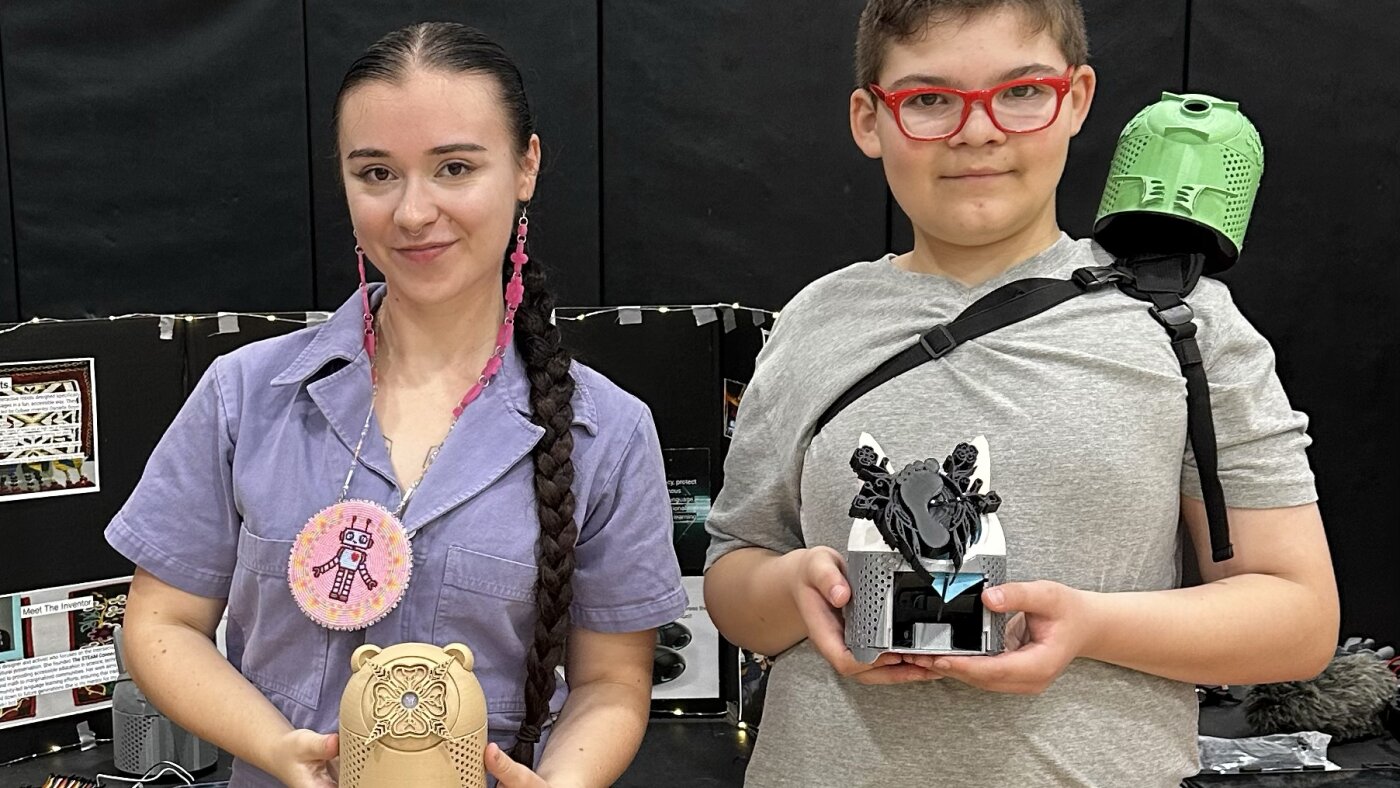
To address this, Boyer created the SkoBot—a toy robot designed to engage Indigenous children in language learning. SkoBots utilize artificial intelligence to speak Indigenous languages and are styled like woodland creatures with Native American floral designs, resembling mini R2-D2 droids.
“I can say ‘Hey SkoBot, what is bear?’ And it will say, ‘Bear is makwa, makwa,'” Boyer explains. This interactive approach is designed to make language learning exciting and relatable.
Boyer’s nonprofit, initiated when she was 18, has empowered hundreds of Native American children to construct their SkoBots. Among them is 12-year-old Holden Hoy, who shares, “I was already a big fan of robotics and how they work… And I’m Ojibwe, and so I’ve always wanted to save the Ojibwe language.”
At Sault Ste. Marie’s JKL Bahweting Anishinaabe School, Hoy presented his SkoBot, named Sabe—meaning Bigfoot, a symbol of honesty in Ojibwe culture. His classmates and their families eagerly engaged with the robot, which responds to commands using prerecorded audio, avoiding the pitfalls of generative AI.
“Basically when it hears that one trigger word, it then plays a prerecorded audio file. So there isn’t synthetic speech, there isn’t any generative AI,” Boyer explains. “AI tends to falsify things a lot,” Hoy adds, emphasizing the importance of accuracy in cultural preservation.
Preserving Culture Through Technology
Boyer’s SkoBot aims not to replace human interaction but to spark interest in Indigenous languages and STEM fields. She cautions against AI developed without Indigenous input, citing potential harm to communities. “When you are putting accurate information into these models … you’re giving away sacred information to companies that don’t have our best interests at heart.”
Hoy’s mother, Jocelyn, is thrilled about her son’s cultural engagement. “As someone who, at a time in my life, did not want to be identified as Native American … now as an adult, I cannot wait to learn more,” she shares, foreseeing the SkoBots as a bridge to deeper cultural understanding.
For Holden Hoy, language and culture are inextricably linked. “The language is the culture,” he asserts, emphasizing the importance of preserving this heritage for future generations.