
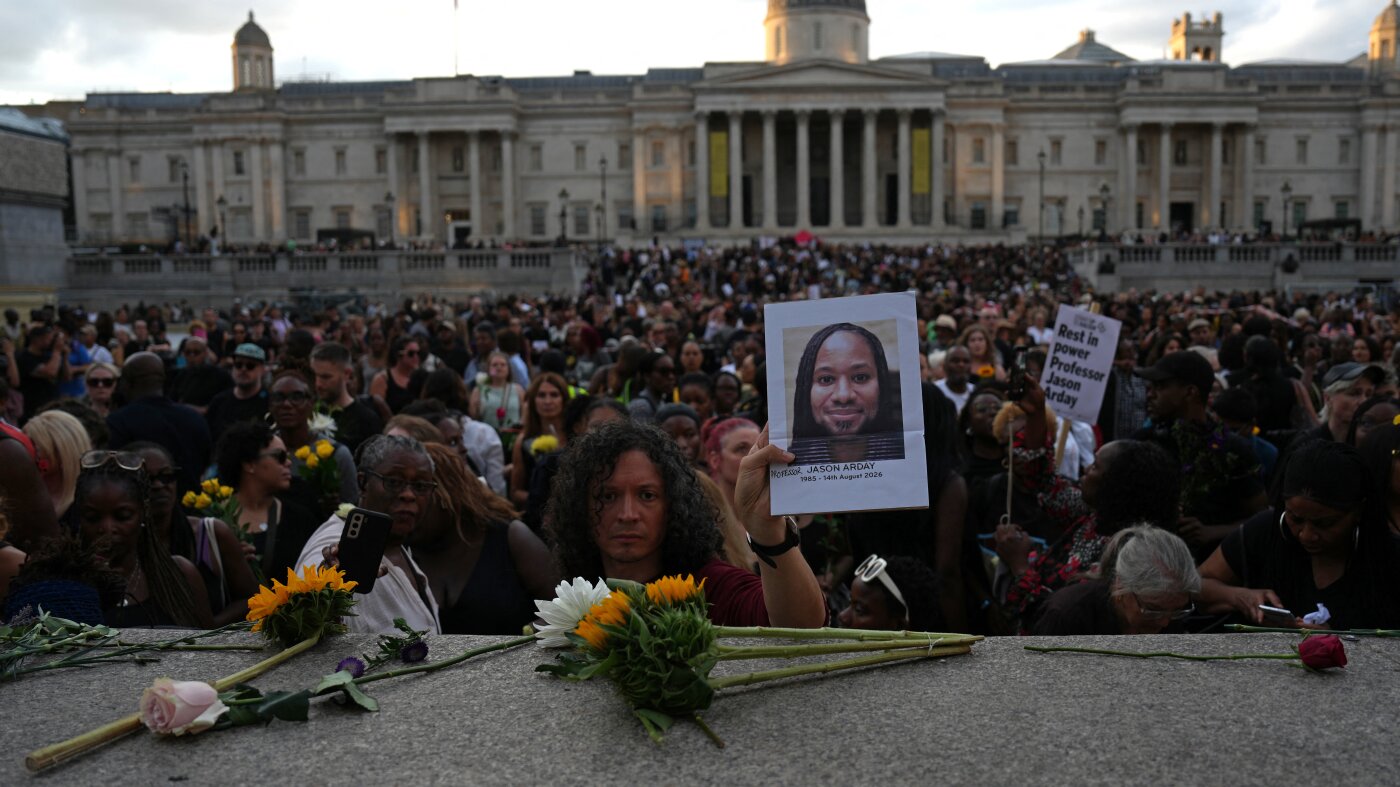

Supporters leave flowers and photographs at a vigil for late Cambridge professor Jason Arday in London on Aug. 17. Arday died Aug. 14 at age 41 amid allegations of plagiarism and embellishing his biography.
Carlos Jasso/AFP via Getty Images
toggle caption
Carlos Jasso/AFP via Getty Images
In a career marked by significant achievements and troubling controversies, Jason Arday’s life was a reflection of the complexities within academia. Arday, a sociologist renowned for his work on race and inequality, became the youngest Black professor at Cambridge University in 2023, only to later face serious allegations regarding his academic integrity.
Arday, who was 41 years old when he passed away on August 14, allegedly fabricated elements of his personal history and academic work. Despite denying any deliberate deception, he resigned from his position at Cambridge as the scrutiny surrounding him intensified, coupled with racial abuse online that persisted post-resignation.
Controversy and Allegations
The case of Jason Arday has sparked a broader debate about the dynamics within academic institutions. While some argue that Arday’s appointment at Cambridge highlights how diversity objectives might overshadow academic rigour, others view his downfall as indicative of the disproportionate and often racially motivated scrutiny faced by Black scholars.
Tyler Austin Harper, former Bates College professor and now The Atlantic writer, shared insights on NPR’s Morning Edition, mentioning that questions arose about various aspects of Arday’s biography, from his academic work to claims of overcoming significant personal challenges. Arday had stated he was nonverbal until the age of 11, unable to read until 18, and had run 600 miles in six days.
“Any one of these things may have perhaps been believable, but the sheer accumulation of implausibilities made it pretty apparent that he was a serial fabulist,” Harper remarked.
Institutional Dynamics and Implications
Harper also pointed out potential issues within the university system itself, suggesting that some institutions might prioritize diversity over academic qualifications, potentially leading to oversight errors in hiring processes. In Arday’s case, Harper suggested that Cambridge may have ignored red flags during his recruitment.
He noted the challenges faced by affirmative action and diversity advocates, as Arday’s situation could be used against such policies. However, Harper emphasized the necessity for elite institutions to remain open to addressing their shortcomings rather than adopting a defensive stance.
For those interested in exploring more details about this conversation, listen to the full interview by clicking the play button above.





Comments are closed.