

Supreme Court Faces Crucial Decision in Climate Lawsuit by Boulder
As the new Supreme Court term kicks off, all eyes are on a significant climate-related lawsuit that could redefine the boundaries of state power. Boulder, Colorado, has taken legal action against major energy companies, accusing them of misleading the public on the impacts of fossil fuels and thereby escalating climate-related disasters.
In 2018, Boulder County filed a lawsuit against Suncor Energy and ExxonMobil, arguing that these companies, along with a trade group, were aware for decades of the environmental risks posed by fossil fuels. The county claims that these actions have increased the likelihood of natural disasters like floods, extreme heat, and wildfires, which have burdened the community with financial and recovery costs.
The case has gained additional weight following the Marshall Fire in December 2021, which ravaged the area and left many residents, including Daryl McCool, grappling with the aftermath. McCool, who lost her home in the fire, now works to raise awareness on the human toll of climate change.
Corey Riday-White, legal director at the Center for Climate Integrity, stated, “This case represents whether or not we believe as a society that corporations should be held to the same standards that all of us are, right?” The lawsuit is still in its early stages in Colorado courts, but the energy companies have appealed to the U.S. Supreme Court to dismiss the case, arguing that only federal authorities have the jurisdiction and capability to manage climate change issues.
Debate on State Versus Federal Authority
The lawsuit has sparked a heated debate about the extent of state power in addressing environmental damage. Todd Zywicki from the Antonin Scalia Law School expressed skepticism, framing the issue as one of local versus global jurisdiction: “This is about whether a bunch of rich hippies in Boulder County are allowed to dictate environment and energy policy to the entire rest of the world.”
Meanwhile, the Trump administration supports the energy companies, viewing climate change as a global matter rather than a regional one. Sai Prakash, a law professor at the University of Virginia, warned of the potential for widespread liability: “If Boulder can attach liability to these two companies … I think it can attach liability to thousands of others as well.”
Financial Implications and Broader Legislative Impact
Boulder’s lawsuit aims not to regulate greenhouse gas emissions but to recover the costs of past and future climate-related damages. This case is among several similar lawsuits across the country, and a Supreme Court ruling could set a precedent affecting many others.
Legal experts, such as Jonathan Adler from the College of William and Mary, note that Congress has not stepped in to address these state-level claims, leaving the courts to navigate the legal complexities.
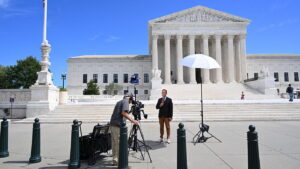
With Justice Samuel Alito’s recent recusal due to potential conflicts of interest, the case is now in the hands of the remaining eight justices. If the Supreme Court finds that it lacks jurisdiction, Boulder’s case could continue in the Colorado state courts.
Louie Delaware, a resident affected by the Marshall Fire, plans to attend the Supreme Court hearing, emphasizing a collective responsibility towards future generations: “You know it’s our responsibility to leave things better for the next generation,” he said.



Comments are closed.