
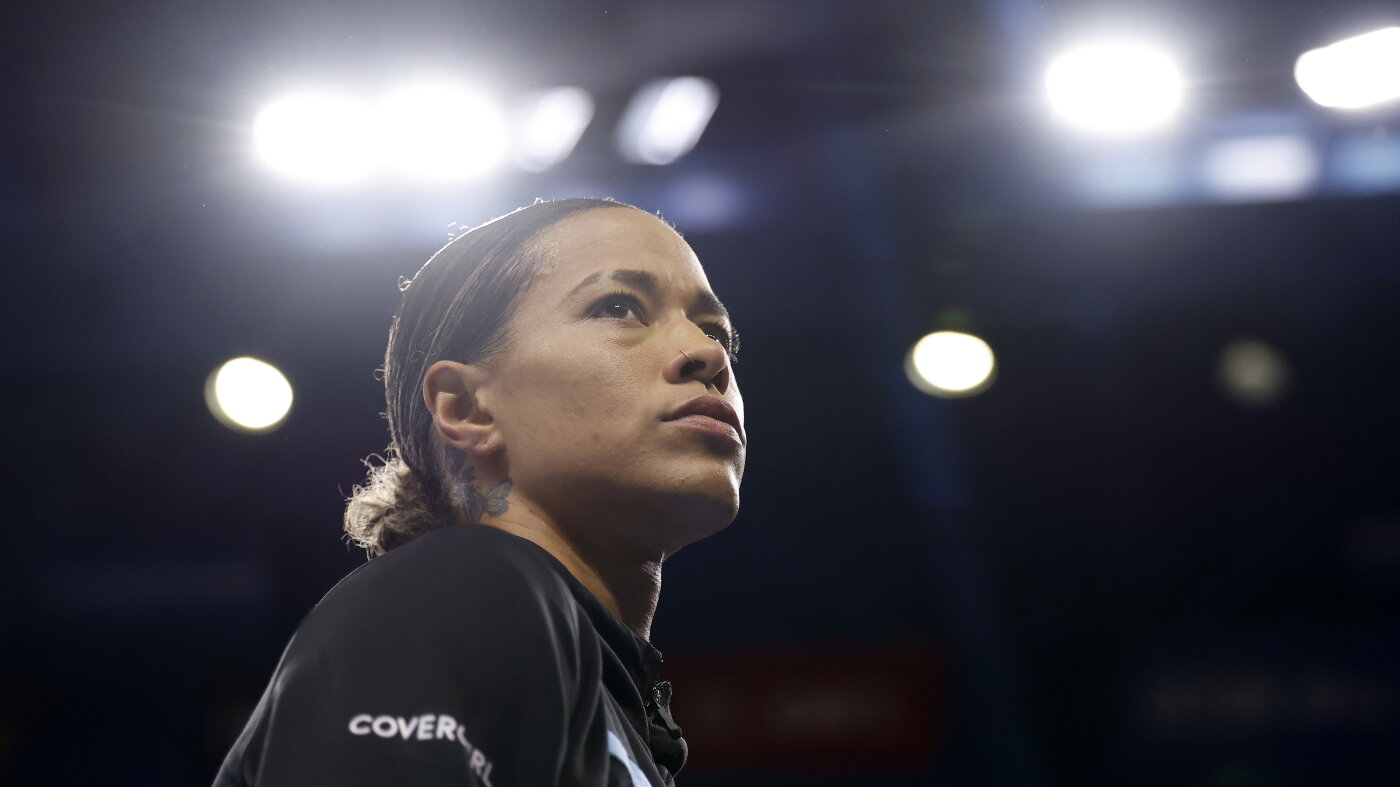

Natasha Cloud of the Chicago Sky looks on prior to the game against the Indiana Fever at Wintrust Arena on Aug. 23 in Chicago.
Michael Reaves/Getty Images
toggle caption
Michael Reaves/Getty Images
The Chicago Sky, a franchise in the WNBA, has taken a unique step in addressing online harassment faced by its players. With the sport’s rising popularity, players have increasingly become targets of abuse and threats, prompting the team to seek innovative solutions.
Nadia Rawlinson, co-owner and chairman of the Chicago Sky, has leveraged her corporate experience to empathize with the challenges faced by her players. “I’m an African-American woman who has been an executive in the private sector for my entire career [and] recently came into sports ownership about four or five years ago,” Rawlinson stated, reflecting on her understanding of their experiences.
Rawlinson’s personal insights enabled her to recognize the gravity of the harassment when players began reporting it. “When our players were telling us this is what they’re seeing, I believed them because it was very much related to how I experience my own life,” she explained.
In response to the escalating online hostility, the WNBA has initiated efforts like the “No Space for Hate” campaign and AI-driven tools to filter toxic comments. However, the Chicago Sky has gone further by teaming up with national security experts to tackle the issue.
“It’s just become a new world that we have to operate in, that we need to figure out how do we combat this level of abuse and harassment,” said Rawlinson, emphasizing the complexity of the situation.
The Sky partnered with the Polarization and Extremism Research and Innovation Lab (PERIL) at American University and Moonshot, a threat intelligence firm. PERIL focuses on countering extremism by enhancing community resilience, and Moonshot employs decade-old national security tools to monitor online threats. Elizabeth Neumann, Moonshot’s chief strategy officer, remarked on the adaptation of these technologies for sports, “It says a lot that here we are, 10 years later, taking that same technology, the methodologies that we use to help governments counter terrorism and other targeted violence, and we are now having to apply it to sports entertainment.”
A vibe shift as a league’s popularity soars
The WNBA’s increasing visibility has attracted not only fans but also those looking to exploit cultural divisions. The narrative around players like Caitlin Clark and Angel Reese has shifted the fan environment, fueled by media-driven rivalries and league promotions.
Journalist Frankie de la Cretaz noted the cultural dynamics at play, describing Clark as the “Great White Hope” and highlighting the league’s tendency to uplift traditionally feminine and straight white players as faces of the league.
The WNBA has not commented on this narrative, but the league’s diverse and inclusive culture is now a focal point for criticism. With the intersection of race, gender, and sexuality, players face a multi-layered onslaught of abuse, as observed by de la Cretaz.
Misogyny: a “Trojan horse” to other forms of hate
Recent incidents at WNBA games have spotlighted the misogyny players encounter, which experts like Cynthia Miller-Idriss of PERIL identify as a gateway to broader hate. Her book, Man Up: The New Misogyny & The Rise of Violent Extremism, explores these connections.
Miller-Idriss argues that addressing misogyny is crucial for tackling other hate forms, describing it as a “Trojan horse” that carries various prejudices. The collaboration with the Chicago Sky provides a platform for PERIL to test educational strategies to combat misogyny through initiatives like the “Be the Sixth Player” campaign.
A rising trend across sports
Data from Moonshot indicates that the WNBA’s experience is part of a broader trend of increasing online abuse in sports. For Team USA athletes during recent Olympics, threats and harassment have surged, with a significant focus on women and athletes of color.
The nature of the abuse varies by gender, with women facing threats based on identity rather than performance, as noted by Moonshot’s Michael Pattullo. The rise in misogyny, intertwined with technological advancements enabling harmful content creation, poses new challenges for the sports community.
WNBA players, by challenging traditional gender roles and societal expectations, find themselves at the forefront of this cultural conflict, as observed by de la Cretaz. Their visibility in rejecting conservative narratives about femininity has made them targets in the ongoing discourse.




Comments are closed.