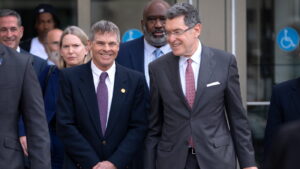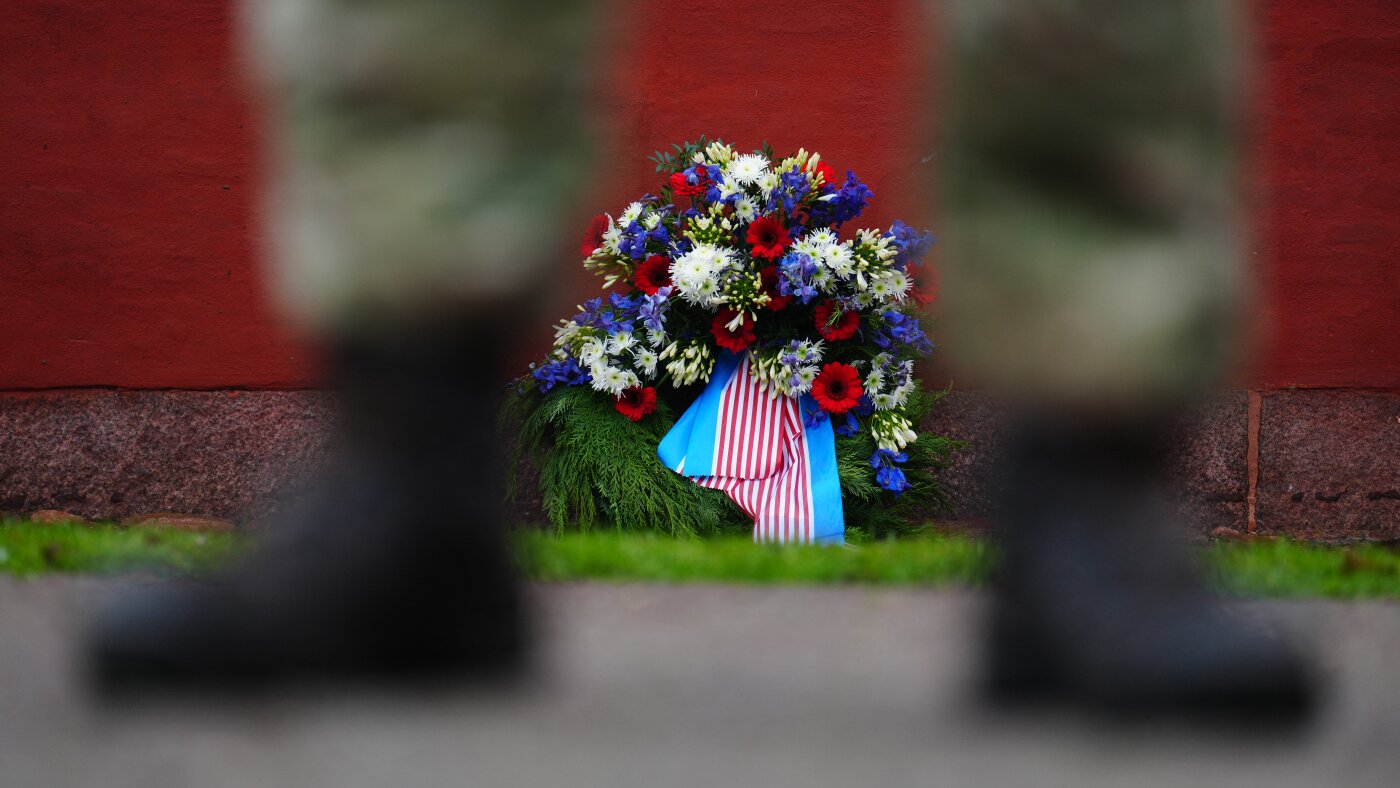

The Memorial for Denmark’s international efforts after 1948 at Kastellet in Copenhagen includes commemoration for fallen Danish soldiers. Members of a U.S. congressional delegation laid a wreath there on Jan. 17, after a visit to voice support for Denmark and Greenland.
IDA MARIE ODGAARD/Ritzau Scanpix/AFP via Getty Images
hide caption
toggle caption
IDA MARIE ODGAARD/Ritzau Scanpix/AFP via Getty Images
In the heart of Copenhagen, against a backdrop of flickering heat lamps, Company Sergeant Major Henrik Bager sat at a cafe sharing a Danish saying about handling stress. “You have a cup. When it’s filled, you need to empty it so you don’t get stressed or angry or to do stupid stuff,” he explained.
Earlier this month, Bager’s “cup” was overflowing, fueled by remarks from President Trump suggesting Denmark’s lack of commitment to Greenland’s security, which he perceived as a slight to Denmark’s alliance with the U.S.
“The first time it felt like a punch to the gut,” said Bager, who has served alongside American troops in Afghanistan and Iraq. “You can survive one punch in the gut. When it just keeps on going, then it fills you up with sadness, disappointment, anger.”
To process these emotions, Bager wrote a heartfelt letter, almost poetic in nature, to former U.S. Ambassador to Denmark Rufus Gifford, expressing his dismay.
Dear Rufus Gifford,
I’m not writing as a politician.
Not as an analyst.
I’m writing as a Danish Afghanistan and Iraq veteran.And yes – this brings tears to my eyes.
When the U.S. today calls Denmark a poor ally, it feels like a slap in the face to those of us who were actually there.
After 9/11, Denmark did not hesitate.
We didn’t debate polls.
We didn’t calculate politics.We put on our gear.
We said goodbye to our families.
We kissed our children goodnight and hoped we’d see them again.We stood side by side with American soldiers.
We patrolled together.
We covered each other.
We bled together.
And we lost people.Danish soldiers never came back home because we took the alliance seriously – not as words, but as a promise between soldiers.
So when Denmark is called disloyal, it doesn’t just hit a country.
It hits those of us who wore the uniform.
It hits the fallen.
It hits the families still paying the price.We don’t expect thanks.
We don’t expect applause.But we do expect honesty.
And respect for history.Denmark was there when it mattered.
And we were not half-hearted.A solider never forgets who stood by his side.
Nations shouldn’t either.Thanks for your voice, you have the respect from the Danish people.
Bager sent the letter without anticipating a reply. However, Gifford did read it and was moved. “I got so emotional when I read it,” Gifford remarked. “It hits me right here – in the heart.” The two met for the first time on a Monday, sharing their thoughts with NPR.

Former U.S. Ambassador to Denmark Rufus Gifford (L) and Company Sergeant Major Henrik Bager (R) meet for the first time on Jan. 19. Bager sent a letter to Gifford earlier this month expressing his sadness and disappointment at the way in which the Trump administration has been talking about Denmark.
Barbara Sprunt/NPR
hide caption
toggle caption
Barbara Sprunt/NPR
Gifford reflected on the significance of NATO alliances, emphasizing the importance of mutual support among member countries. “You think about the success of this alliance, which is about sticking up for your friends just as much as it is about sticking up for yourself,” he stated. He recalled the invocation of Article Five after 9/11, which solidified Denmark’s involvement in Afghanistan.
Bager shared his experiences from his 2009 deployment in Helmand Province, a site of intense conflict with the Taliban. Despite personal loss during this time, he returned to fulfill his duties, embodying the dedication of Danish soldiers. Denmark’s commitment during the conflict is evidenced by the high per capita death rate, with 43 Danish soldiers losing their lives.
The rhetoric from the Trump administration has been a source of pain for many Danes, including those who served and lost loved ones in the conflict. “For those families who didn’t get their soldier home, sitting and listening to this rhetoric being used, it must be more painful, hurtful than it is for me – and I can feel it all the way to my bones,” Bager expressed.
Despite these challenges, Bager extended gratitude to his American counterparts. “If any American veterans are listening to this, thank you for your service,” he said, hoping for future peaceful collaborations.
‘All those deaths seem disrespected’
Danes, like 21-year-old Villads Welling, have expressed disappointment with recent U.S. rhetoric, feeling it disrespects sacrifices made by Danish soldiers. Similarly, Peter Jensen, whose sons are veterans, described the situation as a betrayal of trust.
While Trump dismissed the idea of acquiring Greenland by force, feelings of hurt and betrayal linger among Danes. Jensen emphasized his frustration was directed at the administration rather than the American people, maintaining a fondness for America amidst the chaos.

Søren Knudsen, a retired officer with the Danish Army, and his wife Gina Schaar at their home in Køge, Denmark. The couple said they worry the Trump administration’s rhetoric about Denmark risks a fundamental change in the relationship between Denmark and the U.S.
Barbara Sprunt/NPR
hide caption
toggle caption
Barbara Sprunt/NPR
Taking the Stars and Stripes down
Søren Knudsen, a retired Danish Army officer, reflected on the honor he felt receiving The Stars and Stripes after serving as Deputy Commander of a NATO mission in Afghanistan. The flag, a symbol of acknowledgment from the Americans, once proudly hung in his home’s entrance in Ølby.
However, following recent U.S. rhetoric, Knudsen felt compelled to remove the flag. “I walked down the stairs and said, no way, I’m not going to show this,” he remarked, pointing to where the flag once hung. His wife, Gina Schaar, shared the sentiment, saddened by the strain on their international bond.
Both Knudsen and Schaar expressed concern over the potential long-term impact of the Trump administration’s rhetoric on U.S.-Danish relations. Knudsen, who also serves as vice chairman of the Danish Veterans Association, emphasized the deep connection Danes have felt with America. “The Danes have felt the U.S. was a beacon and a leader of the free world,” he said, hoping for a future where the Stars and Stripes might once again hold its place of honor.