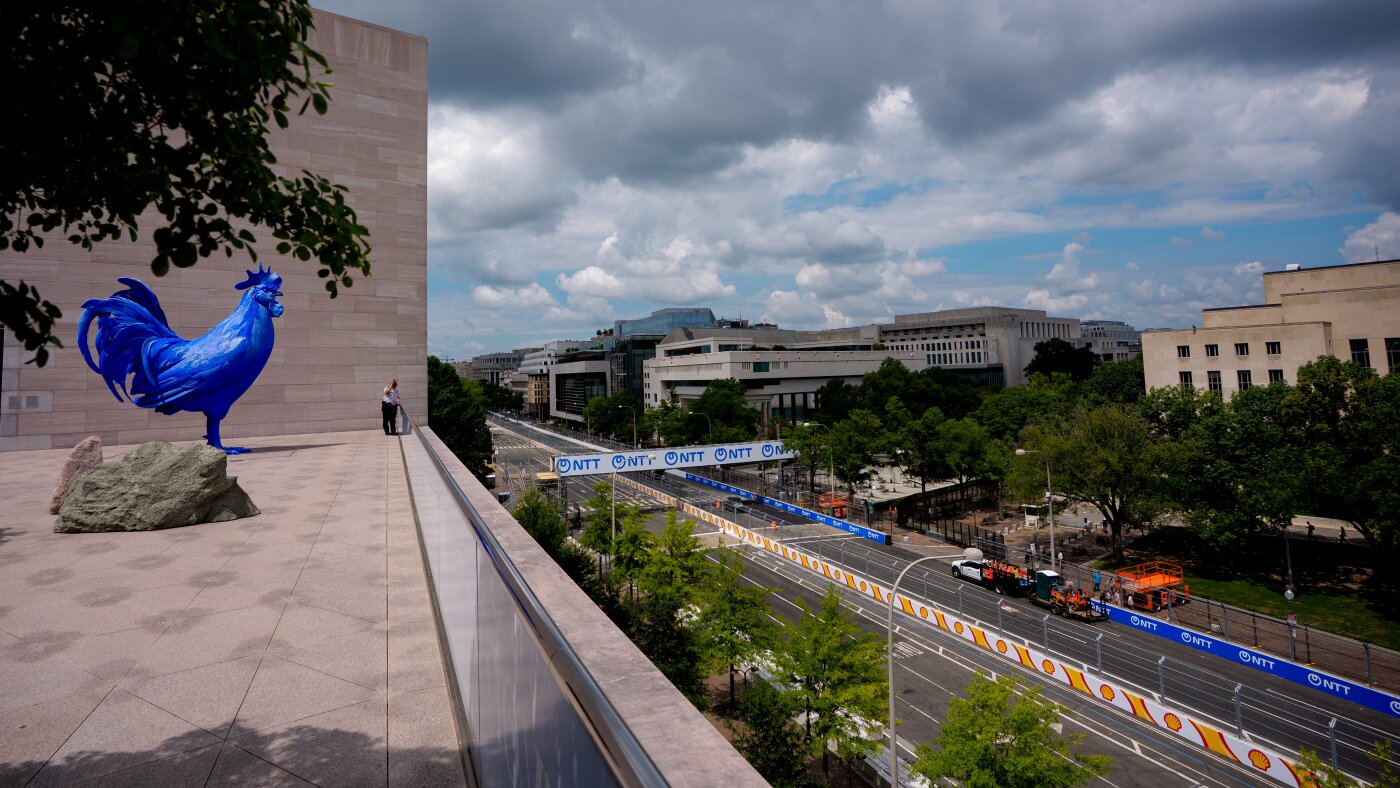

A 14-foot-tall blue rooster sculpture overlooks the racetrack from the roof of the National Gallery of Art’s East Building in Washington, D.C.
Andrew Harnik/Getty Images
hide caption
toggle caption
Andrew Harnik/Getty Images
This weekend, the heart of Washington, D.C., will pulse with the roar of engines as more than 24 IndyCar drivers navigate 147 laps around the National Mall for the Freedom 250 Grand Prix. The event is set to commemorate a significant milestone in the nation’s history.
The weekend-long event will feature practice runs, qualifiers, and warm-ups, leading up to the 250-mile race on Sunday afternoon. The cars are expected to reach speeds of up to 180 mph on the 1.7-mile track that winds through the National Mall.
As they speed along the course, drivers will pass cultural landmarks such as the National Gallery of Art, the National Archives Building, and Smithsonian museums, raising concerns about the potential impact on these historic sites. Could the vibrations from the racing cars pose a risk to the art and artifacts housed within these institutions?
The National Gallery of Art has taken precautions by boarding up some of its outdoor pieces. Chris Abanavas, a spokesperson for the gallery, stated in an email to NPR that the gallery “conducted an extensive vibration study and based on the results we have implemented a set of measures to ensure the safety of our staff, visitors, collection, and facilities during the race.”
While officials from the National Archives and the Smithsonian have not provided comments, race organizers, including the White House and IndyCar, maintain that they are taking necessary safety measures and do not expect any damage. Davis Ingle, a White House spokesperson, assured NPR via email that “the White House and Penske have followed all appropriate protocols and been in close coordination with all relevant agencies to ensure this is also the safest and most secure race for all visitors to enjoy.”
IndyCar officials reference the success of races in similar sensitive environments, such as Detroit’s Belle Isle Park and near the Dalí Museum in St. Petersburg, Florida. “With this excellent track record and the thorough preparation we have done for this event, working closely with all the appropriate local and federal agencies, we do not anticipate any impact on the structures surrounding the circuit as a result of the race,” stated IndyCar spokesperson Alex Damron.
However, some critics argue that the National Mall presents unique challenges, as the area typically observes speed limits around 25 mph and has never hosted an event of this nature. Mary Okin, an art historian and assistant director at Living New Deal, expressed concerns about the potential risks to historic structures and artifacts, emphasizing that such events could jeopardize access to these treasures for future generations. Okin’s letter to the National Park Service outlined her concerns, including potential vibration damage and the risk of fires or flying debris.
“For several hours of racing cars, we might be risking … the access to these extraordinary works for future generations,” Okin remarked to NPR. She highlighted the Wilbur J. Cohen Federal Building, a protected historic site along the race route, as a specific concern.
The race was planned in less than a year
Even the event’s organizers acknowledged the tight timeline for planning. “Instead of having two-and-a-half years to plan this thing, I’ve had seven months,” said Bud Denker, chair of the Freedom 250 Grand Prix. The concept for the race emerged during a casual conversation between Denker and Fox Sports CEO Eric Shanks last year.
Efforts to establish a course around the Capitol building were unsuccessful, leading to President Trump’s authorization of the National Mall route through an executive order in January. Denker, who has been residing in D.C. intermittently, expressed enthusiasm for the event, describing it as “the most incredible celebration that we’ve seen this summer.”
Preparations for the race include constructing the track, pit lane, and viewing structures, while also implementing safety measures such as road closures and manhole cover welding. Denker assured that Penske would cover all costs except for security, which is funded by both district and federal resources.
Despite the comprehensive preparations and studies provided to local institutions, concerns about potential vibration impact remain. Leila Sauvage, a paper conservator and vibration expert at the Rijksmuseum in Amsterdam, emphasized the importance of monitoring and documenting vibration impacts on art collections.
The National Park Service, in response to Okin’s inquiries, did not indicate an intention to install vibration monitors. However, they have assured that the permit review process did not identify the Cohen building as affected. The General Services Administration, which oversees the Cohen building, has promised post-race assessments but has not detailed their scope.
Sauvage believes that an objective assessment of the race’s impact could aid future preservation efforts. She hopes that by documenting the event’s vibration levels, future conservators will have valuable information to reference. Meanwhile, Okin hopes that any potential damage is addressed openly and responsibly, emphasizing the need for transparency and accountability.