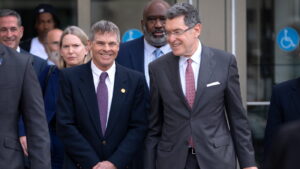
As the government shutdown continues into its 10th day, the halls of Capitol Hill echo with a lack of progress. Despite numerous votes, senators appear to be caught in a cycle of inaction, leaving many to wonder about the efforts being made to resolve the impasse.
Senators have repeatedly cast their votes on two short-term funding measures aimed at reopening the government. The proposals, one largely supported by Republicans and the other by Democrats, have been put to the vote seven times and have failed to reach the necessary 60 votes for advancement on each occasion. Without bipartisan cooperation, the deadlock persists.
Democratic Senator John Fetterman of Pennsylvania, one of the few in his party crossing the aisle to support the Republican-backed bill, expressed frustration. “People really are just kind of dug in and then everything is hyper-politicized,” he remarked, describing the voting routine as far removed from his expectations of Senate service. “I think people should realize that there’s no glamor,” he added.
Once heralded by President James Buchanan as “the world’s greatest deliberative body,” the Senate seems to be falling short of this ideal. Democratic Senator Raphael Warnock of Georgia noted the lack of meaningful discussion, stating, “I wish we did more deliberating.” Despite his reservations, Warnock remains committed to opposing the Republican proposal to protect health insurance subsidies, aligning with the expectations of his constituents. “It’s never too late to come to Jesus,” he mused, hopeful that a compromise might be reached.
Both parties anticipated defections within the opposing ranks; however, neither prediction has materialized. Republican Senator John Kennedy of Louisiana observed, “The further we go, the deeper we get dug in.” For some senators, the repetitive nature of the proceedings evokes a sense of déjà vu, with Republican Senator Thom Tillis expressing his exasperation, “My God, make it stop.”
Independent Senator Angus King of Maine questioned the efficacy of the institution, lamenting, “If you think about it, we’ve only really passed, I think, two or three bills this year, and that’s not what this institution was designed to do.”
Amidst the stalemate, informal efforts to foster dialogue persist. A bipartisan group of senators recently convened over a meal to exchange ideas, though specifics remain undisclosed. “I don’t talk about what happens at mealtimes,” commented Alaska Republican Senator Lisa Murkowski. Emphasizing the importance of communication, she added, “If you don’t have communication, nothing changes, right?”
Republican Senator Markwayne Mullin of Oklahoma participated in these discussions, opting out of the Thai food in favor of simpler fare. “I like cheeseburgers. I like hot dogs. I like pop tarts. I like cookies,” he joked, underscoring the casual nature of the gathering. While no resolution to the shutdown was reached, Mullin valued the candid exchanges, stating, “We trust each other, and we can have candid conversations. And they’ve been, I think, pretty productive.”
Despite the impasse, there are hints of a potential way forward, including a possible vote to extend health insurance subsidies after the government reopens. Democratic Senator Tim Kaine of Virginia sees value in the ongoing voting process, explaining, “Votes tend to be the reason that everybody comes to the floor and then spends time talking to try to find a solution. We haven’t found a solution yet, but we’re going to keep at it.”
As the weekend arrives, senators have returned home without a resolution, leaving the government shutdown to extend into yet another week.