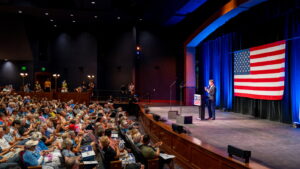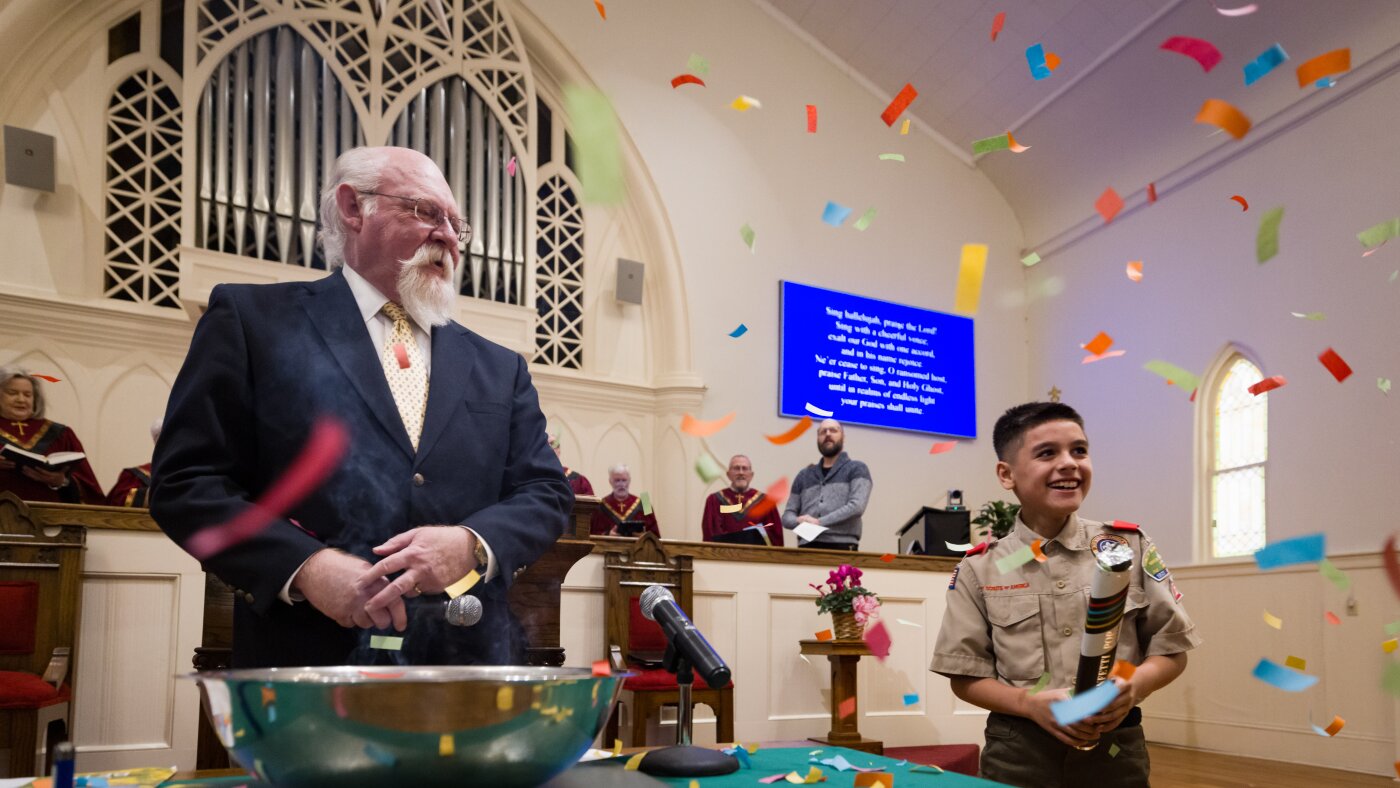

Kids from a local Scouting group helped the Rev. John Jackman celebrate at Trinity Moravian Church in Winston-Salem, North Carolina, as the church marked the end of its latest Debt Jubilee Project to buy up and retire medical debt.
Allison Lee Isley/KFF Health News
hide caption
toggle caption
Allison Lee Isley/KFF Health News
WINSTON-SALEM, N.C. — Inside the walls of Trinity Moravian Church, political differences are not uncommon. Yet, a shared mission to alleviate medical debt has unified the congregation.
“We’ve got quite a spread of political beliefs,” explains the Rev. John Jackman. This 114-year-old church near the old textile mills of Winston-Salem hosts both conservative Republicans and liberal Democrats, creating a “purple congregation,” as Jackman describes it.
A Unique Congregational Mission
Four years ago, Rev. Jackman proposed a project that would bring the church together: a mission to relieve medical debt in the wider Winston-Salem area. “This is the easiest money I’ve ever raised,” Jackman notes. “All I do is tell people what we’re doing, and they write me a check.”
In a country where healthcare debates often divide, the Trinity Moravian community found common ground in addressing what they saw as an unfair burden of medical debt on their neighbors. Contributions poured in, ranging from $25 to $50, supporting a movement that has gained traction not just locally but nationally. Even conservative radio host Glenn Beck praised the initiative.
Trinity Moravian’s efforts have resonated across North Carolina, inspiring state officials to address the issue of medical debt. The church’s success underscores a shared frustration with a healthcare system that leaves many in financial distress.
A Broader Movement
This year, Trinity concluded its eighth medical debt campaign under its Debt Jubilee Project, raising over $17,000 and retiring more than $2.2 million in debt. Medical debt is often purchased for pennies on the dollar, a strategy the church has leveraged effectively.
According to estimates, around 100 million U.S. adults hold some form of healthcare debt, with over half having experienced it at some point in their lives.
Within Trinity’s 200-member congregation, personal stories of overwhelming medical debt are common. Catherine Coe, who works in a hospital’s accounting department, shares, “I see people going into debt every minute of every day. We’re all just one medical bill from financial ruin.”
Coe, who rejoined the church after drifting away, identifies as a conservative and supported Trump. Conversely, Terri Mabe, a long-time member, holds opposing political views but shares a similar experience with medical debt from her years in the construction industry.
Bridging Political Divides
Catherine Coe and Terri Mabe illustrate how political differences fade in the face of shared struggles. “There isn’t a political divide when it comes to medical debt,” Coe asserts. “It all brings us together.”
The pandemic heightened awareness of financial burdens, prompting Jackman to act. “I was hearing about the reason they couldn’t pay their electric bill was because they’d had a few days in the hospital and then they got hit with this huge bill,” he recalls. This led him to discover Undue Medical Debt, a nonprofit that buys and retires unpaid medical bills.
Trinity’s initial 2022 campaign aimed to raise $5,000 to alleviate $500,000 in medical debt in Forsyth County. The goal was quickly met, largely through small donations.
Paul Sluder, a former credit union worker, observes that most people want to pay their debts but face insurmountable challenges when illness strikes. “It’s incredibly unfair, and I think the system’s out of whack,” he says.
Common Ground in Healthcare
The issue of medical debt transcends political lines, as reflected in a 2025 survey where a majority of both Republicans and Democrats opposed wage garnishment for medical debt. Bipartisan efforts have emerged to protect individuals from excessive medical debt burdens.
Coe advocates for capping medical debt, asking, “Why can’t we cap medical debt at a certain dollar amount, and after that it’s either written off or forgiven?”
Trinity’s recent debt campaign concluded with a symbolic gesture of unity and forgiveness. As Rev. Jackman burned a list of 1,631 names whose debts were retired, the congregation celebrated with confetti and song.
Reflecting on the event, members like Cynthia Tesh express hope for broader unity. “There’s just so much division, so much anger,” Tesh says. “We need to look out for one another.”