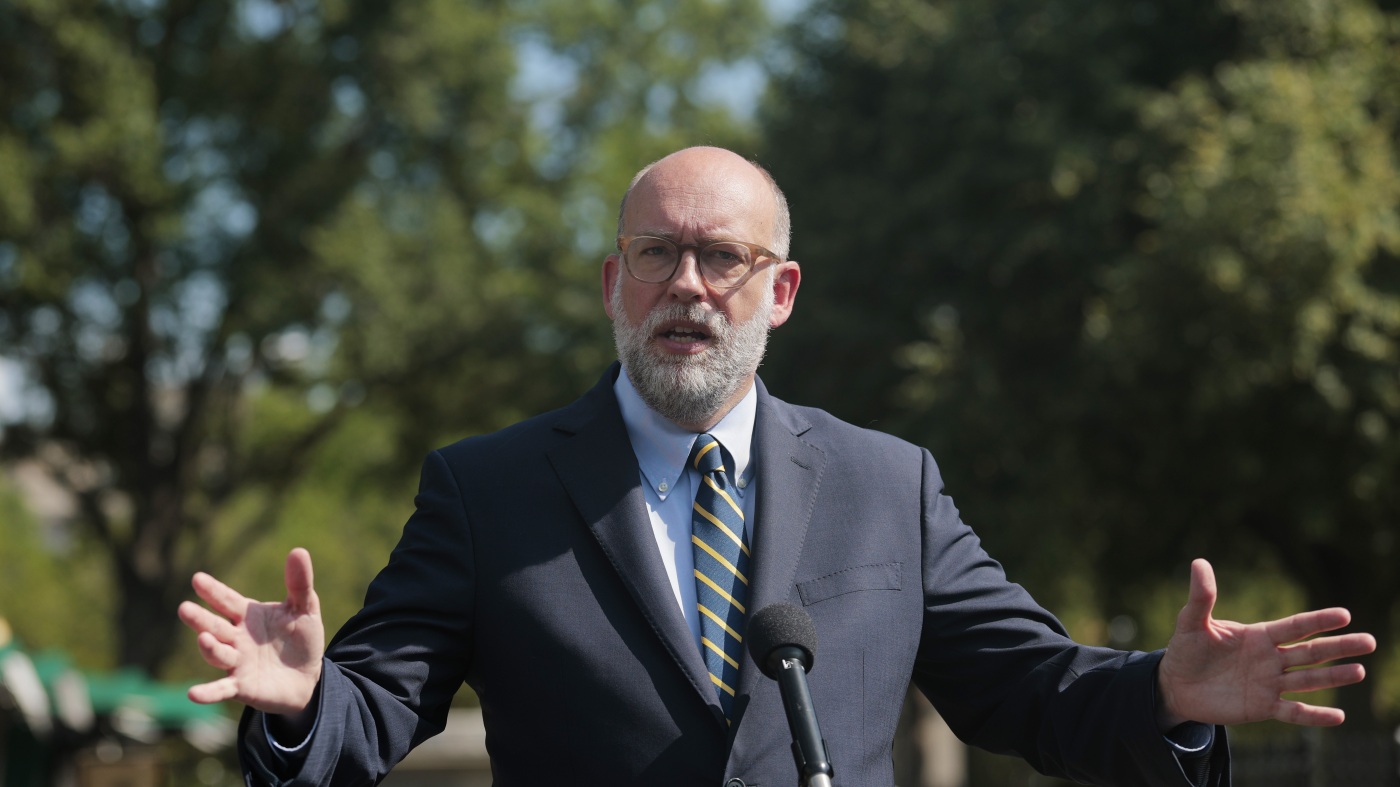

Russell Vought, director of the Office of Management and Budget, speaks with reporters outside of the West Wing of the White House on July 17.
Anna Moneymaker/Getty Images
hide caption
toggle caption
Anna Moneymaker/Getty Images
As the federal government faces a shutdown, President Trump has announced plans to confer with budget director Russ Vought to identify potential cuts in what he terms “Democrat Agencies.” This comes as the administration leverages the shutdown to criticize the Democratic Party.
In a post on Truth Social, Trump expressed surprise at the “unprecedented opportunity” provided by the Democrats and urged Republicans to “clear out dead wood” to save billions through cutting waste and fraud, though he did not provide specific examples (source).
Some view the administration’s threats as a mere “bluff” designed to bring Democrats back to negotiations, yet Vought, heading the Office of Management and Budget, appears to be acting on these promises. Recently, he announced the cancellation of $8 billion in energy projects and an $18 billion infrastructure budget cut for New York City, targeting the home state of prominent Democratic leaders.
House Speaker Mike Johnson, R-La., asserted that Vought’s actions are guided by necessity, attributing blame to Senate Democrats for the current situation. “Russ has to sit down and decide… which policies, personnel, and which programs are essential and which are not,” Johnson stated. He suggested the dilemma could be resolved if Senate Democrats would negotiate.
Executive Power Amid Shutdown
Despite the shutdown, Bridget Dooling, a law professor, clarifies that Vought and the White House do not gain additional authority. She points out the difference between temporary funding lapses and permanent layoffs. “This is a bluff,” Dooling states, suggesting that the administration seeks to leverage the situation to drive negotiations.
Vought’s past advocacy aligns with the administration’s current approach. He played a significant role in creating Project 2025, a conservative agenda promoting drastic spending cuts and federal workforce restructuring.
Impact and Reactions
Democratic leaders have expressed concerns about the administration’s actions. Sen. Chris Murphy, D-Conn., criticized the cancellation of a wind project in his state, viewing it as an attempt to penalize political adversaries. “This is increasing signs of our democracy evaporating before our eyes,” Murphy remarked.
Federal workers, represented by labor unions, have also taken legal action against Vought and OPM Director Scott Kupor, accusing them of unlawful threats to essential services. Everett Kelley, AFGE president, described the administration’s actions as “an illegal abuse of power” in a recent NPR interview.
While the shutdown continues, Senate Appropriations Committee Chair Susan Collins, R-Maine, opposes unilateral cuts and stresses the importance of bipartisan spending agreements. Meanwhile, Sen. Mike Rounds, R-S.D., argues that the shutdown provides an opportunity for cost reduction.
As negotiations persist, the federal government and its workforce remain in a state of uncertainty, with both parties seeking solutions to reopen operations.