
The Smithsonian Institution Building on the National Mall is seen on March 28 in Washington, D.C. The organization is the target of an order from President Donald Trump that seeks to restore “truth and sanity to American history.”
Kevin Dietsch/Getty Images
hide caption
toggle caption
Kevin Dietsch/Getty Images
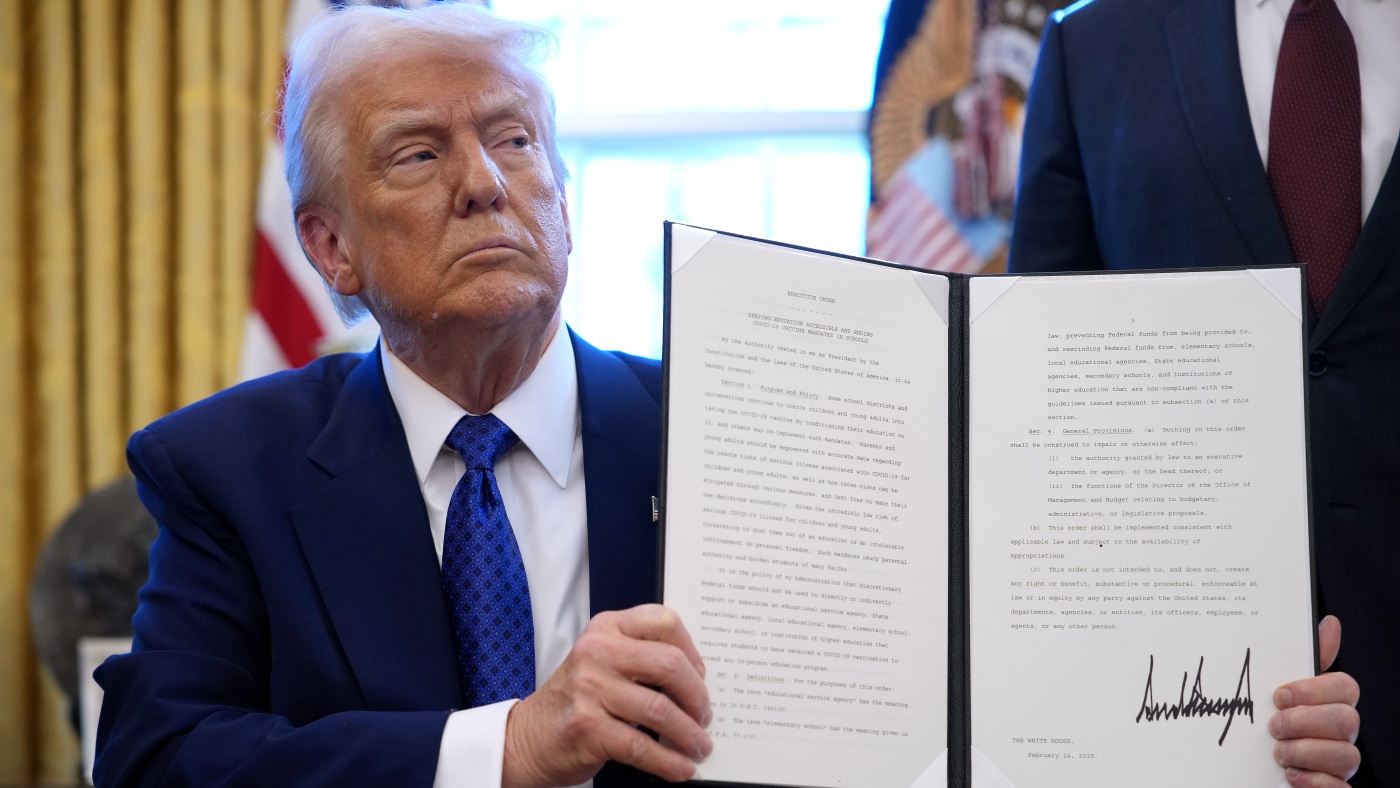
In a bold move to reshape the narrative of America’s past, President Donald Trump has issued a series of executive orders aimed at reinterpreting American history. The series of actions highlights a significant shift in how historical narratives are formed and conveys the administration’s intent to present a new version of the nation’s story.
“Over the past decade, Americans have witnessed a concerted and widespread effort to rewrite our Nation’s history, replacing objective facts with a distorted narrative driven by ideology rather than truth,” the president stated in an executive order titled “Restoring Truth And Sanity To American History.”
This effort appears to be a part of a broader strategy that many presidents utilize, aiming to leverage historical perspectives to reinforce their political agendas. Trump’s approach, however, is being met with both support and criticism, revealing deep divisions in how history should be represented.
While Trump emphasizes a return to “our extraordinary heritage, consistent progress toward becoming a more perfect Union,” historians express concern over the potential implications of these actions. Some fear that the executive orders could lead to a diminishment of the achievements of women and minorities throughout history.
The Organization of American Historians has raised alarms, stating that institutions such as museums are now “under assault.” The group has criticized the president’s actions as an attack on the public presentation of history.
Supporters of Trump’s initiatives argue that these measures are necessary to counteract what they perceive as a skewed version of history. According to White House Spokesman Davis Ingle, “President Trump continues to fulfill his promise in restoring truth and common sense to the United States and its institutions.”

Cadets training to join the first black combat unit in the U.S. Army Air Corps are seen with an instructor in Tuskegee, Ala., on Sept. 5, 1942.
AP
hide caption
toggle caption
AP
Executive actions and orders related to history
- Restoring Truth And Sanity To American History
The March 27 executive order calls for the removal of “divisive, race-centered ideology” at the Smithsonian Institution, and instructs the Interior secretary to revoke recent changes to landmarks and monuments if they’re found to “perpetuate a false reconstruction of American history.” - Improving Education Outcomes by Empowering Parents, States, and Communities
The March 20 executive order seeks to shut down the Department of Education. It also calls for withholding federal money from programs related to diversity, equity and inclusion or “promoting gender ideology.” - Continuing The Reduction Of The Federal Bureaucracy
The March 14 presidential action seeks to dismantle the Institute of Museum and Library Services, which sends federal money to libraries and museums, and six other agencies. - Restoring America’s Fighting Force
The Jan. 27 action abolishes DEI programs and initiatives in the military, long seen as a pioneer in America’s push toward racial equality. The Trump administration later reverses a purge of Pentagon webpages featuring notable female and minority veterans. - Ending Radical Indoctrination in K-12 Schooling
The Jan. 29 action revives Trump’s 2020 call for “patriotic education.” It accuses schools of indoctrinating children in anti-American ideologies, citing gender policies and stating that “demanding acquiescence to ‘White Privilege’ or ‘unconscious bias,’ actually promotes racial discrimination and undermines national unity.” - Restoring Names That Honor American Greatness
Trump seeks to put his stamp on the map in this Jan. 20 action, calling for changing the name of the Alaskan mountain known as Denali back to its earlier name, Mount McKinley, and changing the Gulf of Mexico to the Gulf of America. - Celebrating America’s 250th Birthday
The action from Jan. 29 reinstates and expands Trump’s 2020 plan to create a National Garden of American Heroes. The original list includes civil rights activist Ida B. Wells-Barnett and anti-abortion activist Nellie Gray, along with actor John Wayne and Oglala Lakota war strategist Red Cloud.
Competing visions of how to view American history
Historically, U.S. presidents often reconsider the past to align with their political visions, reversing the actions of their predecessors. However, Trump’s current actions may represent a novel approach to historical reinterpretation.
“Rather than seeking to place himself in [history], he’s trying to transform it to fit him,” says Jefferson Cowie, a Pulitzer Prize-winning historian at Vanderbilt University. He calls Trump’s approach a “completely different kind of project” than previous presidents.

Denali, the tallest mountain on the North American continent, is seen here looming behind a boat on the Susitna River near Talkeetna, Alaska, in June 2021.
Mark Thiessen/AP
hide caption
toggle caption
Mark Thiessen/AP
Cowie says that Trump’s long-running slogan, “Make America Great Again,” points to how he wants to portray history.
“Like a lot of populists, he works on nostalgia for a golden age,” the historian says. “This idea that somebody took your birthright and there’s some version of America we need to get back to.”
Cowie suggests that Trump’s vision invokes two particular eras: the era of American manufacturing when jobs were stable and wages were increasing, and the 1950s, a time before the Civil Rights movement, characterized by white, patriarchal households.
The pursuit of these visions raises a fundamental question: Should America strive to revert to a past era of perceived glory, or should it continue to progress forward, learning from its history?
Angela Diaz, an associate professor at the University of Illinois Urbana-Champaign, notes that for many groups, a return to the past would mean erasing significant social progress. She argues that history should encompass a broader array of stories to provide a more complete and accurate picture.
Conservatives applaud Trump’s moves
Trump’s initiatives have been well-received by conservative groups, including the Heritage Foundation, which created Project 2025. This initiative outlines strategies to counteract what it describes as “The Great Awokening.”
Jonathan Butcher, a senior fellow at the Heritage Foundation, supports Trump’s reinstatement of the 1776 Project, viewing it as a corrective to the 1619 Project from The New York Times.
The 1776 Report identifies several challenges to America’s principles, including slavery, progressivism, fascism, communism, and “racism and identity politics.”

People attend the unveiling of a Confederate monument surrounded by U.S. and Confederate flags at Arlington Cemetery, Va., on June 4, 1914.
Library of Congress
hide caption
toggle caption
Library of Congress
When the administration looks to prohibit DEI programs in schools, he adds, “it is with the understanding that those particular concepts are based on racial favoritism.”
Butcher agrees that there is a tension between two fundamental approaches to history: one focusing on America’s ideals, and one focusing on the country’s failures to embody them.
“Those two ideas are always going to be in competition in American life,” Butcher says. The country’s story includes the institution of slavery and the Jim Crow era, he explains, as well as the Constitution and the Declaration of Independence and the notion of God-given individual rights.
In Butcher’s view, the history of race in the U.S. has been portrayed recently in inaccurate or problematic ways, citing both The 1619 Project and an influential essay, “White Privilege: Unpacking the Invisible Knapsack” by Peggy McIntosh.
Criticizing those works, Butcher argues that they’re based on the “idea that there are burdens that America will either never get around or that systemic racism can’t be resolved.”
“It doesn’t give students the chance to look back in American history and say these were, of course, imperfect people who were trying, in many cases, in key cases, to live up to America’s founding ideals,” Butcher says. “And I think that that’s the message that we need to be giving to the next generation.”
Renaming places can unite people — if done correctly
In the U.S., recent pushes to transform how the past is remembered echo another large-scale attempt at revamping history: the Redemption era.
In the decades after the Civil War, white Southerners led a violent counteraction to Reconstruction and sought a return to the old order based on white supremacy. Statues and monuments sprang up to honor the Confederacy. Through at least the 1940s, U.S. military bases were named for Confederate leaders, according to the U.S. Army.
In the 1950s and ’60s, as tensions again rose over civil rights in the U.S., so did memorials to the Confederacy.
In the past decade, many monuments and memorials linked to white supremacy made headlines again. This time, they’ve been targeted for removal or renaming during a national reckoning that grew after shocking events such as the mass shooting that killed nine Black worshipers at Emanuel African Methodist Episcopal Church in Charleston, S.C., in 2015 and the police killing of George Floyd in Minneapolis in 2020.
A similar dynamic can be seen in other countries: In times of social and political upheaval, leaders seek to refocus the lens of history.
Political regimes seek “to represent and manipulate landscapes to promote their own ideological and political objectives,” says Martha Lungi Kabinde-Machate, who studies language and names at Tshwane University of Technology in Pretoria, South Africa.
Changing things like street names, she says, helps politicians focus “on cleansing, restoring, and transforming memory.”
Kabinde-Machate has analyzed what happened after the end of apartheid when South Africa renamed geographic markers like streets. The most successful efforts, she says, use eponyms “that unite people rather than names that cause divisions…. These [uniting] names include athletes, poets, scholars, doctors, and musicians.”
In some ways, President Trump appears to be following this thinking: Many people to be featured in the “Garden of American Heroes” are from entertainment (Alex Trebek) and sports (Kobe Bryant). But his approach to military forts and historical markers is more divisive.
Trump previously opposed a plan to rename U.S. bases if their namesakes were Confederate figures. And in his second term, Trump’s defense secretary, Pete Hegseth, has restored names such as Fort Benning and Fort Bragg. The Pentagon says those two installations now honor U.S. veterans with the same last names as Confederate officers. But as Hegseth announced the change to the now-former Fort Liberty in North Carolina, he stated, “That’s right: Bragg is back.”
Such reversions raise a question: The Trump administration’s push to remake American history is stirring controversy, but what kind of lasting effects might it have?
“As long as the data is not lost, it seems all reversible,” Vanderbilt’s Cowie says. “Especially since they’re executive orders, which you can immediately reverse with a new regime.”
If Trump’s intent is to make changes that truly resonate and reflect America, Kabinde-Machate’s work suggests that the process should be transparent. The goal, she says, is that “everyone has a chance to participate and express their opinions on the process; the information should be made public.”