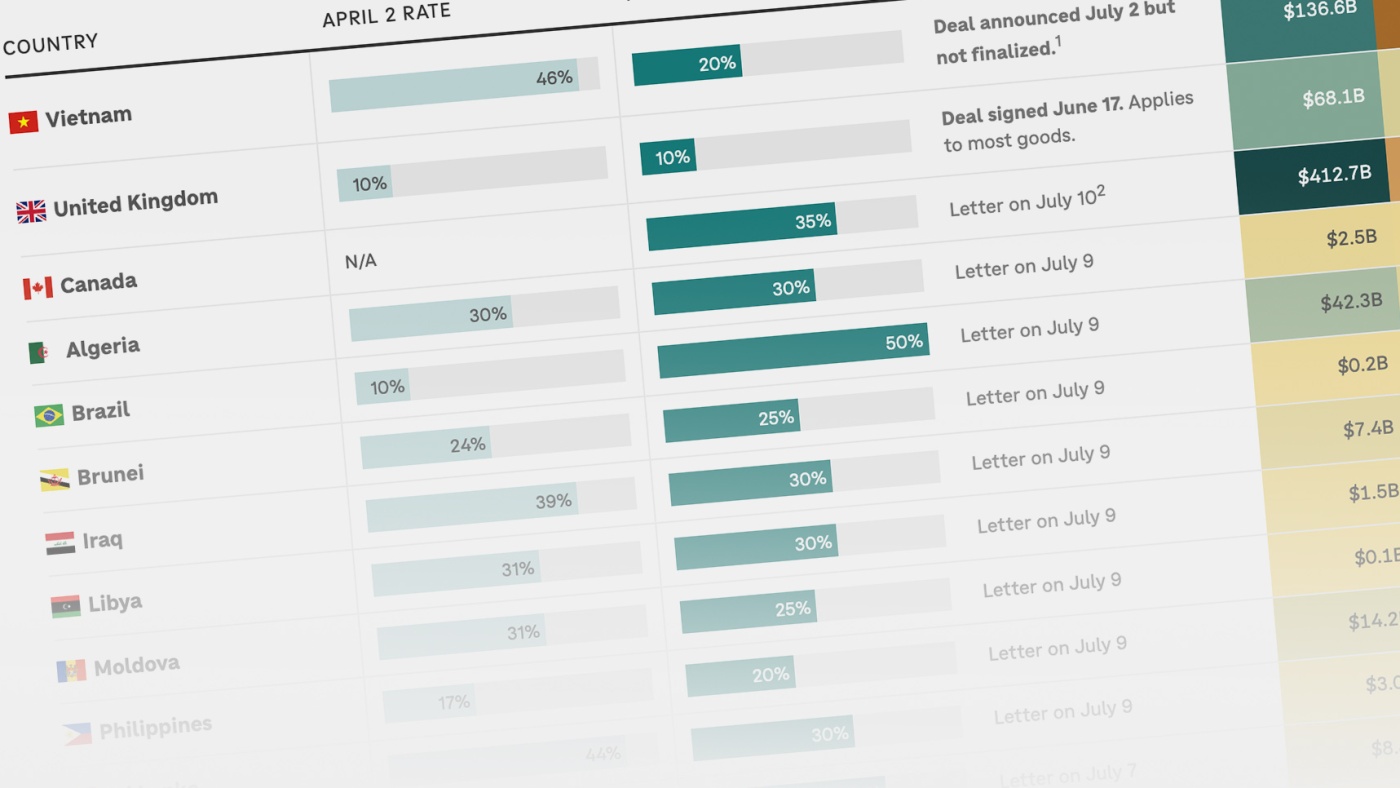
President Trump’s trade strategy continues to surprise, with his latest move involving personal letters to foreign leaders about impending tariff hikes. Set to be implemented on August 1, these tariffs demonstrate a bold shift in trade policy tactics.
This method marks a departure from conventional trade policy, as President Trump outlines considerable tariff increases on numerous countries. However, the approach lacks stability, with Trump stating that the August 1 implementation date is “not 100% firm,” before reversing this statement shortly afterward. The letters also open the door for diplomatic discussions, proposing that tariff rates could decrease if trade barriers are removed by the respective countries. For more details on this unprecedented strategy, click here. For a broader analysis of Trump’s tariff policies, click here.

The letters are a continuation of Trump’s global tariff initiative that started on April 2, where tariffs ranged between 10% and 50%. Following market disturbances, Trump adjusted these tariffs to a uniform 10%, calling it a 90-day “pause” to negotiate tariff agreements with various countries.
Once the pause concluded on July 9, tariffs were set to revert to their initial levels for countries without new agreements. To date, Trump has secured one formal deal with the U.K. and has announced a deal with Vietnam, though specifics remain undisclosed.
Below is a summary of the announced tariffs from Trump’s letters, along with details of the deal with the U.K. and the proposed agreement with Vietnam. It includes the value of imports the U.S. purchased from these nations last year, alongside the U.S. trade deficit or surplus with each. A trade deficit occurs when the U.S. imports more from a country than it exports to it, while a surplus is the opposite.