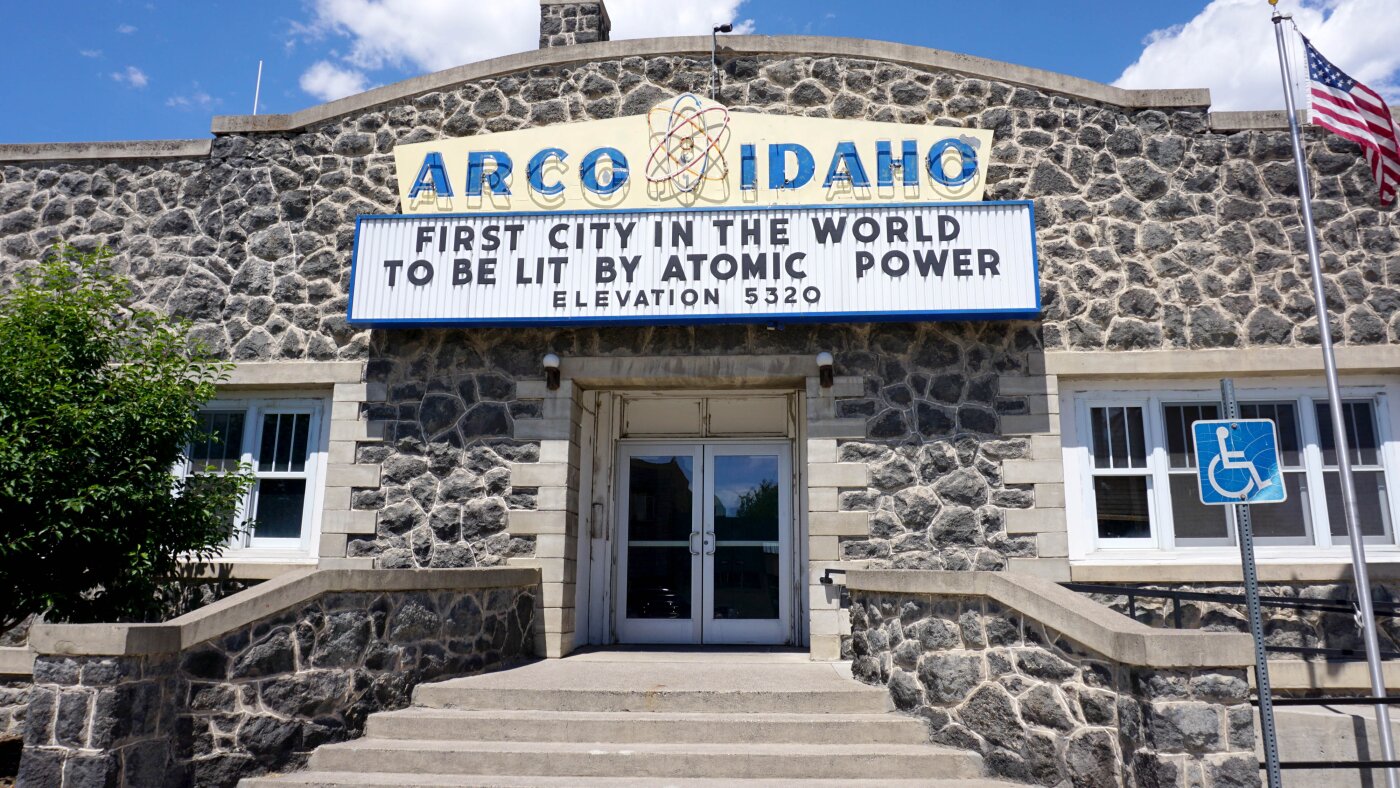

Arco, Idaho is among the small towns near Idaho National Laboratory with a decades-long nuclear energy legacy.
Hanna Merzbach
Hanna Merzbach
In Atomic City, Idaho, with a population of just 52, the local bar stands as a testament to the town’s unique character. Here, smoking indoors is still the norm, and the walls are covered with dollar bills and a “Don’t Tread On Me” flag.
Bar owner Vickie O’Haro greets her regulars with familiarity, knowing their favorite orders by heart—either cold beers or shots aptly named “atomic bombs.” Many of her patrons are employed at the nearby Idaho National Laboratory (INL), a pivotal site for nuclear energy research since 1949.
A recent Gallup poll indicates that while most Americans are against having a nuclear plant in their vicinity, the sentiment differs in this part of Idaho.
“I live 10 miles away, and I’m fine,” O’Haro mentioned. “I’m not glowing in the dark, you know? There’s nothing to be scared of.”

Vickie O’Haro stands behind the bar at Atomic City Bar & Store, which she owns, along with Atomic Motor Raceway, on June 8, 2026. The businesses are located near Idaho National Laboratory.
In recent times, nuclear power is experiencing a resurgence. Under President Donald Trump’s administration, new nuclear projects have been accelerated, paving the way for a new wave of smaller nuclear reactors set to become operational soon.

Recently, three enterprises at INL, along with another in central Utah, initiated their innovative reactors this summer.
“I think it’s actually pretty cool to be happening in my backyard,” commented O’Haro.
Stretching over 900 square miles, Idaho National Laboratory is a vast expanse of sagebrush-covered desert, nearly matching the size of Rhode Island. Within its boundaries, one startup, Deployable Energy, has taken a significant leap forward by achieving a critical state with its test reactor, signifying a successful, sustained chain reaction. This milestone suggests the reactor could eventually produce electricity.
Electricity demand is skyrocketing
Lance Maul, the Chief Operating Officer of Deployable Energy, described this achievement as a “real moment in history for the nation.”
“This could be a real turning point for the energy future,” Maul said, emphasizing the potential of these new reactors.
Unlike the massive nuclear plants of the past, the focus is now on micro reactors. These smaller reactors are designed to power thousands of homes rather than millions. “It’s something deployable,” Maul explained. “It’s something that you can put on the back of a truck. It is a fundamentally different proposition.”

Enthusiasts like Maul envision a future where these reactors, produced en masse, could power secluded communities, military installations, and AI data centers. They see them as a viable option to satisfy America’s increasing energy needs while reducing carbon emissions.
President Trump has been a proponent of this shift. Under his leadership, the Department of Energy expedited the reactor permitting process, which involved streamlining numerous regulations without public disclosure, according to NPR reporting.
Looser federal regulations
Edwin Lyman, Nuclear Power Safety Director at the Union of Concerned Scientists, expressed skepticism, stating, “I have no confidence in the Department of Energy and its oversight of this at all.” He raised concerns about reduced standards regarding radiation, security, and environmental contamination.
Adding to these concerns, ProPublica reporting revealed that the federal commission overseeing commercial nuclear development has experienced significant staff reductions, particularly among safety experts, due to cuts and resignations under the Trump administration. Companies testing their reactors are expected to seek approval from this commission.
“I don’t think cutting corners when you’re talking about nuclear safety is a good idea,” Lyman added. He emphasized his concern about the potential impact on communities surrounding INL.

White House staff secretary Will Scharf hands President Donald Trump an executive order to sign regarding nuclear energy in the Oval Office of the White House, Friday, May 23, 2025, in Washington.
Evan Vucci/AP/AP
Evan Vucci/AP/AP
Meanwhile, back at the Atomic City bar, workers from the lab gather to unwind. O’Haro remains confident in the safety of the operations, saying, “If we weren’t safe, my guys would tell me that we weren’t safe,” before turning up the country music that fills the air.
While the majority of Americans might oppose new nuclear plants nearby, polls also reveal a growing inclination to emphasize nuclear power across the nation.
This article was originally written by www.npr.org